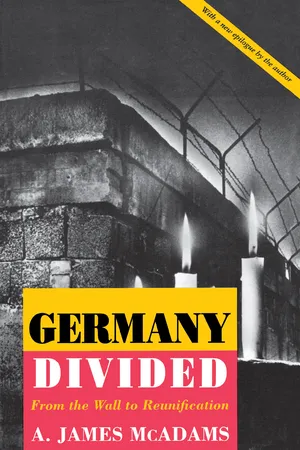
Germany Divided remains one of the most thought-provoking and comprehensive interpretations of the forty-year relationship between East and West Germany and of the problems of contemporary German unity. In this politically controversial and analytically sophisticated account, A. James McAdams dissects the complex process by which East and West German leaders moved over the years from first pursuing the ideal of German unity, to accepting what they believed to be the inescapable reality of division, and then, finally, to meeting the challenges of an unanticipated reunification. This new edition contains an epilogue in which McAdams considers some of the political and economic problems faced by eastern and western Germans as they entered their fourth year of living together.
- English
- ePUB (mobile friendly)
- Available on iOS & Android
eBook - ePub
About this book
Information
Publisher
Princeton University PressYear
2020Print ISBN
9780691001081
9780691078922
eBook ISBN
9780691221977
V
Accepting a Divided Germany
All fruitless discussion about how open the
German question is should be ended. It doesn’t
bring us anything. As the Basic Treaty spécifies,
we should cultivate as good relations as we can
with the GDR, a state that is very much different
from our own, but which is just as sovereign and
independent as any other state in the Warsaw
Pact. We should look for commonalities in spite
of and within the division.
(Willy Brandt, in Reden über das eigene Land, 1984)
Both German states have a vital, common
interest in preserving peace. . . . Now that
“reunification” has proven to be a big illusion,
their differences over the German question have
the drama of a dream, which occasionally recurs,
but is gone once one wakes up.
(Erich Honecker, November 22, 1984)
NO ONE in the 1970s could have imagined a proliferation of contacts taking place between East and West Germany in the 1980s. Yet, this was exactly what happened. During the decade, city partnerships suddenly sprang up everywhere, major economic deals were struck, the GDR-FRG border became more permeable, and most prominently, millions of Germans were temporarily reunited with relatives and friends with whom they had had little or no contact for decades. If only because the two German governments had been so far apart just a few years earlier, these developments were both striking and, simultaneously, perplexing. East Berlin and Bonn may have had reason to cooperate on the technical matters to which their ties had descended in the late 1970s, but there was nothing to account for the two states’ newly acquired enthusiasm for the relationship. Moreover, everything about the timing of this explosion in contacts was wrong, as a triple set of international crises—the conflict over NATO’S December 1979 decision to deploy a new generation of intermediate-range missiles (INF) in Western Europe, the Soviet invasion of Afghanistan, and the outbreak in the summer of 1980 of worker unrest in the Polish Baltic shipyards—threatened to set the German governments permanently against each other.
Was it simply that the Germanys’ leaders finally came to recognize, as almost all studies of the period have emphasized, how much they stood to lose from a dramatic deterioration in relations and, therefore, sought to do what they could to preserve a semblance of inter-German stability? The point is true enough, but it begs the question of what exactly transpired to make a better relationship suddenly compatible with both states’ seemingly divergent interests. The shift seems to have begun with a sequence of events that precipitated the first inter-German summit between Erich Honecker and Helmut Schmidt.
A Threat from the West
By itself, it was surprising that the leaders of the GDR and the FRG should have been able to come together at all as the 1970s ended. The idea of a summit meeting between Honecker and Schmidt was not entirely new, since East Berlin had occasionally broached the possibility of bringing the two figures together during the decade, although there is every reason to suppose the SED regime doubted its counterparts would go along with the proposal. It was clear all along why Honecker would have looked hopefully to the symbolic gains that might be made from such an encounter. He had nothing to risk by meeting with Schmidt and, in view of the GDR’S continual search for external sources of legitimation, could only gain from a situation that put Bonn’s chief representative in the position of having to demonstrate his respect for and recognition of East German sovereignty. The more difficult question, therefore, given the pressures that impinged on the West German government, was why Schmidt should have suddenly concluded that such a meeting was in his own political interest.
The answer, not unexpected in view of the record of GDR-FRG ties which we have already examined, is that the chancellor’s readiness to talk with Honecker was only very indirectly related to developments in the inter-German relationship itself. In October 1977 Schmidt had given a much-publicized lecture at the International Institute for Strategic Studies in London in which he called upon his NATO allies to redress a growing disparity in tactical nuclear and conventional forces in the East-West balance that had emerged from the Strategic Arms Limitation Talks (SALT) between the superpowers. At the time, the West German leader was vague about the specific response that he had in mind, since he was determined only to convince the United States to counter ongoing Soviet deployments of intermediate-range SS-20 missiles in the European USSR. There can, however, be no question that his initiative played a key role in the INF decision of December 1979. It prodded U.S. President Jimmy Carter’s administration into taking seriously the theme of the Eurostrategic balance and, just as significantly, also set the stage for NATO’s “two-track” response to the Soviet buildup. According to this approach, the stationing of Pershing II and cruise missiles in Western Europe was not to begin until the fall of 1983, and only then if the West were unable to persuade the Soviet Union to reduce its nuclear forces on the continent.1
Schmidt himself seems to have been convinced that if he could make the USSR’s leaders believe that the West was prepared to go ahead with the modernization of its nuclear forces, Moscow would have no choice but to foresake its military advantage. In May 1978 he thought that he received Leonid Brezhnev’s assurances to curtail the SS-20 buildup on the occasion of the General Secretary’s long-awaited visit to Bonn. Yet, even when this assumption proved to be wrong—Schmidt rationalized that infighting in the Soviet politburo had somehow limited Brezhnev’s ability to fulfill his promise—the chancellor could still tell his party that the Soviet leader appreciated the gravity of the problem and was prepared to discuss it with the West.2 Less clear, however, is why Schmidt should also have wanted to speak with Erich Honecker. After all the years of basically snubbing his counterpart, there was nothing to suggest that, at least at this early date, he regarded contacts with the East German general secretary as a serious means of influencing Moscow.
A greater clue to Schmidt’s behavior may lie in the fact that by 1979 he was by no means in firm control of his own party. To be sure, his continuing high opinion ratings with the West German public assured that the SPD could be counted on to retain him as its chancellor, particularly after the CDU/CSU announced Franz Josef Strauß as its candidate in the upcoming fall 1980 national elections. Nevertheless, it was also true that after a decade in power, there were unmistakable signs of internal dissension within the Social Democratic Party. A growing Left-wing contingent within the SPD, revolving around the Young Socialists (JUSOS), was becoming more and more vocal in its criticisms of Schmidt’s mainstream social and environmental policies, and especially his support for nuclear energy. Misgivings had also arisen in the party, even among the chancellor’s closest supporters, about Schmidt’s emphasis on relations with the United States, thanks to the Carter administration’s maladroit handling of such issues as human-rights policy in Eastern Europe, the neutron bomb, and American fiscal and monetary affairs.
But INF proved to be a catalyst to an explosive debate within the party. Although the nuclear-force modernization decision itself was still far from the intense public controversy that it would become in only a year’s time, a number of former Brandt associates, including Wehner, Bahr, and Horst Ehmke, and parliamentarians such as the SPD spokesman for security questions, Alfons Pawelczyk, were already evincing mixed feelings about the implications of a Western military buildup in response to the SS-20s. Wehner in particular called attention to the need for more pacific solutions, such as new forms of cooperation with the East—he especially favored the term “security partnership”—to overcome the psychological impediments to arms control talks between the blocs. Urging his government to move beyond its obsession with the primacy of national reunification, he singled out the GDR in his list of worthwhile discussion partners.3
In light of these circumstances, one can more easily understand why, when Schmidt met with his party’s assembled delegates at the SPD’S Berlin Congress on December 3–7, just days before the INF decision was to be formalized, he took the occasion to announce his plans to meet with Honecker in the GDR in early 1980 to discuss ways of improving the inter-German relationship. Very little may have changed between the Germanys themselves, but so long as Schmidt had to sell the party on his determination to keep negotiations between the blocs on a par with the necessity of restoring the military balance with the Soviet Union, the possibility of even a limited dialogue with East Berlin represented one way of proving his commitment to the cause of détente. Even for a chancellor who was not particularly interested in the GDR, it was, as a former member of the Bonn government has put it, “a theme to rebind the party.”4
Nonetheless, the invasion of Afghanistan by the Soviet Union on December 27, 1979, put the West Germans, arguably more than any other state involved in the Western response to the Soviet action, into the uncomfortable position of having to choose between two desiderata. On the one hand, there was their fidelity to the Atlantic alliance, and particularly the demands of the American superpower, and on the other, their countervailing desire to carry on business more or less as usual with the East. In the first months after the conflict erupted, Schmidt and his foreign minister, Hans-Dietrich Genscher, went out of their way to show that their priorities -still lay with the alliance, a point the West German leader reluctantly confirmed by agreeing to go along with a U.S. boycott of the Moscow Olympics. At the same time, nevertheless, Schmidt also insisted on practicing what he called “quiet crisis m...
Table of contents
- Cover
- Title Page
- Copyright Page
- Dedication Page
- Preface
- Acknowledgments
- Abbreviations
- I. A Wall between the Germanys
- II. One Germany, Two Alliances
- III. Two Germanys: Confrontation or Accommodation?
- IV. Two German States: New Relations, Bad Relations
- V. Accepting a Divided Germany
- VI. The Fall of East Germany
- VII. Germany without a Wall
- Epilogue, 1994
- Appendixes
- Select Bibliography
- Index
Trusted by 375,005 students
Access to over 1.5 million titles for a fair monthly price.
Study more efficiently using our study tools.
Frequently asked questions
Yes, you can cancel anytime from the Subscription tab in your account settings on the Perlego website. Your subscription will stay active until the end of your current billing period. Learn how to cancel your subscription
No, books cannot be downloaded as external files, such as PDFs, for use outside of Perlego. However, you can download books within the Perlego app for offline reading on mobile or tablet. Learn how to download books offline
We are an online textbook subscription service, where you can get access to an entire online library for less than the price of a single book per month. With over 1.5 million books across 990+ topics, we’ve got you covered! Learn about our mission
Look out for the read-aloud symbol on your next book to see if you can listen to it. The read-aloud tool reads text aloud for you, highlighting the text as it is being read. You can pause it, speed it up and slow it down. Learn more about Read Aloud
Yes! You can use the Perlego app on both iOS and Android devices to read anytime, anywhere — even offline. Perfect for commutes or when you’re on the go.
Please note we cannot support devices running on iOS 13 and Android 7 or earlier. Learn more about using the app
Please note we cannot support devices running on iOS 13 and Android 7 or earlier. Learn more about using the app
Yes, you can access Germany Divided by A. James McAdams in PDF and/or ePUB format, as well as other popular books in History & German History. We have over 1.5 million books available in our catalogue for you to explore.