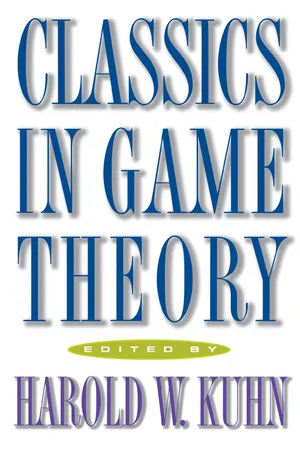
Classics in Game Theory assembles in one sourcebook the basic contributions to the field that followed on the publication of Theory of Games and Economic Behavior by John von Neumann and Oskar Morgenstern (Princeton, 1944). The theory of games, first given a rigorous formulation by von Neumann in a in 1928, is a subfield of mathematics and economics that models situations in which individuals compete and cooperate with each other. In the "heroic era" of research that began in the late 1940s, the foundations of the current theory were laid; it is these fundamental contributions that are collected in this volume. In the last fifteen years, game theory has become the dominant model in economic theory and has made significant contributions to political science, biology, and international security studies. The central role of game theory in economic theory was recognized by the award of the Nobel Memorial Prize in Economic Science in 1994 to the pioneering game theorists John C. Harsanyi, John Nash, and Reinhard Selten. The fundamental works for which they were honored are all included in this volume.
Harold Kuhn, himself a major contributor to game theory for his reformulation of extensive games, has chosen eighteen essays that constitute the core of game theory as it exists today. Drawn from a variety of sources, they will be an invaluable tool for researchers in game theory and for a broad group of students of economics, political science, and biology.
eBook - PDF
Classics in Game Theory
- 382 pages
- English
- PDF
- Available on iOS & Android
eBook - PDF
Classics in Game Theory
About this book
Information
Publisher
Princeton University PressYear
2020Print ISBN
9780691011929
9780691011936
eBook ISBN
9781400829156
Table of contents
- Cover Page
- Half-title Page
- Title Page
- Copyright Page
- Contents
- Permissions
- Foreword
- An Appreciation
- 1. Equilibrium Points in n-Person Games
- 2. The Bargaining Problem
- 3. Non-Cooperative Games
- 4. An Iterative Method of Solving a Game
- 5. Equivalence of Games in Extensive Form
- 6. Extensive Games and the Problem of Information
- 7. A Value for n-Person Games
- 8. Stochastic Games
- 9. Recursive Games
- 10. Von Neumann-Morgenstern Solutions to Cooperative Games without Side Payments
- 11. A Limit Theorem on the Core of an Economy
- 12. The Bargaining Set for Cooperative Games
- 13. Existence of Competitive Equilibria in Markets with a Continuum of Traders
- 14. The Core of an n-Person Game
- 15. Games with Incomplete Information Played by "Bayesian" Players
- 16. The Big Match
- 17. On Market Games
- 18. Reexamination of the Perfectness Concept for Equilibrium Points in Extensive Games
- List of Contributors
- Index
Trusted by 375,005 students
Access to over 1.5 million titles for a fair monthly price.
Study more efficiently using our study tools.
Frequently asked questions
Yes, you can cancel anytime from the Subscription tab in your account settings on the Perlego website. Your subscription will stay active until the end of your current billing period. Learn how to cancel your subscription
No, books cannot be downloaded as external files, such as PDFs, for use outside of Perlego. However, you can download books within the Perlego app for offline reading on mobile or tablet. Learn how to download books offline
Perlego offers two plans: Essential and Complete
- Essential is ideal for learners and professionals who enjoy exploring a wide range of subjects. Access the Essential Library with 800,000+ trusted titles and best-sellers across business, personal growth, and the humanities. Includes unlimited reading time and Standard Read Aloud voice.
- Complete: Perfect for advanced learners and researchers needing full, unrestricted access. Unlock 1.5M+ books across hundreds of subjects, including academic and specialized titles. The Complete Plan also includes advanced features like Premium Read Aloud and Research Assistant.
We are an online textbook subscription service, where you can get access to an entire online library for less than the price of a single book per month. With over 1.5 million books across 990+ topics, we’ve got you covered! Learn about our mission
Look out for the read-aloud symbol on your next book to see if you can listen to it. The read-aloud tool reads text aloud for you, highlighting the text as it is being read. You can pause it, speed it up and slow it down. Learn more about Read Aloud
Yes! You can use the Perlego app on both iOS and Android devices to read anytime, anywhere — even offline. Perfect for commutes or when you’re on the go.
Please note we cannot support devices running on iOS 13 and Android 7 or earlier. Learn more about using the app
Please note we cannot support devices running on iOS 13 and Android 7 or earlier. Learn more about using the app
Yes, you can access Classics in Game Theory by Harold W. Kuhn, Harold W. Kuhn,Harold William Kuhn, Harold William Kuhn in PDF and/or ePUB format, as well as other popular books in Economics & Econometrics. We have over 1.5 million books available in our catalogue for you to explore.