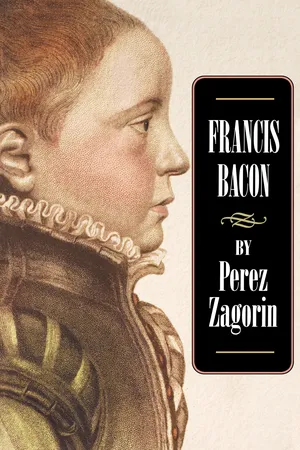
Francis Bacon (1561-1626), commonly regarded as one of the founders of the Scientific Revolution, exerted a powerful influence on the intellectual development of the modern world. He also led a remarkably varied and dramatic life as a philosopher, writer, lawyer, courtier, and statesman. Although there has been much recent scholarship on individual aspects of Bacon's career, Perez Zagorin's is the first work in many years to present a comprehensive account of the entire sweep of his thought and its enduring influence. Combining keen scholarly and psychological insights, Zagorin reveals Bacon as a man of genius, deep paradoxes, and pronounced flaws.
The book begins by sketching Bacon's complex personality and troubled public career. Zagorin shows that, despite his idealistic philosophy and rare intellectual gifts, Bacon's political life was marked by continual careerism in his efforts to achieve advancement. He follows Bacon's rise at court and describes his removal from his office as England's highest judge for taking bribes. Zagorin then examines Bacon's philosophy and theory of science in connection with his project for the promotion of scientific progress, which he called "The Great Instauration." He shows how Bacon's critical empiricism and attempt to develop a new method of discovery made a seminal contribution to the growth of science. He demonstrates Bacon's historic importance as a prophetic thinker, who, at the edge of the modern era, predicted that science would be used to prolong life, cure diseases, invent new materials, and create new weapons of destruction. Finally, the book examines Bacon's writings on such subjects as morals, politics, language, rhetoric, law, and history. Zagorin shows that Bacon was one of the great legal theorists of his day, an influential philosopher of language, and a penetrating historian.
Clearly and beautifully written, the book brings out the richness, scope, and greatness of Bacon's work and draws together the many, colorful threads of an extraordinarily brilliant and many-sided mind.
eBook - ePub
Francis Bacon
About this book
Information
Publisher
Princeton University PressYear
2020Print ISBN
9780691009667
9780691059280
eBook ISBN
9780691221625
1
Introduction: Bacon’s Two Lives

FRANCIS BACON lived two separate but interconnected lives. One was the meditative, reserved life of a philosopher, scientific inquirer, and writer of genius, a thinker of soaring ambition and vast range whose project for the reconstruction of philosophy contained a new vision of science and its place in society. The other was the troubled, insecure life of a courtier, professional lawyer, politician, royal servant, adviser, and minister to two sovereigns, Elizabeth I and James I, who from early youth to old age never ceased his quest for high position and the favor of the great. It was the first of his two lives that brought Bacon the lasting fame for which he strove, and established his claim to the permanent interest of posterity. The second, however, absorbed a large part of his time and energy, pitting him against rivals in a continual competition for office and power, diverting him from pursuing some of his most cherished intellectual goals, and forcing him to leave his main philosophical enterprise fragmentary and unfinished. Moreover, although he was in many ways the most intelligent English statesman of his generation, better equipped than any other to advise a ruler, his political life was a failure. Despite all his efforts, he never attained the kind of influence in government he needed in order to give effect to his ideas and was always obliged to submit to the direction of lesser minds.
Bacon was very conscious of the split between his two lives and the disharmony they imposed on his existence. He sometimes applied to himself the sorrowful words of Psalm 19 in the Vulgate version, “Multum incola fuit anima mea” (“My soul was a stranger”); and in a prayer he composed in 1621 after his condemnation for corruption in his office as lord chancellor, he confessed that he had made poor use of the gifts God had granted him, misspending his talents “in things for which I was least fit, so as I may truly say, my soul hath been a stranger in the course of my pilgrimage.”1
Despite such expressions of regret, Bacon was irresistibly attracted to politics and would never willingly retire into a private existence. The contrast between his two lives as philosopher and politician, and certain of his traits and actions as a public man, have made his complex personality an enigma to many. Noting the curious mixture of elements in his mental composition, Lytton Strachey felt compelled to put the question, “Who has ever explained Francis Bacon?”2 Another scholar has commented that “even to the keenest minds Bacon is ultimately an impenetrable mystery.”3 Even Lord Macaulay, who with his customary self-confidence presumed in a famous essay on Bacon that he understood him thoroughly, was perplexed by the contradictions he perceived between Bacon’s greatness as a thinker and his baseness as a man.4 Because politics was so important to Bacon, no account of his philosophy can be adequate that fails to consider certain aspects of his personal history and political career and the character they reveal. This is essential not only for the insight it provides into the human being and his experiences that are present in his writings, but no less for its relevance in helping us to understand some of his ideas. What follows is accordingly a brief and selective biographical sketch discussing chiefly those features of his life that may shed light on his thought.5
Bacon came by his aspiration to acquire power in the royal service as a natural inheritance from his father, Sir Nicholas Bacon, a lawyer, statesman, privy councillor, and for over twenty years until his death England’s highest judge as Queen Elizabeth’s lord keeper of the great seal. Born on 22 January 1561, Francis was Sir Nicholas Bacon’s younger son by his second wife, Ann Cooke. Besides his brother Anthony, three years his senior, Francis had a number of siblings stemming from his father’s first marriage. He was also related to the Cecil family, whose head, Sir William Cecil, Lord Burghley, the queen’s principal minister, was his uncle by marriage. Royal officials of exceptional ability, the two brothers-in-law Nicholas Bacon and William Cecil were recently arrived members of the English governing class. They were part of an administrative elite and new service aristocracy that had taken shape under the Tudor monarchy, particularly since the later period of Henry VIII’s reign following England’s break with the Catholic Church. Possessing long experience in government, they had risen to the highest positions under Queen Elizabeth and also founded landed families. With influential connections like these, Bacon might reasonably have looked forward to a successful career of his own in the crown’s service.6
Bacon manifested his extraordinary intellectual powers very early in life. In his boyhood, the queen was impressed by his precocity and wit and called him the young lord keeper. At the age of twelve he was sent to Cambridge University where he stayed for about two and a half years. In 1576 he was admitted to Gray’s Inn, of which his father was an eminent member, destined for the study of law. In the same year, in order to broaden his education and fit him for state affairs, his father arranged for him to be part of Sir Amias Paulet’s embassy to France. He remained abroad for nearly three years and was in Paris when the news of his father’s death in February 1579 obliged him to return home. The loss of his father significantly affected his future prospects. Sir Nicholas, owing apparently to inadvertence and delay, had neglected to make any provision for him in his will. Bacon was thus left without independent means and forced to earn his living. Law was his chosen profession; but as his chaplain, secretary, and earliest biographer, Willam Rawley, wrote, “His heart was more carried after the affairs and places” of state.7 Lacking any considerable income following his father’s death, he continued his legal studies at Gray’s Inn. In 1582 he was admitted as an utter barrister and four years later became a bencher and thus eligible to plead in the courts at Westminster. During this time and subsequently, however, his chief aim was to obtain a position in the crown’s service. As early as the fall of 1580, therefore, he sought to enlist the patronage of his uncle Lord Burghley on his behalf in a suit of some kind to the queen.8 Although nothing came of this suit, his main objective thenceforth was to gain office and rise at court.
In 1581, at the age of twenty, he was elected for the first time to the House of Commons for the Cornish borough of Bosinney.9 This event marked the commencement of his public career. He was a member thereafter of all the successive parliaments of Queen Elizabeth’s reign, the last in 1601, as well as of all but one of the parliaments of James I, taking an increasingly active part in business and acquiring a growing reputation for his knowledge and his ability as a speaker.10 Meanwhile, he pursued his quest for advancement, but without any tangible result.11 Probably with the aim of bringing his opinions before the queen and her council, he wrote two papers on public affairs at this period, both circulated only in manuscript during his lifetime. The first in 1584 was a letter of advice to Queen Elizabeth concerning her foreign and domestic enemies. In essence it was an acute, well-informed political analysis covering various features of England’s international and internal situation. Regarding religious dissidence at home, where the government was faced with the joint problems of Catholic disaffection and Puritan agitation against the established church, Bacon cautioned against the undue persecution of Puritan ministers, pointing out how useful they were as preachers in the battle against popery. He likewise counseled against the too severe treatment of Catholics, recommending that they be discouraged but not driven to desperation. In considering these matters, he used the phrase “reason of state” to indicate his standpoint.12 The second paper, composed around 1589, dealt with the controversies in the English church between the Puritan Nonconformists and the ecclesiastical authorities. Bacon’s approach to this subject was moderate and evenhanded. While expressing his reverence for the bishops’ calling, he rebuked them for various faults, including their refusal of needed reforms and their harsh and unjust treatment of Nonconformity. On the other side, he was also critical of the Puritans for some of their opinions and practices, and called their demand for “parity and equality of ministers . . . a thing of wonderful great confusion.” In the course of his discussion he referred to Machiavelli without naming him, quoting a passage from the Italian author’s Discourses on the First Ten Books of Livy.13 Both of these papers were unusual productions, especially for a man still in his twenties and without an official position. Penetrating and thoroughly objective, they looked at the issues involved in a wholly political light.
In 1589 Bacon was granted the reversion to the clerkship of the Council in the Star Chamber, a position yielding sixteen hundred pounds yearly. Procured for him by Burghley, it was the sole office he was destined to obtain under Queen Elizabeth. As it was given him only in reversion, however, it could not become his until its present occupant vacated it, an event for which he was obliged to wait nearly twenty years, while in the meantime it brought him nothing.14 Conscious of his great powers and eager to play a role in affairs, he saw himself still without advancement as he entered his thirties. Despite his interest in the theoretical problems of the law, which is reflected in some of his early writings,15 he did not want to practice law; hence in 1592 he appealed anew to Burghley to help him gain some official position, citing his poor estate and increasing age. With this plea he coupled a statement (to which I shall return in the following chapter) of his “vast contemplative ends” contrasted with his “moderate civil ends,” famously adding that “I have taken all knowledge to be my province.” If Burghley did not assist him, he said, he would renounce his worldly aims and dedicate himself entirely to an intellectual occupation.16 His uncle was indisposed, though, to do much for him. His heart was set on promoting the career of his younger son, Robert Cecil, who was rising rapidly in the queen’s government, and he regarded Bacon as a possible rival to him.
Bacon had no intention, however, of laying aside his political aspirations. From an early time, moreover, the latter were linked with his philosophical ambitions; for as he wrote a few years later in an unpublished autobiographical fragment, if he gained a high position in the state, he would have the power to command the ability of others to aid him in his intellectual work.17 Around 1590 or 1591 he became acquainted with the earl of Essex, Queen Elizabeth’s new favorite, with whom he soon formed a close relationship. A warrior and a courtier, intelligent, handsome, high-spirited, and generous, the youthful Essex attracted many men to him and gained a strong hold on the queen’s affection. Unfortunately, his virtues were accompanied by some serious faults. Essex was impulsive, headstrong, and sometimes petulant, lacking in sound judgment of situations, quick to take offense, and eager to triumph over his rivals at court. The aging queen humored these traits at the same time that she tried to discipline his temper; but his willfulness and demands for military commands, offices, and favors to raise his political status at court led to frequent strains and quarrels with her, which were made up only to recur. As the 1590s went on, a factional conflict for power developed between Essex, and his partisans, and the Cecils, Lord Burghley and Sir Robert Cecil and their followers, which affected the court and government.18 It was with this nobleman, five years younger than himself, that Bacon joined forces, doing various things for him, acting more and more in the capacity of an adviser, and tying his own long-deferred hopes of political advancement to the earl’s fortunes. As he wrote in his essay “Of Faction,” “mean men in their rising must adhere,” an observation that certainly reflected his own situation.19 Although he maintained his relationship with the Cecils, it naturally tended to cool on account of his attachment to Essex. His brother Anthony, with whom he was on very close terms, likewise allied himself with Essex. Anthony Bacon had lived abroad for almost thirteen years, mainly in France, as an extremely knowledgeable agent engaged in collecting political intelligence for the English government through his many foreign connections. Back in England, he entered Essex’s service in 1593 in the role of a foreign secretary, using his intelligence sources to provide the earl with the best foreign information to enhance his influence in the government.
In the parliament of 1593, Bacon made the serious mistake of provoking the queen’s displeasure by obstructing a bill to provide new taxes. The government, financially very hard-pressed by the costs of England’s war with Spain, was asking Parliament for an exceptional money grant of three subsidies payable in only three years. While Bacon did not oppose this amount, he argued in the House of Commons for spreading its payment over six years lest the tax set a dangerous precedent, breed popular discontent, and lay too heavy a burden on the country. When he learned of Elizabeth’s anger at his conduct, he wrote explaining himself to Burghley, whom he told that he spoke his conscience, and asked to intercede to restore him to the queen’s favor.20 As Bacon’s tactics in the political arena were usually carefully calculated with a view to his own fortunes, his statement that he spoke his conscience was doubtless sincere. This was the last time, though, that he ever took an ind...
Table of contents
- Cover
- Title Page
- Copyright Page
- Dedication
- Preface
- References and Abbreviations
- Chapter 1: Introduction: Bacon’s Two Lives
- Chapter 2: Philosophy and the Reconstruction of Knowledge: The Genesis of Bacon’s Project
- Chapter 3: The Great Instauration
- Chapter 4: Human Philosophy: Morals and Politics
- Chapter 5: Language, Law, and History
- Chapter 6: Conclusion
- Notes
- Index
Trusted by 375,005 students
Access to over 1.5 million titles for a fair monthly price.
Study more efficiently using our study tools.
Frequently asked questions
Yes, you can cancel anytime from the Subscription tab in your account settings on the Perlego website. Your subscription will stay active until the end of your current billing period. Learn how to cancel your subscription
No, books cannot be downloaded as external files, such as PDFs, for use outside of Perlego. However, you can download books within the Perlego app for offline reading on mobile or tablet. Learn how to download books offline
Perlego offers two plans: Essential and Complete
- Essential is ideal for learners and professionals who enjoy exploring a wide range of subjects. Access the Essential Library with 800,000+ trusted titles and best-sellers across business, personal growth, and the humanities. Includes unlimited reading time and Standard Read Aloud voice.
- Complete: Perfect for advanced learners and researchers needing full, unrestricted access. Unlock 1.5M+ books across hundreds of subjects, including academic and specialized titles. The Complete Plan also includes advanced features like Premium Read Aloud and Research Assistant.
We are an online textbook subscription service, where you can get access to an entire online library for less than the price of a single book per month. With over 1.5 million books across 990+ topics, we’ve got you covered! Learn about our mission
Look out for the read-aloud symbol on your next book to see if you can listen to it. The read-aloud tool reads text aloud for you, highlighting the text as it is being read. You can pause it, speed it up and slow it down. Learn more about Read Aloud
Yes! You can use the Perlego app on both iOS and Android devices to read anytime, anywhere — even offline. Perfect for commutes or when you’re on the go.
Please note we cannot support devices running on iOS 13 and Android 7 or earlier. Learn more about using the app
Please note we cannot support devices running on iOS 13 and Android 7 or earlier. Learn more about using the app
Yes, you can access Francis Bacon by Perez Zagorin in PDF and/or ePUB format, as well as other popular books in Technology & Engineering & Science & Technology Biographies. We have over 1.5 million books available in our catalogue for you to explore.