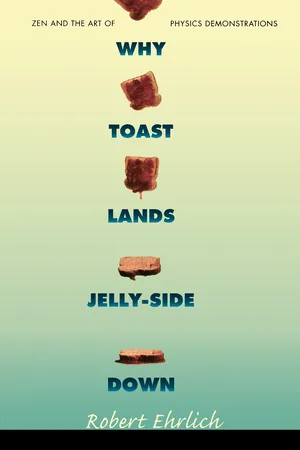
Physics has the reputation of being difficult to understand and remote from everyday life. Robert Ehrlich, however, has spent much of his career disproving these stereotypes. In the long-awaited sequel to Turning the World Inside Out and 175 Other Simple Physics Demonstrations, he provides a new collection of physics demonstrations and experiments that prove that physics can, in fact, be "made simple." Intentionally using "low tech" and inexpensive materials from everyday life, Why Toast Lands Jelly-Side Down makes key principles of physics surprisingly easy to understand.
After laying out the basic principles of what constitutes a successful demonstration, Ehrlich provides more than 100 examples. Some of the more intriguing include: Terminal Velocity of Falling Coffee Filters; Spinning a Penny; Dropping Two Rolls of Toilet Paper; Avalanches in a Sand Pile; When to Add the Cream to Your Coffee; Deep Knee Bends on a Bathroom Scale; Recoil Force on a Bent Straw; Swinging Your Arms While Walking; Estimating the Net Force on a Moving Book; and, of course, Why Toast Lands Jelly-Side Down.
The book begins with a practical introduction on how to design physics demonstrations. The benefits of designing one's own "demos" are numerous, but primary among them is an increased understanding of basic physics. For many people who teach the principles of physics, demonstrations seem dauntingly complex, filled with hard-to-find equipment and too many possibilities for failure. The demonstrations described in this book are exactly the opposite. Ehrlich describes them with characteristic candor: "You can fit many of them in your pocket, bring them to your class without any set-up required, and best of all, you need not fear that your demo will more likely illustrate Murphy's laws rather than Newton's."
For anyone with even the slightest interest in physics, Why Toast Lands Jelly-Side Down is filled with learning opportunities. For everyone who is studying physics or teaching the subject at any level, from amateur scientists to professional teachers, it is an essential resource.
- 212 pages
- English
- PDF
- Available on iOS & Android
eBook - PDF
About this book
Information
Publisher
Princeton University PressYear
2020Print ISBN
9780691028873
9780691028910
eBook ISBN
9780691221656
Table of contents
- Cover Page
- Half-title Page
- Title Page
- Copyright Page
- Dedication Page
- Contents
- Acknowledgments
- 1. How to Design Simple Physics Demos
- 2. Newton's Laws
- 3. Statics, Equilibrium, and Accelerometers
- 4. Orbital Motion and Angular Momentum
- 5. Conservation of Momentum and Energy
- 6. Fluids
- 7. Thermodynamics
- 8. Mechanical Oscillations and Waves
- 9. Electricity and Magnetism
- 10. Optics
- 11. Interference and Diffraction
- 12. Modern Physics
- Bibliography
- Index
Trusted by 375,005 students
Access to over 1.5 million titles for a fair monthly price.
Study more efficiently using our study tools.
Frequently asked questions
Yes, you can cancel anytime from the Subscription tab in your account settings on the Perlego website. Your subscription will stay active until the end of your current billing period. Learn how to cancel your subscription
No, books cannot be downloaded as external files, such as PDFs, for use outside of Perlego. However, you can download books within the Perlego app for offline reading on mobile or tablet. Learn how to download books offline
Perlego offers two plans: Essential and Complete
- Essential is ideal for learners and professionals who enjoy exploring a wide range of subjects. Access the Essential Library with 800,000+ trusted titles and best-sellers across business, personal growth, and the humanities. Includes unlimited reading time and Standard Read Aloud voice.
- Complete: Perfect for advanced learners and researchers needing full, unrestricted access. Unlock 1.5M+ books across hundreds of subjects, including academic and specialized titles. The Complete Plan also includes advanced features like Premium Read Aloud and Research Assistant.
We are an online textbook subscription service, where you can get access to an entire online library for less than the price of a single book per month. With over 1.5 million books across 990+ topics, we’ve got you covered! Learn about our mission
Look out for the read-aloud symbol on your next book to see if you can listen to it. The read-aloud tool reads text aloud for you, highlighting the text as it is being read. You can pause it, speed it up and slow it down. Learn more about Read Aloud
Yes! You can use the Perlego app on both iOS and Android devices to read anytime, anywhere — even offline. Perfect for commutes or when you’re on the go.
Please note we cannot support devices running on iOS 13 and Android 7 or earlier. Learn more about using the app
Please note we cannot support devices running on iOS 13 and Android 7 or earlier. Learn more about using the app
Yes, you can access Why Toast Lands Jelly-Side Down by Robert Ehrlich in PDF and/or ePUB format, as well as other popular books in Physical Sciences & Physics. We have over 1.5 million books available in our catalogue for you to explore.