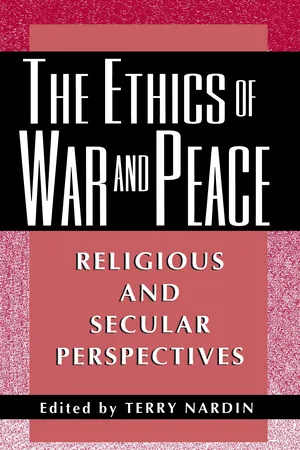
A superb introduction to the ethical aspects of war and peace, this collection of tightly integrated essays explores the reasons for waging war and for fighting with restraint as formulated in a diversity of ethical traditions, religious and secular. Beginning with the classic debate between political realism and natural law, this book seeks to expand the conversation by bringing in the voices of Judaism, Islam, Christian pacifism, and contemporary feminism. In so doing, it addresses a set of questions: How do the adherents to each viewpoint understand the ideas of war and peace? What attitudes toward war and peace are reflected in these understandings? What grounds for war, if any, are recognized within each perspective? What constraints apply to the conduct of war? Can these constraints be set aside in situations of extremity? Each contributor responds to this set of questions on behalf of the ethical perspective he or she is presenting. The concluding chapters compare and contrast the perspectives presented without seeking to adjudicate their differences. Because of its inclusive, objective, comparative, and dialogic approach, the book serves as a valuable resource for scholars, journalists, policymakers, and anyone else who wants to acquire a better understanding of the range of moral viewpoints that shape current discussion of war and peace. In addition to the editor, the contributors are Joseph Boyle, Michael G. Cartwright, Jean Bethke Elshtain, John Finnis, Sohail H. Hashmi, Theodore J. Koontz, David R. Mapel, Jeff McMahan, Richard B. Miller, Aviezer Ravitzky, Bassam Tibi, Sarah Tobias, and Michael Walzer.
- English
- ePUB (mobile friendly)
- Available on iOS & Android
eBook - ePub
About this book
Information
Publisher
Princeton University PressYear
2020Print ISBN
9780691058405
9780691037134
eBook ISBN
9780691221854
Topic
PhilosophySubtopic
Political PhilosophyPART ONE
The Classic Debate: Natural Law and Political Realism
CHAPTER 1
The Ethics of War and Peace in the Catholic Natural Law Tradition
PEACE AND WAR
Law, and a legalistic morality and politics, can define peace and war by their mutual opposition. Any two communities are either at peace or at war with one another. If they are at war, each is seeking a relationship to the other (“victory over,” “prevailing over”) which that other seeks precisely to frustrate or overcome. If they are at peace, each pursues its own concerns in a state of indifference to, noninterference in, or collaboration with the concerns of the other.
But sound moral and political deliberation and reflection is not legalistic. Despite some tendencies towards legalism, the Catholic tradition of natural law theory very early articulated and has steadily maintained a richer and more subtle conception of peace and war. From the outset, the philosophers in the tradition have accepted that social theory (a theory of practice) should have a distinct method, appropriate to its uniquely complex subject matter. It should not seek to articulate univocal terms and concepts which, like the concepts a lawyer needs, extend in the same sense to every instance within a clearly bounded field. Rather, it should identify the central cases of the opportunities and realities with which it is concerned, and the focal meanings of the terms which pick out those opportunities and realities. What is central, primary, and focal, and what peripheral, secondary, and diluted, is a function of (that is, is settled by reference to) what is humanly important, which in turn is a function of what are the good reasons for choice and action. So there are central and secondary forms of community, of friendship, of constitution, of the rule of law, of citizenship—and of peace. The secondary forms are really instances. But a reflection which focuses on them will overlook much that is important both for conscientious deliberation (practice) and for a fully explanatory reflection (theory).
So: to describe or explain peace as the absence of war is to miss the important reasons why, as the tradition affirms, peace is the point of war. That affirmation is not to be taken in the diluted and ironical sense of the Tacitean solitudinem faciunt pacem appellant.1 The tradition knows well enough that wars are sometimes, in fact, waged to annihilate, out of hatred or sheer delight in inflicting misery, destruction, and death, and that even such wars can be said to be “for the sake of peace,” that is, for the inner peace of satiation of desire and the outward peace of an unchallenged mastery over one’s domain.2 But even the inner peace attainable by such means is partial, unstable, and unsatisfying, and the peace of an unfair and cruel mastery is deeply disordered and deficient. More adequately understood, peace is the “tranquillity of order,” and “order is the arrangement of things equal and unequal in a pattern which assigns to each its proper position.”3
But a definition of peace in terms of things resting tranquilly in their proper places still fails to articulate the peace which could be the point of war. It remains too passive. The account needs to be supplemented by, indeed recentered on, what Augustine had treated as primary in the two immediately preceding sentences: concordia and societas, concord and community. For concord is agreement and harmony in willing, that is, in deliberating, choosing, and acting, and community is fellowship and harmony in shared purposes and common or coordinated activities. Peace is not best captured with metaphors of rest. It is the fulfillment which is realized most fully in the active neighborliness of willing cooperation in purposes which are both good in themselves and harmonious with the good purposes and enterprises of others.
Peace, then, is diminished and undermined generically by every attitude, act, or omission damaging to a society’s fair common good—specifically, by dispositions and choices which more or less directly damage a society’s concord. Such dispositions and choices include a proud and selfish individualism, estranged from one’s society’s (or societies’) concerns and common good;4 contentiousness, obstinacy, or quarrelsomeness;5 feuding with one’s fellow citizens6 and sedition against proper authority;7 and, most radically, war.
To choose war is precisely to choose a relationship or interaction in which we seek by lethal physical force to block and shatter at least some of their undertakings and to seize or destroy at least some of the resources and means by which they could prosecute such undertakings or resist our use of force.8 (Do not equate “lethal” with “intended to kill”: see under “Attitudes toward War and Nonviolence” below.) In the paradigm case of war, the we and the they are both political communities, acting as such—what the tradition called “complete or self-sufficient (perfectae) communities.” But there are only “material,” not “formal” (essential, morally decisive), differences between that paradigm case (“war” strictly so called) and other cases:9 the war of a political community against pirates; the revolt of part of a political community against their rulers, or the campaign of the rulers against some part of their community, or some other form of civil war; the armed struggle of a group or individual against gangsters, bandits, or pirates; the duel of one person against another. In each case, the relationship and interactions between us and them which we bring into being in choosing to go to war replace, for the war’s duration, the neighborliness and cooperation which might otherwise have subsisted between us and them. But the tradition teaches that a choice of means which involves such a negation of peace (of concord, neighborliness, and collaboration) cannot be justified unless one’s purpose (end) in choosing such means includes the restoration, and if possible the enhancement, of peace (concord, neighborliness, and collaboration) as constitutive of the common good of the imperfect community constituted by any two interacting human societies.10
This requirement of a pacific intention is, for the tradition, an inescapable implication of morality; it is entailed by the truly justifying point of any and every human choice and action. For peace, in its rich central sense and reality, is materially synonymous with the ideal condition of integral human fulfillment—the flourishing of all human persons and communities.11 And openness to that ideal, and the consistency of all one’s choices with such openness, is the first condition of moral reasonableness.12
In the classic sources of the tradition, that primary moral principle is articulated not as I have just stated it, but as the principle that one is to love one’s neighbor as oneself, a principle proposed as fundamental not only to the Gospel law but also to the natural law, to practical reasonableness itself.13 Accordingly, the tradition’s classic treatments of war are found in the treatises on caritas, precisely on love of neighbor.14 Justice removes obstacles to peace, and is intrinsic to it, but the direct source of peace is love of neighbor.15 And war is to be for peace.16
For true peace, not a false or seeming peace. War might often be averted by surrender. But the peace thus won would often be a false peace, corrupted and diluted by injustices, slavery, and fear. Preserving, regaining, or attaining true peace can require war (though war will never of itself suffice to achieve that peace17).
MOTIVE OR INTENTION
An act, a deed, is essentially what the person who chooses to do it intends it to be. Intention looks always to the point, the end, rather than to means precisely as such; intention corresponds to the question, “Why are you doing this?” But any complex activity is a nested order of ends which are also means to further ends: I get up to walk to the cupboard to get herbs to make a potion to drink to purge myself to get slim to restore my health to prepare for battle to. . . .18 So, though intention is of ends, it is also of all the actions which are means.
English lawyers try to mark the distinction between one’s more immediate intentions and one’s further intentions by reserving the word “motive” for the latter. The spirit in which one acts, the emotions which support one’s choice and exertions, can be called one’s motives, too, but become the moralist’s direct concern only if and insofar as they make a difference to what is intended and chosen. If the proposal one shapes in deliberation and adopts by choice is partly molded by one’s emotional motivations (more precisely, by one’s intelligence in the service of those emotions), then those motivations are to be counted among one’s intentions (and motives), help make one’s act what it is, and fall directly under moral scrutiny.
A war is just if and only if it is right to choose to engage in it. A choice is right if and only if it satisfies all the requirements of practical reasonableness, that is, all relevant moral requirements. If one’s purpose (motive, further intention) is good but one’s chosen means is vicious, the whole choice and action is wrong. Conversely, if one’s means is upright (say, giving alms to the poor) but one’s motive—one’s reason for choosing it—is corrupt (say, deceiving voters about one’s character and purposes), the whole choice and action is wrong. The scholastics had an untranslatable maxim to make this simple point: bonum ex integra causa, malum ex quocumque defectu, an act will be morally good (right) if what goes into it is entirely good, but will be morally bad (wrong) if it is defective in any morally relevant respect (bad end, or bad means, or inappropriate circumstances). Treatises on just war are discussions of the conditions which must all be satisfied if the war is to be just.
The preceding three paragraphs enable us to see that, in the tradition, no clear or clearly relevant distinction can be drawn between “grounds for” war and “motive or intention” in going to war. The proper questions are always: What are good reasons for going to war? What reasons must not be allowed to shape the proposal(s) about which I deliberate, or motivate my adoption of a proposal?
In the first major treatise on war by a philosophical theologian (as opposed to a canonist), Alexander of Hales (c. 1240) identifies six preconditions for a just war. The person declaring war must have (1) the right affectus (state of mind) and (2) authority to do so; the persons engaging in war must (3) not be clerics, and must have (4) the right intentio; the persons warred upon must (5) deserve it (the war must have meritum) ; and there must be (6) causa, in that the war must be waged for the support of the good, the coercion of the bad, and peace for all.19 Here the word causa is less generic than in the maxim bonum ex integra causa, but less specific than in Aquinas’s discussion of just war, about thirty years later. Aquinas (c. 1270) cuts the preconditions down to three: authority, causa iusta, and intentio recta. Aquinas’s causa is essentially what Alexander of Hales had called meritum. There is a just causa, says Aquinas, when those whom one attacks deserve (mereantur) the attack on account of their culpability; just wars are wars for righting wrongs, in particular a nation’s wrong in neglecting to punish crimes committed by its people or to restore what has been unjustly taken away.20
Thus it is clear that, in Aquinas, the term causa is not equivalent to “a justifying ground.” Rather, it points to something more like the English lawyer’s “cause of action,” a wrong cognizable by the law as giving basis for a complaint, a wrong meriting legal redress. As Francisco Suarez notes, 350 years later, a discussion of such iustae causae for war is primarily a discussion of the justifying grounds for war other than self-defense:21 to act in self-defense really needs no causa. (Throughout I shall follow Article 51 of the UN Charter in using the term “self-defense” to include all cases of justifiable defense, légitime défense) So there is an important difference between a present-day inquiry into the justifying grounds for war and a medieval inquiry into iusta causa. Aquinas had more reason to distinguish (as he firmly does22) between causa (in his sense) and intentio than we now have to distinguish between “ground” and “motive or intention.”
Is there nonetheless some room, in considering the rightness of initiating or participating in a war or act of war, for an inquiry into the spirit or sentiment in which a people, an official, or a citizen acts? Perhaps there is. We might draw a distinction between “grounds” and “spirit” by recalling that war is paradigmatically a social and public act. Now, just as an individual’s act or deed is essentially what the person who chooses to do it intends it to be, so the acts of a society are essentially what they are defined to be in the public policy which members of the society are invited or required to participate in carrying out. That defining policy, which organizes the actions of individual participants in a war (thus constituting their acts a social act),23 and does so by more or less explicit ...
Table of contents
- Cover
- Title Page
- Copyright Page
- Contents
- Preface
- Contributors
- Introduction—Terry Nardin
- Part One: The Classic Debate: Natural Law and Political Realism
- Part Two: Expanding the Dialogue: Judaism and Islam
- Part Three: Critical Perspectives: Christian Pacifism and Feminism
- Part Four: Comparative Overview
- Index
Trusted by 375,005 students
Access to over 1.5 million titles for a fair monthly price.
Study more efficiently using our study tools.
Frequently asked questions
Yes, you can cancel anytime from the Subscription tab in your account settings on the Perlego website. Your subscription will stay active until the end of your current billing period. Learn how to cancel your subscription
No, books cannot be downloaded as external files, such as PDFs, for use outside of Perlego. However, you can download books within the Perlego app for offline reading on mobile or tablet. Learn how to download books offline
We are an online textbook subscription service, where you can get access to an entire online library for less than the price of a single book per month. With over 1.5 million books across 990+ topics, we’ve got you covered! Learn about our mission
Look out for the read-aloud symbol on your next book to see if you can listen to it. The read-aloud tool reads text aloud for you, highlighting the text as it is being read. You can pause it, speed it up and slow it down. Learn more about Read Aloud
Yes! You can use the Perlego app on both iOS and Android devices to read anytime, anywhere — even offline. Perfect for commutes or when you’re on the go.
Please note we cannot support devices running on iOS 13 and Android 7 or earlier. Learn more about using the app
Please note we cannot support devices running on iOS 13 and Android 7 or earlier. Learn more about using the app
Yes, you can access The Ethics of War and Peace by Terry Nardin in PDF and/or ePUB format, as well as other popular books in Philosophy & Political Philosophy. We have over 1.5 million books available in our catalogue for you to explore.