
eBook - ePub
Hydraulic Tables; The Elements Of Gagings And The Friction Of Water Flowing In Pipes, Aqueducts, Sewers, Etc., As Determined By The Hazen And Williams Formula And The Flow Of Water Over The Sharp-Edged And Irregular Weirs, And The Quantity Discharged
- 122 pages
- English
- ePUB (mobile friendly)
- Available on iOS & Android
eBook - ePub
Hydraulic Tables; The Elements Of Gagings And The Friction Of Water Flowing In Pipes, Aqueducts, Sewers, Etc., As Determined By The Hazen And Williams Formula And The Flow Of Water Over The Sharp-Edged And Irregular Weirs, And The Quantity Discharged
About this book
Many of the earliest books, particularly those dating back to the 1900s and before, are now extremely scarce and increasingly expensive. We are republishing these classic works in affordable, high quality, modern editions, using the original text and artwork.
Information
ADDITIONAL DATA.

IT is eighteen years since the Williams-Hazen formula was first used and fifteen since the first edition of these tables appeared. During this time many new experiments on the flow of water in pipes have been made. As a new edition goes to press, it is appropriate to examine these to see if changes or adjustments are required.
There are three values open to consideration—two exponents and one coefficient. The exponents will be considered first.
EXPONENT OF SLOPE.
This exponent shows the rate at which friction increases with velocity. A value for the exponent of s may be obtained from a series of experiments made upon a single pipe line, but each series of experiments, to be useful, must cover a considerable range in velocities, and these velocities must extend at least as high as those ordinarily used in practice.
Experiments with seventeen pipes have been selected as being helpful in reaching a representative value for this exponent. Each of these pipes was very smooth. The value of the coefficient actually found in the experiments is taken as the best evidence of smoothness. Many older data have been excluded, because the values of c show that the pipes which they represent were not really smooth. The best cast-iron pipe of fifty years ago was inferior in smoothness to average pipe of today.
Data for pipes less than two inches in diameter are not included. Such data are numerous and accurate; but viscosity is a greater element in the flow of water in small pipes. Viscosity tends to increase the exponent of s in small pipes.
To get a good indication of the true exponent of s for any pipe the range in velocities covered by the tests must be considerable. It was first intended to use only data where the tests extended to a velocity of ten feet per second; but a rigid application of this rule would leave so few data for large pipes, that the limit was reduced to five feet per second. Experiments in each series at low velocities if inconsistent with those obtained at higher velocities, have been omitted in computing the exponent, and for this reason there are divergences in a few cases from exponents previously stated for the same data. The data, bearing upon the exponent of s, are shown in Table 1.
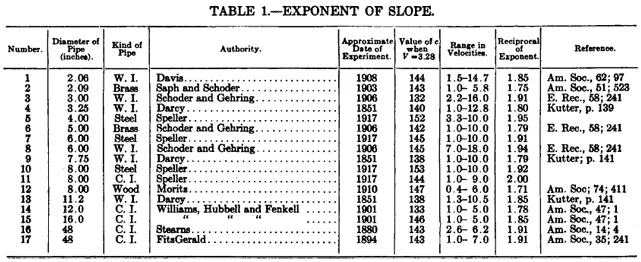
In this table four results attributed to F. N. Speller have not previously been published. These relate to experiments made at McKeesport, Penn., in 1917. The steel pipes used in experiments Numbers 5, 7, and 10 were rolled at a temperature so low that mill scale did not form; and were as smooth as brass pipe. They were laid perfectly straight; flows were measured by Venturi meter, and the loss of head in two straight runs of 1000 ft. parallel with each other, one out and one back, were measured by differential gauges attached at four points, each about 104 ft. from an end or turn. In one case, No. 11 of the table, cast-iron pipe was used, but otherwise the conditions of the tests were the same.
Of the seventeen series of experiments now selected, ten have been made since the Williams-Hazen formula was proposed in 1902.
The average of the seventeen values is 0.538. Taking the results for 8-inch pipe and over as being perhaps a safer guide for use in calculations for large pipes, the average is found to be 0.536. In other words, in these selected data pipes from 2 to 7.75 inches in diameter give practically the same indications as do the larger pipes. The values for three pipes of brass and wood, taken by themselves, average 0.572, while the fourteen remaining ones, representing pipes of iron and steel, average 0.531.
These results are not far from the value used in the Williams-Hazen formula, which is 0.54. No revision of this value appears to be necessary.
For rough pipes the value of the exponent s is lower, but seldom or never lower than 0.50. Perhaps 0.52 would be a representative value for old pipe. Practically the one value of the formula is close enough for general use.
EXPONENT OF r.
This exponent indicates the rate of increase in velocity with hydraulic radius (or diameter) at a constant slope.
In order to study the Exponent of r, comparison must be made of the records of pipes of different sizes. In making comparison it is not easy to be sure that the large pipes and small pipes that are compared are really of equal smoothness. Perhaps the safest procedure is to compare the very smoothest pipes of all sizes by themselves, regardless of material. To do this, data showing the highest coefficients known to the authors are selected. Comparison is made by plotting the values of the coefficients in the ...
Table of contents
- Cover
- Title
- Preface to the Section Edition
- Contents
- Introduction
- Additional Data
- Flow over Weirs
Trusted by 375,005 students
Access to over 1.5 million titles for a fair monthly price.
Study more efficiently using our study tools.
Frequently asked questions
Yes, you can cancel anytime from the Subscription tab in your account settings on the Perlego website. Your subscription will stay active until the end of your current billing period. Learn how to cancel your subscription
No, books cannot be downloaded as external files, such as PDFs, for use outside of Perlego. However, you can download books within the Perlego app for offline reading on mobile or tablet. Learn how to download books offline
Perlego offers two plans: Essential and Complete
- Essential is ideal for learners and professionals who enjoy exploring a wide range of subjects. Access the Essential Library with 800,000+ trusted titles and best-sellers across business, personal growth, and the humanities. Includes unlimited reading time and Standard Read Aloud voice.
- Complete: Perfect for advanced learners and researchers needing full, unrestricted access. Unlock 1.5M+ books across hundreds of subjects, including academic and specialized titles. The Complete Plan also includes advanced features like Premium Read Aloud and Research Assistant.
We are an online textbook subscription service, where you can get access to an entire online library for less than the price of a single book per month. With over 1.5 million books across 990+ topics, we’ve got you covered! Learn about our mission
Look out for the read-aloud symbol on your next book to see if you can listen to it. The read-aloud tool reads text aloud for you, highlighting the text as it is being read. You can pause it, speed it up and slow it down. Learn more about Read Aloud
Yes! You can use the Perlego app on both iOS and Android devices to read anytime, anywhere — even offline. Perfect for commutes or when you’re on the go.
Please note we cannot support devices running on iOS 13 and Android 7 or earlier. Learn more about using the app
Please note we cannot support devices running on iOS 13 and Android 7 or earlier. Learn more about using the app
Yes, you can access Hydraulic Tables; The Elements Of Gagings And The Friction Of Water Flowing In Pipes, Aqueducts, Sewers, Etc., As Determined By The Hazen And Williams Formula And The Flow Of Water Over The Sharp-Edged And Irregular Weirs, And The Quantity Discharged by Gardner Stewart Williams in PDF and/or ePUB format, as well as other popular books in History & World History. We have over 1.5 million books available in our catalogue for you to explore.