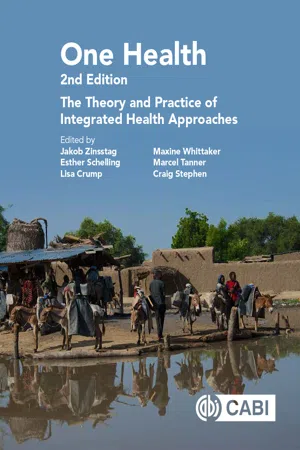
One Health, the concept of combined veterinary and human health, has now expanded beyond emerging infectious diseases and zoonoses to incorporate a wider suite of health issues. Retaining its interdisciplinary focus which combines theory with practice, this new edition illustrates the contribution of One Health collaborations to real-world issues such as sanitation, economics, food security and vaccination programmes. It includes more non-infectious disease issues and climate change discussion alongside revised case studies and expanded methodology chapters to draw out implications for practice. Promoting an action-based, solutions-oriented approach, One Health: The Theory and Practice of Integrated Health Approaches highlights the lessons learned for both human and animal health professionals and students.
eBook - ePub
One Health
The Theory and Practice of Integrated Health Approaches
- 472 pages
- English
- ePUB (mobile friendly)
- Available on iOS & Android
eBook - ePub
One Health
The Theory and Practice of Integrated Health Approaches
About this book
Information
1 One Health in History
MICHAEL BRESALIER,1* ANGELA CASSIDY2 AND ABIGAIL WOODS3
1 Department of History, Swansea University, Swansea, UK; 2 Department of Sociology, Philosophy and Anthropology, University of Exeter, UK; 3 College of Arts, University of Lincoln, UK
Introduction
The purpose of this chapter is to outline the history of One Health. This task immediately raises the question of how to approach the history of a subject that only became known as ‘One Health’ a few years ago, and is still evolving conceptually under the influence of health challenges, scientific advances, and political, economic, environmental and professional priorities. While there were many precedents to One Health, they did not go by this term, and they occurred at times when health problems, scientific ideas, and the wider world were very different from today. This state of affairs makes it impossible to impose a simple structure on to past events, or to link them, in linear fashion, to present-day One Health.
It is important to highlight this problem because existing histories of One Health usually gloss over it. These accounts are structured around key historical figures and scientific advances, whose contributions to health are used to argue for the importance of pursuing a One Health approach today. The achievements of Rudolf Virchow, Robert Koch, William Osler, John McFadyean, James Steele and Calvin Schwabe are routinely celebrated, along with the health benefits of vaccination, the germ theory and zoonosis control. While the importance of these individuals and activities cannot be denied, their roles within the history of One Health require more critical consideration. The accounts in which they feature are neither politically neutral nor historically well grounded, and have been assembled not for the purpose of understanding the past, but for advancing the case for One Health today. While this strategy may be useful in justifying and winning support for One Health, it has resulted in an extremely partial and selective reading of the past.
Rather than analysing history retrospectively from the perspective of present-day agendas, this chapter adopts a neutral, prospective, evidence-based approach that pays due regard to historical context.1 Drawing on an extensive body of historical literature and source material, it aims to effect a fundamental shift in the way that the history of One Health is popularly conceived. It takes as its subject matter the constellation of ideas, practices and circumstances that brought human and animal health (and to a lesser extent, the environment) into alignment, the people and institutions involved, and the reasons for change over time. Partly due to space constraints, and also because this history is still under active investigation, it makes no claim to completeness, particularly with regard to very recent events which are well described elsewhere (Lebouef, 2011; A. Cassidy, 2020, unpublished results). While Western medical and veterinary traditions form the primary focus, it acknowledges the importance of cross-cultural exchanges, which were often facilitated by international health organizations concerned with human and animal disease control.
The first section of the chapter analyses intersections between human and animal health in the pre-modern era, to reveal how deeply animals and animal health were embedded within human medicine. The second section extends from the late 18th-century foundation of the veterinary profession until the turn of the 20th century. It tracks the evolving relationship between the veterinary and medical professions, and how, as scientific ideas and practices changed, new links were forged between human and animal bodies and diseases. The third section extends this analysis into the 20th century, focusing particularly on the changing status of animals within medical research, and on international efforts to develop comparative medicine and veterinary public health. The conclusion reflects on the importance of these findings for history and for One Health today.
Pre-modern Connections
Looking back on the pre-modern era, commentators often highlight the existence of a fundamental, well-entrenched distinction between humans and animals, which derived from the Christian belief that only humans had souls (Hardy, 2003). In fact, this divide has been overstated, for the perceived boundaries between humans and animals were often blurred and unstable (Fudge, 2000). In health and medicine there historically existed three key points of intersection. First, animals were used to work out the anatomy and physiology of human bodies. Secondly, they were studied in comparison to humans in order to work out the relations between them. Thirdly, the theory and practice of animal medicine attracted the attention of human doctors, usually as an end in itself, but occasionally as a basis for comparison with human medicine. Aspects of these connections can be identified in very ancient civilizations (Gordon and Schwabe, 2004). However, as all three featured in ancient Greek thought, which exerted a powerful influence in the West right up to the 17th century, this will form the starting point of our survey.
Around one-quarter of the surviving works produced by the Greek philosopher Aristotle in the 4th century BC are devoted to animals, most importantly History of Animals, Parts of Animals and Generation of Animals. While Aristotle distinguished humans from animals through their possession of a rational soul, he also sought to relate them, by documenting differences and similarities in the form, function and purpose of their parts, and drawing up a taxonomic system. The numerous dissections he conducted in the course of this work illustrated the possibility of learning about humans from animals (Clutton-Brock, 1995). Taboos on the use of human bodies led the famous Greek doctor, Galen, working in 2nd-century Rome, to follow Aristotle’s lead. In an extensive and influential body of writing he documented the results of his numerous observations and experiments on animals. The errors he made in extrapolating from animal to human anatomy were not discovered until Andreas Vesalius (1514–1564) revived human dissection at Padua University in the 16th century (Guerrini, 2003).
Vesalius, and several of his contemporaries and successors, also vivisected animals in their attempts to work out the differences between living and dead bodies, and to describe and explain how body parts functioned (Shotwell, 2013). Vivisection was problematic: debates surrounded the value of knowledge drawn from animals and the suffering involved (Guerrini, 2003). Nevertheless, it enabled Realdo Columbo (1516–1559) and Fabricius (1537–1619) to identify the pulmonary transit of the blood and the function of the venous valves, respectively. After studying under Fabricius, William Harvey took up an Aristotelian programme of research on animals that resulted in his novel and, at the time controversial, proposal that blood circulated. Meanwhile, as part of the wider investigation of nature, medical doctors followed Aristotle in dissecting dead animals, for example at the elite Paris Academy Royale des Sciences during the 1660s and 1670s. This activity, described as ‘comparative anatomy’, drew on animals derived from colonial conquests that were contained within European leaders’ menageries (Cunningham, 2010).
The health of humans and animals, and their relations to the environment, were defined by the same medical theory: humouralism. Drawing on the ideas of Hippocrates and Galen, this formed the dominant system of medical thought until the 18th century. It held that all bodies were composed of four humours, influenced by factors such as feeding, climate, ventilation, exercise and sexual behaviour. Disease resulted from an imbalance between the humours (Curth, 2002). Bodily health was also influenced by changes in the environment, which the Hippocratic text, Airs, Waters, Places, held responsible for the rise and fall of epidemics (Wilkinson, 1992; Nutton, 2004). These ideas implied that similar interventions, such as bleeding, purging, lifestyle changes and improvements in the environment, could restore or maintain the humoural balance in both human and animal bodies. Formally trained healers usually focused on one or the other. Physicians, surgeons and apothecaries treated humans, while animals received dedicated attention from medieval veterinarians at the Mamluk courts, and from British farriers, French marechals, Spanish beitars and their equivalents in other countries (Conrad et al., 1995; Shehada, 2012). However, such healers were expensive and few in number. Consequently most humans and animals relied on self-help, clergymen, gentry, and the various self-styled healers that made up the ‘medical marketplace’. Here, the division between species was less well defined (Curth, 2002).
The 17th and 18th century movement away from ancient Greek thought brought humans and animals into even greater proximity. The new experimental philosophy of nature, and Rene Descartes’ (1596–1650) conception of animals as ‘automata’ (self-operating machines), resulted in the more extensive use of animal vivisection in medical research and teaching (Guerrini, 2003). For example, Swiss physiologist Albrecht von Haller (1708–1777) used live animals to work out human neurological functions (Eichberg, 2009). At Leiden in the Netherlands, and later in Edinburgh, Scotland, anatomy lecturers vivisected dogs and dissected humans simultaneously, in order to demonstrate to students the structure and the function of body parts (Guerrini, 2006). A new scheme of classifying animals, drawn up by Swedish naturalist, Carolus Linnaeus (1707–1778), placed humans, apes, monkeys and bats within the same order of primates, and brought humans and orangutans together in the genus Homo, thereby challenging notions of a human‑animal divide (Ritvo, 1995). Subsequently, in Paris, additional classification schemes were drawn up using dissected animals from the Versailles menagerie. Here, the key figures were George Buffon (1739–1788), the medically trained comparative anatomist, Louis Daubenton (1716–1799), and Georges Cuvier (1769–1832) (Cunningham, 2010).
One of Daubenton’s pupils, the physician Vicq d’Azyr (1749–1794), went beyond comparative anatomy to develop a truly comparative form of medicine. His initial concern was cattle plague or rinderpest. This disease was prevalent throughout Europe in the 18th century. It inspired much medical comment and attempts to control it by quarantine, modelled on responses to bubonic plague in humans (Wilkinson, 1992). After reporting upon this disease to the French government, d’Azyr was made secretary to a Royal Commission of Enquiry into epidemics and epizootics, and steered its 1778 evolution into the Societe Royale de Medicine. His investigations drew on medical meteorology and topology to correlate human and animal epidemics with climatic and geographical conditions. D’Azyr also performed animal experiments. He believed that by understanding the functioning of or...
Table of contents
- Cover
- Half Title
- Title
- Copyright
- Contents
- Contributors
- Editors’ Preface to the Second Edition
- Acknowledgements
- Section 1 Theoretical Foundations
- Section 2 Methods, Skills and Perspectives for the Practice of One Health
- Section 3 One Health in Practice
- Section 3(a) Infectious Disease
- Section 3(b) Non-communicable Disease
- Section 4 Governance and Capacity Building
- Index
- Cabi
- Back
Trusted by 375,005 students
Access to over 1.5 million titles for a fair monthly price.
Study more efficiently using our study tools.
Frequently asked questions
Yes, you can cancel anytime from the Subscription tab in your account settings on the Perlego website. Your subscription will stay active until the end of your current billing period. Learn how to cancel your subscription
No, books cannot be downloaded as external files, such as PDFs, for use outside of Perlego. However, you can download books within the Perlego app for offline reading on mobile or tablet. Learn how to download books offline
Perlego offers two plans: Essential and Complete
- Essential is ideal for learners and professionals who enjoy exploring a wide range of subjects. Access the Essential Library with 800,000+ trusted titles and best-sellers across business, personal growth, and the humanities. Includes unlimited reading time and Standard Read Aloud voice.
- Complete: Perfect for advanced learners and researchers needing full, unrestricted access. Unlock 1.5M+ books across hundreds of subjects, including academic and specialized titles. The Complete Plan also includes advanced features like Premium Read Aloud and Research Assistant.
We are an online textbook subscription service, where you can get access to an entire online library for less than the price of a single book per month. With over 1.5 million books across 990+ topics, we’ve got you covered! Learn about our mission
Look out for the read-aloud symbol on your next book to see if you can listen to it. The read-aloud tool reads text aloud for you, highlighting the text as it is being read. You can pause it, speed it up and slow it down. Learn more about Read Aloud
Yes! You can use the Perlego app on both iOS and Android devices to read anytime, anywhere — even offline. Perfect for commutes or when you’re on the go.
Please note we cannot support devices running on iOS 13 and Android 7 or earlier. Learn more about using the app
Please note we cannot support devices running on iOS 13 and Android 7 or earlier. Learn more about using the app
Yes, you can access One Health by Jakob Zinsstag, Esther Schelling, Lisa Crump, Maxine Whittaker, Marcel Tanner, Craig Stephen, Jakob Zinsstag,Esther Schelling,Lisa Crump,Maxine Whittaker,Marcel Tanner,Craig Stephen in PDF and/or ePUB format, as well as other popular books in Medicina & Salud pública, administración y atención. We have over 1.5 million books available in our catalogue for you to explore.