eBook - ePub
Available until 23 Dec |Learn more
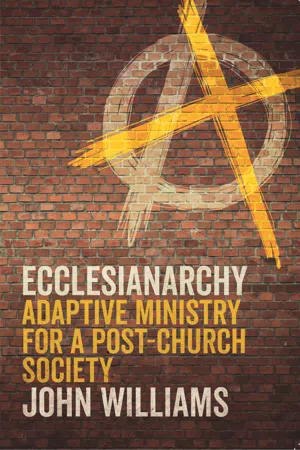
Ecclesianarchy
Adaptive Ministry for a Post-Church Society
This book is available to read until 23rd December, 2025
- 288 pages
- English
- ePUB (mobile friendly)
- Available on iOS & Android
eBook - ePub
Available until 23 Dec |Learn more
About this book
Arguing that what is needed is a provisional approach to ministry which recognises that all forms of ministry are, and always have been a response to social and cultural context, 'Ecclesianarchy' brings theological and practical insight to bear on the question of ministry's provisionality.
Frequently asked questions
Yes, you can cancel anytime from the Subscription tab in your account settings on the Perlego website. Your subscription will stay active until the end of your current billing period. Learn how to cancel your subscription.
No, books cannot be downloaded as external files, such as PDFs, for use outside of Perlego. However, you can download books within the Perlego app for offline reading on mobile or tablet. Learn more here.
Perlego offers two plans: Essential and Complete
- Essential is ideal for learners and professionals who enjoy exploring a wide range of subjects. Access the Essential Library with 800,000+ trusted titles and best-sellers across business, personal growth, and the humanities. Includes unlimited reading time and Standard Read Aloud voice.
- Complete: Perfect for advanced learners and researchers needing full, unrestricted access. Unlock 1.4M+ books across hundreds of subjects, including academic and specialized titles. The Complete Plan also includes advanced features like Premium Read Aloud and Research Assistant.
We are an online textbook subscription service, where you can get access to an entire online library for less than the price of a single book per month. With over 1 million books across 1000+ topics, we’ve got you covered! Learn more here.
Look out for the read-aloud symbol on your next book to see if you can listen to it. The read-aloud tool reads text aloud for you, highlighting the text as it is being read. You can pause it, speed it up and slow it down. Learn more here.
Yes! You can use the Perlego app on both iOS or Android devices to read anytime, anywhere — even offline. Perfect for commutes or when you’re on the go.
Please note we cannot support devices running on iOS 13 and Android 7 or earlier. Learn more about using the app.
Please note we cannot support devices running on iOS 13 and Android 7 or earlier. Learn more about using the app.
Yes, you can access Ecclesianarchy by John Williams in PDF and/or ePUB format, as well as other popular books in Theology & Religion & Christian Ministry. We have over one million books available in our catalogue for you to explore.
Information
1. Liquid Modernity: Hallmarks of the Post-Church Society
The condition of postmodernity
This chapter offers an overview of features of the contemporary cultural environment in the post-Christendom West that challenge the churches to reimagine their ministry and mission. The first task is to establish what is meant by describing the context as ‘postmodern’.
At the beginning of his seminal work The Postmodern Condition, Jean-François Lyotard announced: ‘Our working hypothesis is that the status of knowledge is altered as societies enter what is known as the postindustrial age and cultures enter what is known as the postmodern age’ (1984, p. 3). In particular, this altered status of knowledge manifests in an ‘incredulity towards metanarratives’, or ‘big stories’ (grands récits) that purport to provide a unified overarching framework of explanatory power, within which all other fields of knowledge achieve their proper interpretation. As Tim Woods puts it, ‘there is a disillusionment with ambitious “total explanations” of reality such as those offered by science, or religion, or political programmes like Communism’ (2009, p. 20). Two crucial points stand out at once. First, the thesis of postmodernity is of enormous relevance for theology and the Church, which have historically relied heavily upon precisely the kind of ‘grand narrative’ now called into question. Second, whereas at the height of modernity, empiricists argued that science has rendered religion untenable as a source of true knowledge, the postmodern temper problematizes both science and religion insofar as they make these totalizing claims.
It is important to note that Lyotard refers to the postmodern condition. This is significant for theologians, because it leaves open the possibility of recognizing the cultural styles and attitudes we classify as ‘postmodern’ (the ‘condition’), to which the churches need to respond, while retaining a critical distance with regard to the philosophy. This distinction is observed by Graham Ward, who uses the term postmodernism for the more theoretical philosophical framework, and postmodernity to refer to the experienced cultural situation (Ward (ed.), 2005, p. xiv). It would be a denial of the postmodern mindset itself to embrace ‘postmodernism’ as an ‘ism’, turning it into some kind of grand narrative in its own right. The churches, therefore, have tended to engage with the indicators of ‘postmodernity’, the cultural condition of our time, rather than with ‘postmodernism’ and its philosophers.
Stanley Grenz writes of the erosion of confidence in a series of ‘myths’ of modernity: that progress is inevitable, that ‘truth is certain and hence purely rational’, and that ‘knowledge is [wholly] objective’ (1996, p. 7). In abandoning ‘the quest for a unified grasp of objective reality’, the postmodern mood calls into question the idea of a ‘universe’, in the face of the irreducible plurality and unending ‘flow’ of knowledge that resists being gathered and demystified into a single field. As David Harvey puts it, faced with ‘ephemerality, fragmentation, discontinuity and the chaotic’, the postmodern mind ‘swims, even wallows, in the fragmentary and chaotic currents of change as if that is all there is’ (1990, p. 44). From an evangelical Christian perspective, Kieran Beville depicts the postmodern person as ‘intimately fractured’, struggling to find a connected, relational identity, manifesting fluidity of personality and worldview, with a rejection of dogmatism and a desire for experience, a longing for community, and an openness to the supernatural (2016, pp. 95–118).
These features of the condition of postmodernity are manifested in the popular phenomenon of the quest for ‘spirituality’. In 2005, Channel 4 ran a series called Spirituality Shopper in which non-religious young people were given a variety of ‘taster experiences’ of spiritual practices to discover whether they would find some personal benefit in them. An entertaining review appeared in the Daily Mirror:
In the first of three programmes, triple-jumping Christian Jonathan Edwards performs a mystical makeover on 29-year-old Michaela Newton-Wright, whose great job in advertising leaves her feeling strangely shallow and unfulfilled. Explaining that it’s not necessary for her to actually believe in any of the religions, Jonathan introduces Michaela to an array of God-bothering options for her to mix and match. She gets lessons in Buddhist meditation, cooks a meal for friends on the Jewish Sabbath, gives Sufi dancing a whirl, visits one rather surprised old lady and is even persuaded to give up hair straighteners for an imaginary Lent. It’s easy to scoff at the idea that spiritual enlightenment can be achieved in four weeks without believing in anything at all … But amazingly after one month the transformation in Michaela is astonishing – her hair really is much, much curlier. (Jane Simon, ‘Today’s TV’, Daily Mirror, 6 June 2005; cit. Voas and Bruce, 2007, p. 52)
Despite the typically sceptical and humorous journalistic tone, this does capture several familiar elements in the culture of popular postmodernity. Michaela is entirely alienated from any kind of conventional religion or church life. She is attracted by the notion of not having to believe anything but just to experience it, the idea of an entirely eclectic approach to giving things a try, and the expectation that the objective is some sort of personal therapeutic or cosmetic benefit. Today’s churches have to operate in an environment where Michaela’s attitudes and responses are commonplace, and the cultural landscape is critical for the expressions of both church and mission that will or will not connect with someone like her. A somewhat ironic addendum to this story is that within a couple of years of hosting this programme, Edwards himself publicly announced the loss of his Christian faith when he abruptly pulled out of his role as a presenter of BBC’s Songs of Praise in February 2007. The encounter with the condition of postmodernity at its most prolifically relativistic can indeed be corrosive of conventional religious convictions.
Church responses: accommodation or resistance
Within the world of organized religion, the responses to the postmodern temper have tended to be expressed as a binary choice between accommodation and resistance. As Hannah Steele asks in her exposition of the theology of the ‘emerging church’ movement, ‘is the church subject to the whims of cultural change, forced to compromise and change or risk inevitable extinction? Or is the church to function as a prophetic voice to be followed?’ (2017, p. 155). Steele herself strongly favours the latter option, but put in these binary terms this is a false choice. A degree of accommodation is always inevitable, as the Church cannot help but be part of the culture; but it is from within that compromised position that the gospel handed on through culture continues to harbour the subversive alternatives that can break out afresh when the time is opportune (see Martin, 1980).
The binary choice of accommodation or resistance was prevalent in the 1960s in relation to the response of the churches, not yet to postmodernity, but to secularization. Some more progressive theologians sought to respond in terms of a moderate adaptation of church and mission to cultural change (Richardson, 1966; Barry, 1969), whereas others of more conservative views judged them to have capitulated to the spirit of the age, and urged a more robust affirmation of orthodox essentials (Mascall, 1965; Holloway, 1972). Yet at just this time, a major debate about the ‘secularization thesis’ was beginning within the sociology of religion (Wilson, 1966; Martin, 1967). Bryan Wilson defined secularization as ‘the process whereby religious thinking, practice and institutions lose social significance’ (1966, p. 14), an inevitable and irreversible consequence of the advance of modernity. David Martin on the other hand demanded a much more complex analysis of what was happening to religion under the conditions of modernity: ‘far from being secular, our culture wobbles between a partially absorbed Christianity, biased towards comfort and the need for confidence, and beliefs in fate, luck and moral governance incongruously joined together’ (1967, p. 76).
A defining moment in the de-churching of society that made significant advances in the 1960s (Brown, 2001) was the ‘ferment’ that came to its most prominent public focus in the events surrounding the publication of John Robinson’s Honest to God (1963), in which the ‘accommodation versus resistance’ debate was central. The next section will take this as a case study, not so much considering the contents of Robinson’s book as the lessons to be learned from the controversy it precipitated.
Honesty to God in the swinging sixties
In post-war Britain, religion (and especially Church of England religion) remained a powerful mainstay of inherited moral attitudes. Brown and Lynch cite the case of Margaret Knight, a lecturer in psychology, who in 1955 presented two talks on the BBC making the case for humanism, and urging that religious education should encourage a non-dogmatic attitude towards diverse faith traditions. One newspaper warned: ‘Don’t let this woman fool you. She looks – doesn’t she? – just like a typical housewife: cool, comfortable, harmless. But Mrs Margaret Knight is a menace. A dangerous woman. Make no mistake about that’ (cit. Brown and Lynch, 2012, p. 332). Had today’s technology been available then, she would no doubt have been subjected to a torrent of abuse on Twitter.
Within a decade, the ‘menace’ of Mrs Knight’s views steadily became normal public ethical discourse; ‘religiously-legitimated moral principles’ were now ‘the preserve of committed minorities, rather than being part of the taken-for-granted assumptions of the majority of the population’ (McLeod, 1995, p. 4). The fallout from this was noteworthy, focused nowhere better than in the publication of Honest to God, a slim paperback by the Bishop of Woolwich, John Robinson, a former Cambridge biblical scholar, proposing an overhaul in the Church’s thinking about the fundamentals of theology and morality (for the Honest to God debate, see Clements, 1988, chapter 7; Bowden (ed.), 1993; Williams, 1986 and 2015). As a bishop, Robinson had scandalized the media by giving evidence in favour of the publication of Lady Chatterley’s Lover at the obscenity trial of October 1960. His remark that ‘what Lawrence is trying to do is to portray the sex relationship as something essentially sacred … as in a real sense an act of holy communion’ (cit. James, 1987, p. 95) was a piece of ‘modern theology’ far beyond what most of those who heard of it could take (Williams, 1986, p. 159).
Robinson’s prior notoriety, combined with some high-profile efforts by the churches in the early 1960s to respond to the onset of a sharp decline in attendances by various strategies of modernization, often through the medium of popular culture, were critical factors in extending the reach of Honest to God to a wider audience. Debates about updating the Church were already under way: for example, at Salisbury Cathedral a ‘Pop Evensong’ was held, which produced the response from one critic: ‘it does not speak very highly for the standard of preaching nowadays if the only method of drawing people to Church is to pander to their worst instincts’ (Church Times, 6 April 1962). John Robinson went on ITV’s youthful religious magazine Sunday Break to be quizzed by a group of sceptical teenagers; and the Archbishop of York, Donald Coggan, discussed God, sex and the younger generation with the pop singer Adam Faith on the BBC. (Coggan said, ‘Religion is so jolly relevant to this life.’)
On 4 November 1962, the BBC’s flagship religious discussion programme, Meeting Point, featured the Cambridge theologian Alec Vidler in conversation with the agnostic journalist Paul Ferris, who was a keen commentator on the affairs of the Church of England (Ferris, 1964). The ensuing controversy was not caused by anything critical about the Church said by Ferris, the self-confessed outsider, but the remarks of the insider Vidler, who signally failed to assume the role of the Church’s defender. Among the opinions he advanced were that the Church ought not to concentrate so much on ‘religion’, that open discussion should replace the sermon, and that he was ‘bored with parsons’ and thought the ‘clerical caste’ ought to be abolished. In response to the Church Times report under the headline ‘Cambridge Priest’s Attack on Church’, one woman wrote: ‘Those of us who are struggling to teach the young and uphold our Churchmanship in a materialist world are not helped when her ordained ministers themselves deny all that we have received and learnt to hold most dear.’ Put crudely, the BBC was now living in the 1960s, while this woman remained lodged firmly in the 1950s.
Honest to God thus became the rallying point for those on either side of the debate about the future of the churches and the vitality of faith in a context of secularization, towards either a more far-reaching adaptation to the ‘modern world’ on the one hand, or a more vehement confrontation of it on the other. Within the overall ‘accommodation versus resistance’ question, key issues in Robinson’s writings included whether conventional organized religion continued to have value as a vehicle for conveying the reality of God to contemporary men and women, and whether faithful church membership was compatible with a spirit of critical, open enquiry towards the dogmatic and moral teachings of the Church. All of these issues are present with still greater urgency in the situation facing the churches more than half a century later and are relevant to how they approach the need to reimagine ministry.
What is different is that in the early years of the twenty-first century, the favoured sociological framework for thinking about church renewal has shifted from secularization to ‘postmodernity’ (Archbishops’ Council of the Church of England, 2004), but it remains the case that either ‘selling out’ to the culture, or railing ‘prophetically’ against it, is a false dichotomy. The Church cannot speak ‘into’ the culture from some hypothetical neutral space beyond it, but must tackle head-on the ways in which the culture is both forming and challenging it as an institution, and the faith it proclaims. Only if this takes place might some kind of ‘prophetic’ outcome be envisaged; but this happens only on the far side of the movement of deconstruction, to be explored in Chapters 9 and 10. Before proceeding any further with an analysis of the contemporary cultural landscape, however, it will be helpful to sketch the contours of the journey by which we got to where we are.
Narratives of decline
In historical perspective, there is actually much to celebrate in the state of the churches in the third millennium: church buildings have never been better kept; clergy have never been more thoroughly trained; congregations have never been more actively involved in sharing ministry; worship has never been better led, on the whole, than today. But churchgoing has largely ceased to be a regular habit. The Church Health Check, published in a four-part series in the Church Times under the oversight of Linda Woodhead, is forthright about the statistics:
The Church’s greatest failure in our lifetime has been its refusal to take decline seriously. The situation is now so grave that it is no longer enough simply to focus on making parts grow again. The whole structure needs to be reviewed from top to toe, and creative and courageous decisions need to be made. (31 January 2014)
The narrative of decline is traced typically from a high point somewhere in the late nineteenth century. This choice of timescale makes it easy to attribute declining churchgoing to an advancing process of secularization beginning with the Enlightenment and the Industrial Revolution, and accelerating throughout the last century. Callum Brown draws on a range of oral testimony to record numerous examples of the drift away from regular churchgoing among the generations born towards the end of the nineteenth century and early in the twentieth:
‘Mum and dad were not churchgoers, but we were made to go to Sunday School always’ … ‘hundred per cent Christians but not churchgoers’, teetotallers who never gambled and who made the...
Table of contents
- Copyright information
- Contents
- Preface
- Introduction
- 1. Liquid Modernity: Hallmarks of the Post-Church Society
- 2. Unfinished Business: The Historical Contestation of Ministry
- 3. Threefold Disorder: Diaconal, Presbyteral and Episcopal Ministry Today
- 4. Interrogating Ordination: Ontology, Function and Gender
- 5. Shared, Lay, Local and Collaborative: The Road Less Travelled
- 6. Distribution and Difference: The Pentecostal and Charismatic Inheritance
- 7. Chaplaincy: A Very Ancient and Postmodern Ministry
- 8. Fresh Expressions: Hope for the Mainstream Denominations?
- 9. Signals of the Impossible: Reimagining the Role of Christian Faith
- 10. ‘Ecclesianarchy’: A Blueprint for Adaptive Ministry
- 11. Stirring Up the Gift: On Being Formed for Christian Ministry
- 12. Identity Crisis: Negotiating Role and Person in Ministry
- Conclusion
- Bibliography