eBook - ePub
Available until 23 Dec |Learn more
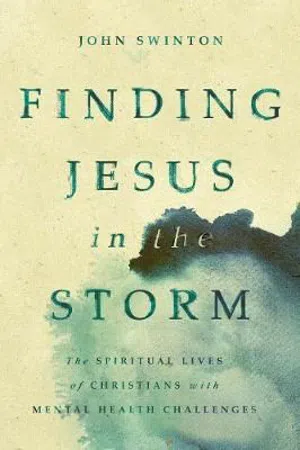
Finding Jesus in the Storm
The Spiritual Lives of Christians with Mental Health Challenges
This book is available to read until 23rd December, 2025
- 320 pages
- English
- ePUB (mobile friendly)
- Available on iOS & Android
eBook - ePub
Available until 23 Dec |Learn more
Finding Jesus in the Storm
The Spiritual Lives of Christians with Mental Health Challenges
About this book
By listening carefully to the lived experiences of people with severe mental health problems, Finding Jesus in the Storm will open up new understandings and perspectives that challenge current assumptions and draws out fresh perspectives for care, healing, recovery and community.
Frequently asked questions
Yes, you can cancel anytime from the Subscription tab in your account settings on the Perlego website. Your subscription will stay active until the end of your current billing period. Learn how to cancel your subscription.
No, books cannot be downloaded as external files, such as PDFs, for use outside of Perlego. However, you can download books within the Perlego app for offline reading on mobile or tablet. Learn more here.
Perlego offers two plans: Essential and Complete
- Essential is ideal for learners and professionals who enjoy exploring a wide range of subjects. Access the Essential Library with 800,000+ trusted titles and best-sellers across business, personal growth, and the humanities. Includes unlimited reading time and Standard Read Aloud voice.
- Complete: Perfect for advanced learners and researchers needing full, unrestricted access. Unlock 1.4M+ books across hundreds of subjects, including academic and specialized titles. The Complete Plan also includes advanced features like Premium Read Aloud and Research Assistant.
We are an online textbook subscription service, where you can get access to an entire online library for less than the price of a single book per month. With over 1 million books across 1000+ topics, we’ve got you covered! Learn more here.
Look out for the read-aloud symbol on your next book to see if you can listen to it. The read-aloud tool reads text aloud for you, highlighting the text as it is being read. You can pause it, speed it up and slow it down. Learn more here.
Yes! You can use the Perlego app on both iOS or Android devices to read anytime, anywhere — even offline. Perfect for commutes or when you’re on the go.
Please note we cannot support devices running on iOS 13 and Android 7 or earlier. Learn more about using the app.
Please note we cannot support devices running on iOS 13 and Android 7 or earlier. Learn more about using the app.
Yes, you can access Finding Jesus in the Storm by John Swinton in PDF and/or ePUB format, as well as other popular books in Theology & Religion & Christian Ministry. We have over one million books available in our catalogue for you to explore.
Information
PART I
THE ART OF DESCRIPTION
1
REDESCRIBING THE WORLD OF “MENTAL ILLNESS”
Description, Explanation, and the Problem with the DSM
I deliberately use the phrase “living under the description of manic depression (or bipolar disorder)” to refer to people who have received this medical diagnosis. The phrase is meant to reflect the social fact that they have been given a diagnosis. At the same time, it calls attention to another social fact: the diagnosis is only one description of a person among many.
—Emily Martin1
THE FIELD OF MENTAL HEALTH IS HIGHLY CONTESTED. PEOPLE HAVE DESCRIBED, categorized, and responded to unconventional mental health experiences in a multitude of ways and have elicited a wide range of responses. At any given historical or cultural moment, particular descriptions of the experience and explanations for its occurrence—that it is caused by demons, the subconscious, chemical imbalances, genetics, neurology—become elevated to the status of the “standard account.” This account is assumed to provide the interpretative framework used by a majority of people to explain unconventional thoughts, experiences, and actions. Each generation thinks that its descriptions should be the “standard accounts,” and each generation assumes that its descriptions are more accurate than previous descriptions. The current emphasis within Western cultures on describing mental health challenges in biological terms is relatively new but nonetheless powerful. Genes, neurology, and chemical imbalances all can easily serve as conversation-closing explanations for mental health challenges. Yet, while biology is an important factor, it is not the only one. Running alongside this account are other important ways of describing such challenges, even if people do not necessarily give them the same social or scientific weight as the standard account. People still believe in demons, psychoanalysis, behaviorism, and many other descriptions. This book gives voice to some of these other forms of describing and understanding what is going on in people’s lives.
But first, we must ask: What does it mean to describe something?
THE PRACTICE OF DESCRIPTION
In the epigraph to this chapter, the anthropologist Emily Martin refers to people living with bipolar disorder as living under a description, meaning that the diagnostic description “bipolar disorder” is only one way to describe an individual. “Bipolar disorder” is a powerful clinical description, one with a profound impact on a person’s life not only in how the person’s experiences are described and explained but also in how the person is perceived in the light of the professional and social interpretations of that particular diagnosis. Martin, however, reminds us that the clinical description “bipolar disorder,” important as it may be, is only one description among many that apply to the life of any given person. Human beings do not live according to a single description. We live under multiple descriptions, some of them accurate, some of them not, but all of them significant in their potential to affect our identity (who we are, who we think we are, who others think we are), our perception (how we and others perceive ourselves), and our actions in relation to others and toward ourselves.
The conflict over terms occurs because culture, medicine, religion, personality, and the zeitgeist all shape and form particular descriptions and explanations of mental health phenomena and then offer ways of naming, controlling, and responding to people’s experiences. Of course, more than one description can apply to any given experience. It is quite possible, for example, to argue that factors in mental health challenges are biological and cultural and spiritual—all at the same time. Nevertheless, we give certain descriptions more social and clinical power than others. At least part of the theological task of this book is to peel away those descriptions that are false, distracting, unfaithful, and damaging and replace them with ones that more accurately capture the nuances of people’s experience.
Descriptions are thus identity forming, action oriented, and action determining. To repeat, the ways in which we describe the world determine what we think we see. What we think we see determines how we respond to what we see. How we respond determines the faithfulness of our actions. Descriptions matter because descriptions change things.
In her work on the nature of intention, the philosopher Elizabeth Anscombe highlights the way in which description (the way we describe something) and intentionality (our ability to act deliberately toward something in the light of that description) are deeply interwoven. In Anscombe’s view, intentional actions, that is, actions that are about something as opposed to, for example, unintentional reflexes, are inevitably and irreducibly “actions under a description.”2 Descriptions define and confine the possible options open to us for comprehending and responding to any given situation. As Ian Hacking has put it: “All our acts are under descriptions, and the acts that are open to us depend, in a purely formal way, on the descriptions available to us.”3 Without a description there can be no intentional action. There is thus a dynamic interaction between describing something and the impact the description has on our responses to the things described. To suggest that descriptions shape our practices is not to suggest that the structure of the world is physically determined by our descriptions of it. Our descriptions do not have ontological power—meaning that things in the world do not actually come into existence because we describe them in particular ways. The universe will remain the universe regardless of my description of it. Nevertheless, my perception of and response to the universe are, to a greater or lesser extent, determined by how I choose to describe it.
Descriptions may not have ontological impact, but they do have epistemological power—meaning they shape and form the ways in which we come to know and respond to things in the world. This epistemological power of description is inseparably bound to practice: “Descriptions are embedded in our practices and lives. But if a description is not there, then intentional actions under that description cannot be there either…. What is curious about human action is that by and large what I am deliberately doing depends on the possibilities of description…. Hence if new modes of description come into being, new possibilities for action come into being as a consequence.”4 Much of the world around us exists for most of the time as nothing other than unnoticed background noise. Like the invisibility of water to the swimming fish, a good deal of our life in the world is lived unintentionally; it just hums along under the hood. When we bring certain things to the fore and choose to describe them, we bring them to attention. The nature of our descriptions determines the kind of attention we pay to those things. Once these things are described, we can act intentionally toward them. The same phenomenon can be described in many ways, and each description brings with it new sets of possibilities for intentional action. Different descriptions provide different modes of awareness, levels of intentionality, and possibilities for different forms of meaningful action.
THE PROBLEM OF THIN DESCRIPTIONS
There are different kinds of descriptions, depending on the angle from which one looks at a phenomenon, but there are also different types of descriptions. In his book The Interpretation of Cultures, the anthropologist Clifford Geertz presents us with the idea of thick and thin descriptions.5 A thin description provides us with the minimum amount of information necessary to describe a situation or context. A survey, for example, provides a thin account of a phenomenon insofar as it captures only certain statistical aspects and provides no contextual, relational, experiential, or cultural information. Statistics also provide thin descriptions. So, for example, we might note that one in four people will experience mental health challenges over a lifetime. This emphasizes at a general level the fact that mental health challenges are a significant issue in the population. However, this statistic tells us very little about the particularities of either the one or the four. Thin descriptions provide us with high-level insights but no low-level details. Another example might be Google Translate, a web-based program that translates typed words into a different language. Through this process, you do get a rough understanding of what words mean in other languages, but that understanding is extremely limited and can even be quite badly skewed. It is an understanding of language stripped of culture, experience, history, or linguistic subtleties and idioms. It is too thin to provide more than a very basic level of insight into the language.
As we enter the world of mental health, it will quickly become clear that thin descriptions abound, both within public conceptions of people’s experiences and within the mental health professions. In what follows, I examine four key areas where thin descriptions have become particularly problematic:
1 Stigma
2 The DSM diagnostic system
3 The turn to biology
4 The field of spirituality in mental health care
STIGMA AS THIN DESCRIPTION
We find a particularly powerful and devastating example of a thin description and its dangers in the phenomenon of stigma. Stigma is one of the most destructive aspects of living with unconventional mental health experiences and one of the most painful experiences that people have to endure. Stigma occurs when a person is reduced from being a whole to being a mere part; from being a full human being to being the sum of a single part. The sociologist Erving Goffman informs us that the concept of stigma originated in the Greek slave trade. After a slave was purchased, the slave was branded and, in branding, was reduced (or thinned down) to the size of the brand. The slave was no longer described as a person, a citizen, a friend, or a family member but was now simply property. Stigma functions in the area of mental health in a very similar way. Stigma reduces people living with unconventional mental health problems to the shape and form of their diagnosis, or more accurately, to people’s perceptions and caricatures of the implications of their diagnosis. In this way, stigma thins down or reduces people’s descriptions to impersonal caricatures based on the connotations of their diagnoses. People cease to be perceived as persons and become “schizophrenics,” “depressives,” “neurotics,” or any other thin diagnostic facade that people choose to project when they don’t want to engage with real individuals.
A Spoiled Identity
Goffman describes stigma as a phenomenon that occurs when an individual with an attribute deeply discredited by his or he...
Table of contents
- Cover
- Title
- Copyright
- Dedication
- Contents
- Acknowledgments
- Introduction: Life in all its Fullness
- Part I: The Art of Description
- Part II: Redescribing Diagnosis
- Part III: Redescribing Depression
- Part IV: Hearing Voices
- Part V: Redescribing Bipolar Disorder
- Appendix: Mental Health Resources
- Bibliography
- Index