This innovative work of historical sociology locates the origins of modern democratic discourse in the emergent culture of printing in early modern England. For David Zaret, the key to the rise of a democratic public sphere was the impact of this culture of printing on the secrecy and privilege that shrouded political decisions in seventeenth-century England. Zaret explores the unanticipated liberating effects of printing and printed communication in transforming the world of political secrecy into a culture of open discourse and eventually a politics of public opinion.
Contrary to those who locate the origins of the public sphere in the philosophical tracts of the French Enlightenment, Zaret claims that it originated as a practical accomplishment, propelled by economic and technical aspects of printing--in particular heightened commercialism and increased capacity to produce texts. Zaret writes that this accomplishment gained impetus when competing elites--Royalists and Parliamentarians, Presbyterians and Independents--used printed material to reach the masses, whose leaders in turn invoked the authority of public opinion to lobby those elites.
Zaret further shows how the earlier traditions of communication in England, from ballads and broadsides to inn and alehouse conversation, merged with the new culture of print to upset prevailing norms of secrecy and privilege. He points as well to the paradox for today's critics, who attribute the impoverishment of the public sphere to the very technological and economic forces that brought about the means of democratic discourse in the first place.
eBook - ePub
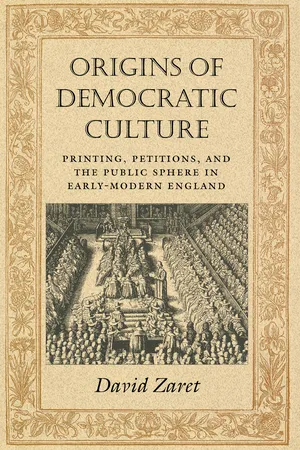
Origins of Democratic Culture
Printing, Petitions, and the Public Sphere in Early-Modern England
- English
- ePUB (mobile friendly)
- Available on iOS & Android
eBook - ePub
Origins of Democratic Culture
Printing, Petitions, and the Public Sphere in Early-Modern England
About this book
Information
CHAPTER ONE
Introduction
PUBLIC OPINION is a central yet elusive aspect of democracy that several generations of scholars have explored as they pursued different questions about the cultural moorings of democratic governance. Three decades ago, when research on democracy examined prospects for new nations carved from colonies in Africa and Latin America, a key issue was the relationship between democracy’s institutional arrangements and supportive cultural developments in the rise of “civic culture,” “psychological modernity,” and “value generalization.”1 Globalization and the demise of state socialism have renewed scholarly interest in these issues, although different concepts guide current research on democracy’s communicative foundations. One line of work revives the eighteenth-century idea of civil society2–a societal community whose axial principle of solidarity demarcates it from political and economic realms based on power and money. Studies of civil society emphasize the centrality of public opinion in politics because opinion is held to be the principal link between the democratic state and civil society. So does research on the public sphere,3 whose current status and future prospects are topics of lively, cross-disciplinary debates among social scientists and philosophers.
Although widespread agreement exists over the importance of public opinion for democratic governance, our understanding of its origins as a factor in politics is shrouded in confusion and controversy. In chapter 2 I survey widespread disagreement over every conceivable aspect of the early public sphere: the date of its appearance, the social background of its participants, and the extent to which exclusionary practices contradicted universalistic ideals of inclusion and open debate. Divergent ideological commitments are one source of disagreement over these issues. Radical critics of liberal democracy trace the origins of the public sphere to imperatives of capitalist development. Proponents of liberal democracy are more likely to cite structural differentiation and Protestant religion, while feminists point to patriarchal assumptions among capitalist men. These accounts of origins are not infrequently a foil for politically charged claims on the current and future prospects of the public sphere.
Another source of disagreement is methodological in nature. Writings by philosophers and social scientists on the public sphere highlight the intellectual tendencies of the hedgehog, who, unlike the fox that knows many things, seeks answers in discovering one big secret. The hedgehog’s predilection for overly broad generalization appears in scholarly accounts whose big secret is that the early public sphere was an accretion of the bourgeoisie, capitalism, the Enlightenment, patriarchy, Protestantism, modernity, or some other grand category. Hedgehog approaches underwrite disagreement, already sufficiently fueled by ideology, because they promote an excessively speculative mode of analysis. Its practitioners, in undergraduate parlance, follow a “laid-back” version of the sociology of knowledge that cites affinities or parallels between epochal events, categories, or trends (e.g., capitalism, Protestantism, differentiation) and any of the many attributes of the concept of a public sphere—between, for example, economic competition and a marketplace of ideas or the sanctity of conscience and free speech. Though communicative issues—for example, modes of textual reproduction, rhetorical conventions, distribution and reception—are central to any concept of the public sphere, little empirical work on these issues guides research on the early public sphere. And when the public sphere is analyzed in isolation from these communicative issues, it becomes an extremely elastic concept, and our knowledge of its origins flows more from speculation on the relevance of epochal trends and events than from empirical study of what, after all, is the ultimate dependent variable in this line of inquiry.
Yet empirical referents exist for the concept of a public sphere and its history. They appear when inquiry into the communicative origins of democracy descends from the higher regions of culture and ceases to explore writings by Locke, Smith, Rousseau, Kant, and other luminaries of the Enlightenment as indicators of communicative practices that constitute the modern public sphere. If we want empirical evidence on the early public sphere, we must attend to communicative practices by a larger group of speakers, writers, printers, petitioners, publishers, and readers. We must study how individuals talked, argued, sang, wrote, read, and petitioned about public issues, and how this changed, not only in salons and universities, but in alehouses, shops, and churchyards. For this, the way has been cleared by historians who in recent years have explored many communicative issues pertaining to media, rhetoric, and reception.4 These issues have been pursued in historical studies of printing, news, and politics in early-modern France and colonial America,5 as well as in England.6 References to media, rhetoric, and reception routinely appear in sociological studies of the modern public sphere,7 but in accounts of the early public sphere they vanish behind interpretations of formal writings by Enlightenment philosophers and Protestant theologians. Use of these sources unites an otherwise heterogeneous collection of studies that is riddled with disagreement over key issues pertaining to the development of a public space in which appeals to opinion become central to politics.8 These disagreements are inevitable principally because relying on texts from the summit of high culture as evidence for studying the birth of public opinion is like looking the wrong way through a telescope—the withering criticism advanced long ago by Peter Laslett against novels as a source of data for social history. The indirect path, reading philosophers and theologians, might be justified if no better sources existed for political communication among ordinary persons in the past. Yet such evidence exists, more or less abundantly, for many different types of political communication.
Far more is concealed than revealed by studies of the early public sphere that overlook direct evidence on political communication and, instead, rely on philosophical and theological texts. In chapter 2 we shall see that this has led many scholars to associate the early public sphere with elite, eighteenth-century developments, most notably the rise of bourgeois society, leavened by the Enlightenment as the prototype for open, critical debate on public issues in civil society.9 But the “invention” of public opinion as a political force occurred well before the Enlightenment, in a more popular social milieu, a consequence not of theoretical principles but of practical developments that flowed from the impact of printing on traditional forms of political communication.10 The rationality and normative authority of public opinion appeared in English politics, unevenly to be sure, long before they were celebrated in writings by Enlightenment philosophers. During the English Revolution (1640–60) these practical developments led to precisely those democratic tenets—for example, the importance of consent, open debate, and reason for the authority of opinion in politics—that current scholarship describes as intellectual discoveries of the Enlightenment. Hence, empirical knowledge of the origins of our democratic culture will not be advanced by interpretations of philosophic or theological texts in order to establish the Enlightenment or Protestant religion as a prototype of the democratic public sphere.
When developed empirically, research on the origins of the public sphere confronts the following questions. When and why did political communication cease to be governed by norms of secrecy and privilege? How did invocation of public opinion become a central feature of political discourse? In pursuing these questions, my goal is not simply to attack hedgehogs. The point is not to discredit theoretical reflection on the origins of democratic culture, but to sharpen it, to bring it into closer proximity to contemporary historical scholarship. Toward this end, English history is “the model case” for studying developments in political communication that eventuate in the birth of the public sphere.11 The shift from norms of secrecy to appeals to public opinion at the level of communicative practice in mid-seventeenth-century England occurred before comparable democratic initiatives in other Western societies.12 Moreover, these practical innovations provided precedents for democratic ideas in Leveller writings and, later, in writings by Locke and others toward the end of the century.13 Subsequently, these developments exercised great influence over reflection on politics in the French Enlightenment. Yet French philosophes warily regarded the English model of public opinion—unruly, relatively unconstrained by courtly manners—and preferred tamer, deferential discourse than that which flourished in a marketplace of ideas.14 Here, then, is yet another reason for not using formal writings from the French Enlightenment as a source for exploring the origins of the public sphere.
For the case of England, the turn from theology and philosophy to communicative practice leads to the following point of departure for a new account of the birth of the public sphere. At the beginning of the seventeenth century, English politics afforded little place for public opinion. Political communication existed but was severely restricted by norms of secrecy and privilege, confined mostly to discussion among local and national elites. In Parliament, a customary right of free speech in the fifteenth century had evolved into a formal privilege under the Tudors. But disclosure of parliamentary debates was a crime. Popular participation in political discourse was limited to the receiving end of symbolic displays of authority. Though conflict was endemic to politics, and followed fissures between and within national and local communities, no “opposition,” no parties, and no public space existed in which political factions competed in an open exchange of ideas. Yet by the end of the century, a privileged place for public opinion appears in liberal-democratic conceptions of political order, advanced by John Locke (1632–1704) and other Whig writers, such as Anthony Ashley Cooper, the earl of Shaftesbury (1621–83) and Algernon Sidney (1622–83). In examining the transition from communicative norms of secrecy and privilege to public opinion in English politics, we confront the practical origins of democratic culture: real-world communicative developments that made it possible for Locke and subsequent philosophers to uphold democratic conceptions of political order that presuppose the existence, rationality, and normative authority of public opinion.
At the core of democracy’s formal philosophies and institutional arrangements lies the elusive idea of public opinion. Assuring the authority of opinion and limiting its volatile excess are principal goals of democracy’s institutional arrangements, such the franchise and constitutional ground rules. Democratic governance is often associated with these visible arrangements, so much so that their development is often treated as coterminous with the history of democracy. Yet they are not the essence of the matter, for they presuppose the existence of free and open debate, a public sphere where political discourse derives from rival appeals to public opinion.15 Public opinion in modern democracy is a specific type of vox populi, one that arises out of a “marketplace of ideas,” whose authority for ultimately setting the political agenda derives from specific suppositions about the importance of consent, open debate, and rationality. That public opinion is in principle the prime mover of democratic politics is a commonplace observation. Yet unlike democracy’s institutional arrangements and constitutional rules, public opinion defies easy description and explanation.
Like the commodity famously described by Marx as abounding in metaphysical subtlety, public opinion is a complex thing. This complexity reflects the dual nature of public opinion as a real and nominal entity. Nominally it is a discursive fiction; qua public opinion it collectively exists only when instantiated in discourse, when invoked by a politician, pollster, journalist, or social scientist in support of a contention about what the public thinks or desires. At the same time, real individuals participate in political discourse, as readers, speakers, hearers, and writers. This underlies the paradox, noted fifty years ago by Herbert Blumer, that public opinion research led to many technical improvements in methods but did little to dispel uncertainly and confusion over what public opinion is. The same situation exists today, according to Noelle-Neumann.16 Compounding this complexity is the potential of the discursive fiction—public opinion invoked as a collective entity—to influence the opinion of individuals. One way to handle this complexity is an old convention in public opinion research: simplify matters with an operational definition that equates public opinion and the aggregation of individual opinions on public issues.17
Yet there is little novelty in the fact that today’s opinion polls are inscription devices that transform individual opinions into their nominal counterpart and, in the process and after, often alter the former.18 So were monster petition campaigns in the seventeenth century. Petitions and public opinion polls mediate between the real and nominal sides of public opinion.19 Public opinion has always had close links to political propaganda, and its expression was never indep...
Table of contents
- Cover Page
- Title Page
- Copyright Page
- Dedication Page
- List of Illustrations
- Acknowledgments
- Abbreviations
- Chapter One: Introduction
- Chapter Two: Theory and History
- Chapter Three: Secrecy and Privilege
- Chapter Four: Traditional Communicative Practice
- Chapter Five: News
- Chapter Six: Printing and the Culture of Print
- Chapter Seven: Printing and Politics in the 1640s
- Chapter Eight: Petitions
- Chapter Nine: Epilogue
- Index
Trusted by 375,005 students
Access to over 1.5 million titles for a fair monthly price.
Study more efficiently using our study tools.
Frequently asked questions
Yes, you can cancel anytime from the Subscription tab in your account settings on the Perlego website. Your subscription will stay active until the end of your current billing period. Learn how to cancel your subscription
No, books cannot be downloaded as external files, such as PDFs, for use outside of Perlego. However, you can download books within the Perlego app for offline reading on mobile or tablet. Learn how to download books offline
Perlego offers two plans: Essential and Complete
- Essential is ideal for learners and professionals who enjoy exploring a wide range of subjects. Access the Essential Library with 800,000+ trusted titles and best-sellers across business, personal growth, and the humanities. Includes unlimited reading time and Standard Read Aloud voice.
- Complete: Perfect for advanced learners and researchers needing full, unrestricted access. Unlock 1.5M+ books across hundreds of subjects, including academic and specialized titles. The Complete Plan also includes advanced features like Premium Read Aloud and Research Assistant.
We are an online textbook subscription service, where you can get access to an entire online library for less than the price of a single book per month. With over 1.5 million books across 990+ topics, we’ve got you covered! Learn about our mission
Look out for the read-aloud symbol on your next book to see if you can listen to it. The read-aloud tool reads text aloud for you, highlighting the text as it is being read. You can pause it, speed it up and slow it down. Learn more about Read Aloud
Yes! You can use the Perlego app on both iOS and Android devices to read anytime, anywhere — even offline. Perfect for commutes or when you’re on the go.
Please note we cannot support devices running on iOS 13 and Android 7 or earlier. Learn more about using the app
Please note we cannot support devices running on iOS 13 and Android 7 or earlier. Learn more about using the app
Yes, you can access Origins of Democratic Culture by David Zaret in PDF and/or ePUB format, as well as other popular books in History & British History. We have over 1.5 million books available in our catalogue for you to explore.