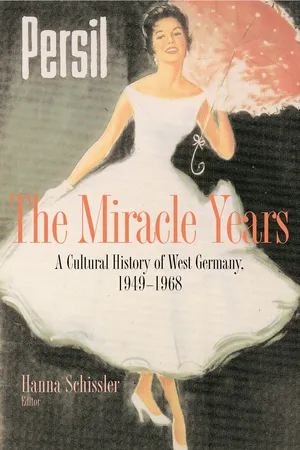
Stereotypical descriptions showcase West Germany as an "economic miracle" or cast it in the narrow terms of Cold War politics. Such depictions neglect how material hardship preceded success and how a fascist past and communist sibling complicated the country's image as a bastion of democracy. Even more disappointing, they brush over a rich and variegated cultural history. That history is told here by leading scholars of German history, literature, and film in what is destined to become the volume on postwar West German culture and society.
In it, we read about the lives of real people--from German children fathered by black Occupation soldiers to communist activists, from surviving Jews to Turkish "guest" workers, from young hoodlums to middle-class mothers. We learn how they experienced and represented the institutions and social forces that shaped their lives and defined the wider culture. We see how two generations of West Germans came to terms not only with war guilt, division from East Germany, and the Angst of nuclear threat, but also with changing gender relations, the Americanization of popular culture, and the rise of conspicuous consumption. Individually, these essays peer into fascinating, overlooked corners of German life. Together, they tell what it really meant to live in West Germany in the 1950s and 1960s.
In addition to the editor, the contributors are Volker R. Berghahn, Frank Biess, Heide Fehrenbach, Michael Geyer, Elizabeth Heineman, Ulrich Herbert, Maria Höhn, Karin Hunn, Kaspar Maase, Richard McCormick, Robert G. Moeller, Lutz Niethammer, Uta G. Poiger, Diethelm Prowe, Frank Stern, Arnold Sywottek, Frank Trommler, Eric D. Weitz, Juliane Wetzel, and Dorothee Wierling.
- English
- ePUB (mobile friendly)
- Available on iOS & Android
eBook - ePub
About this book
Information
Publisher
Princeton University PressYear
2020Print ISBN
9780691058207
9780691058191
eBook ISBN
9780691222554
PART ONE
The Weight of the Past, New Beginnings, and the Construction of National Memory
Introduction
THIS SECTION ADDRESSES the impact of war and destruction on Germans’ concrete life worlds as well as their projections for the future.
Elizabeth Heineman depicts how the experiences of women at the end of the Second World War and in the postwar period were universalized and constructed into the national imagery of the new West Germany. The mass rape of German women in the East by Soviet troops was turned into a powerful image of German victimhood and served to distract attention from the multiple victims of German occupation, including those who had suffered mass extermination. The “rape” of Germany by the Allied forces became a common metaphor in postwar politics, even though a veil of silence, especially in the East, descended upon women’s real experiences of violation. At the same time, the “woman of the rubble” became a national icon, a symbol of devotion to reconstruction and, with their passing, a symbol of Germany’s rising like a “phoenix from the ashes.” But the real women who had cleaned the debris faced various kinds of discrimination within the new West German state. Heineman addresses yet a third range of women’s experiences that were used as political significations: women who engaged in relations with members of the occupation forces were charged with stabbing the German people in the back. By locating “moral decay” in the actions of postwar women, leading members of German society also deflected attention from the very real crimes of the Third Reich. In commenting upon the “women historians’ debate,” Heineman carries her investigation of the appropriation of women’s postwar experiences into the 1980s.
The new West German state faced multiple problems of integration, not the least of which was how returning POWs were to be woven into the fabric of West German society and politics. Frank Biess focuses on the reconstruction of masculinity by exploring the ways in which West German society dealt with returning POWs from the Soviet Union. He shows how POWs’ camp experiences were equated with those of Jewish victims of Nazi persecution and extermination. The POWs became “victims of totalitarianism.” This move blurred differences among the POWs, particularly those between ordinary soldiers and former SS men. By turning them all into victims, who then qualified for the special amnesty for late returners, they were saved from denazification procedures and enabled to make restitution claims. “Victims of totalitarianism” were transformed to “survivors of totalitarianism,” whose supposed Christian and “timeless German” values had empowered them to resist the dehumanizing experiences of the camps. According to prevailing sentiment, they came back to become breadwinner fathers and husbands, not soldiers. This represents departure from previous ideals of masculinity and, ultimately, a far more successful mode of integration than that pursued by the Weimar Republic after World War I.
Elizabeth Heineman portrays the universalization of women’s experiences for West Germans’ self-definition in the 1950s, and Frank Biess elaborates on the multiple uses of POWs from the Soviet Union for the (re-)constructing of West German masculinity and citizenship. Robert G. Moeller shows how West Germany anchored its sense of achievement in the ways in which it dealt with the victims of war and destruction—the German victims. Moeller starts with Adorno’s critique of Germans’ failure to “come to terms” with the Nazi past and shows that remembering selectively is not equivalent to forgetting. In fact, Germans remembered a great deal: they remembered the war crimes committed on the Eastern front—that is, the crimes committed against Germans. These memories played a pivotal role in West Germans’ self-definition. Implicitly as well as explicitly, the fate of expellees and POWs in Soviet captivity was weighed against—indeed, made equivalent to—the destiny of Jewish victims of the Holocaust. All sorts of organizations documented in fine detail the expulsion of Germans from East Central Europe. Numerous individuals wrote biographies and memoirs depicting the frightful experiences of the German expellees. The laments of the expellees and their advocates were heard and, accordingly, had a large impact on West German politics. In contrast, the victims of German atrocities and extermination policies were not given a voice during the 1950s. While Jewish victims remained for the most part objects—of reconciliation policies and restitution payments—homosexuals, Jehovah’s witnesses, Sinti and Roma, or foreign laborers who had been forced to work in Germany went completely unacknowledged. Only much later were survivors of the Holocaust and other victims of German occupation granted a hearing by a broader public and by politicians—a development that occupies us right to the present with the question of restitution for foreign laborers and the involvement of renowned domestic as well as foreign banks in hoarding Nazi gold.
Dorothee Wierling shows how the experiences of living through the Third Reich and the Second World War deeply shaped the founding generation of East and West Germany but played out in different ways. The parents of a defeated Germany invested great hopes in their children, who were to carry their parents’ aspirations and their projections for the future. Endowed with a “mission to happiness,” the children were supposed to make up by their sheer existence for their parents’ sufferings during the war. But the life worlds of the children also diverged significantly after 1949, the year in which the Federal Republic and the German Democratic Republic were founded. Wierling describes the similarities and differences through an investigation of the emotional and power relations within the family, especially the roles of women and men within it. She shows how Germans, possessed of a common legacy, were made into East and West Germans, who developed quite different ways of dealing with the challenges of life. While focusing on the 1950s, she carries her analysis to the different meanings of “1968.” In that tumultuous year, young West Germans ventured on a cultural revolution that, among other things, cleared the way to address the past in an unprecedented manner. Young East Germans largely kept silent in the face of the violent repression of the Prague Spring. The contrasting experiences marked the definite parting of the two German societies. When the Berlin Wall opened in 1989, Germans faced the socialization into different life worlds and, for East Germans, the loss of a future that had been advocated for forty years.
CHAPTER ONE
The Hour of the Woman
MEMORIES OF GERMANY’S “CRISIS YEARS’ AND WEST GERMAN NATIONAL IDENTITY
ELIZABETH HEINEMAN
IN A MID-1980S interview, an elderly West Berlin woman recalled a conversation whose contours would have been familiar to many in the Federal Republic.1 As the woman explained, she had once attended a talk in which a young historian had accused her and members of her generation of not having confronted the Nazi past more aggressively, starting right in 1945, at the end of the war.
I asked him, “When were you born?" [He replied,] “1946.” I said, “You know, only someone who didn’t experience those times can utter such nonsense.” I mean, after ‘45 no one thought about confronting the past. Everyone thought about getting something on the stove so they could get their children something to eat, about rebuilding, clearing away the rubble... . But this is what one is told today, and strangely enough it’s all from people who didn’t live through those times.2
By now, the exchange seems commonplace. A member of the younger generation, horrified by what he knows about the Nazi era and suspicious about his elders’ relative quiet on the subject, accuses his seniors of not having seriously confronted their past. The older German resents the younger man’s moralizing tone and his focus on the Nazi years at the expense of the traumatic period immediately following.
The older woman, however, does not simply propose a generational history. In casting her generation’s understanding of the past, she universalizes on the basis of stereotypically female experiences. “Everybody” was trying to get something on the stove to feed their children; “everybody” was clearing away the rubble. These are references to the activities of women, yet they have come to stand for the experience of the entire wartime generation—at least, that portion that had not experienced persecution at the hands of the Nazi regime.
This chapter will explore the universalization, in West German collective memory, of aspects of the stereotypically female experience of Germany at the end of the war and during the immediate postwar years. It will further examine the effects of this universalization on West German national identity and on the status of women in the Federal Republic. In doing so, it will explore the relationship among the “counter memories” of a subordinate group, the “public” and “popular” memories of a dominant culture, national identity, and gender.
Memories of three “moments” in German women’s history of 1943–48 were central to the development of a West German national identity. First were memories of female victimhood during the latter part of the war, which were generalized into stories of German victimhood. Second were images of women’s efforts to rebuild a devastated landscape and people. The “woman of the rubble” (Trümmerfrau), who cleaned away the rubble from Germany’s bombed cities, lay the groundwork for the Federal Republic’s founding myth of the “phoenix rising from the ashes"—a myth that did not inquire too deeply into the origin of the ashes. Finally, there were recollections of female sexual promiscuity. With this history of sexual disorder generalized to describe a much broader moral decay, Germans found the opportunity to view the military occupation—and not the Nazi period—as Germany’s moral nadir.3
These three “moments” told at least three different stories, and as they were transformed in memory, they continued to serve different functions. They did not describe a straightforward, uncomplicated West German national identity. Instead, they functioned within, and helped to shape, varying strands of this emerging identity. The Cold War, the economic miracle, the effort to achieve national and cultural sovereignty from the Western powers (especially the United States), and the need to explain the Federal Republic’s relationship to the Nazi past informed the development of West German national identity in complex and sometimes contradictory ways. Yet memories of women’s experiences from 1943 to 1948 served all these facets of the emerging West German national identity.
Appropriating the female experience for the nation might seem surprising in the aftermath of a highly militarized society such as Nazi Germany. Yet a popular identification with selected aspects of women’s experience is in some respects not surprising. First, it is worth recalling the environment in which most Germans began to think of the Nazi era, and their part in it, retrospectively. These were the “crisis years” of 1943–48, framed by the defeat at Stalingrad (which marked the beginning of Germany’s military collapse) and the currency reform of June 1948 (which symbolized the beginning of the recovery in the Western occupation zones). During this period of prolonged crisis, Germans experienced death, dislocation, hunger, and uncertainty about the future, and women’s role in the community’s survival was unusually visible. In fact, these years came to be known as the “hour of the women.”4 Women’s prominence did not signal the beginning of a new, sexually equitable order.5 It did, however, provide potent images for popular representations of the recent past.
Second, Germany’s total defeat and the discrediting of the ideology for which the war was fought made the largely male military experience problematic. This did not serve to discredit men or their leading role in society; it did not even serve to discredit individual men’s military activities or the military as an institution. Given the prior importance of military imagery in national symbolism, however, it did create a certain representational vacuum.6 New symbols, often drawing from protot...
Table of contents
- Cover Page
- Title Page
- Copyright Page
- Dedication
- Table of Contents
- Preface
- The Miracle Years
- Introduction
- Part One: The Weight of the Past, New Beginnings, and the Construction of National Memory
- Introduction
- Part Two: Stigma: “Others” in the Shaping of West Germany
- Introduction
- Part Three: The Presence of the Absent
- Introduction
- Part Four: The Emergence of Civil Society, Modernity’s Claims And Limits
- Introduction
- Part Five: The Ambiguity of American Influences, Popular Culture and the Breaking of “High Culture’s” Hegemony
- Introduction
- Epilogue
- Selected Readings
- Biographical Note
- Index
Trusted by 375,005 students
Access to over 1.5 million titles for a fair monthly price.
Study more efficiently using our study tools.
Frequently asked questions
Yes, you can cancel anytime from the Subscription tab in your account settings on the Perlego website. Your subscription will stay active until the end of your current billing period. Learn how to cancel your subscription
No, books cannot be downloaded as external files, such as PDFs, for use outside of Perlego. However, you can download books within the Perlego app for offline reading on mobile or tablet. Learn how to download books offline
Perlego offers two plans: Essential and Complete
- Essential is ideal for learners and professionals who enjoy exploring a wide range of subjects. Access the Essential Library with 800,000+ trusted titles and best-sellers across business, personal growth, and the humanities. Includes unlimited reading time and Standard Read Aloud voice.
- Complete: Perfect for advanced learners and researchers needing full, unrestricted access. Unlock 1.5M+ books across hundreds of subjects, including academic and specialized titles. The Complete Plan also includes advanced features like Premium Read Aloud and Research Assistant.
We are an online textbook subscription service, where you can get access to an entire online library for less than the price of a single book per month. With over 1.5 million books across 990+ topics, we’ve got you covered! Learn about our mission
Look out for the read-aloud symbol on your next book to see if you can listen to it. The read-aloud tool reads text aloud for you, highlighting the text as it is being read. You can pause it, speed it up and slow it down. Learn more about Read Aloud
Yes! You can use the Perlego app on both iOS and Android devices to read anytime, anywhere — even offline. Perfect for commutes or when you’re on the go.
Please note we cannot support devices running on iOS 13 and Android 7 or earlier. Learn more about using the app
Please note we cannot support devices running on iOS 13 and Android 7 or earlier. Learn more about using the app
Yes, you can access The Miracle Years by Hanna Schissler in PDF and/or ePUB format, as well as other popular books in History & German History. We have over 1.5 million books available in our catalogue for you to explore.