![]()
THE LAND FOR THE PEOPLE
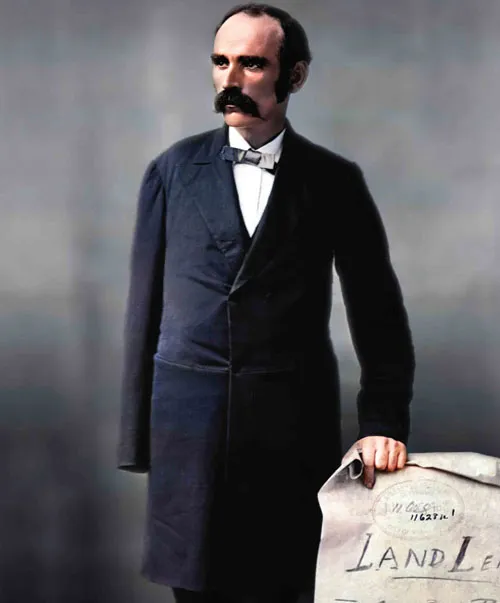
c.1882, New York City
Michael Davitt (1846–1906), was born in Co. Mayo, the second of five children. At the age of 4, Michael and his family were evicted from their home and forced to migrate to Lancashire, England. At the age of 11, while working in a cotton mill, Davitt had his arm so badly maimed in an accident that it had to be amputated. Davitt was the founder of the Irish Land League in 1879. The league organised resistance to absentee landlordism and sought to relieve the poverty of tenant farmers by securing fixity of tenure, fair rent, and free sale of the tenant’s interest.
THE FIRE BRANDS
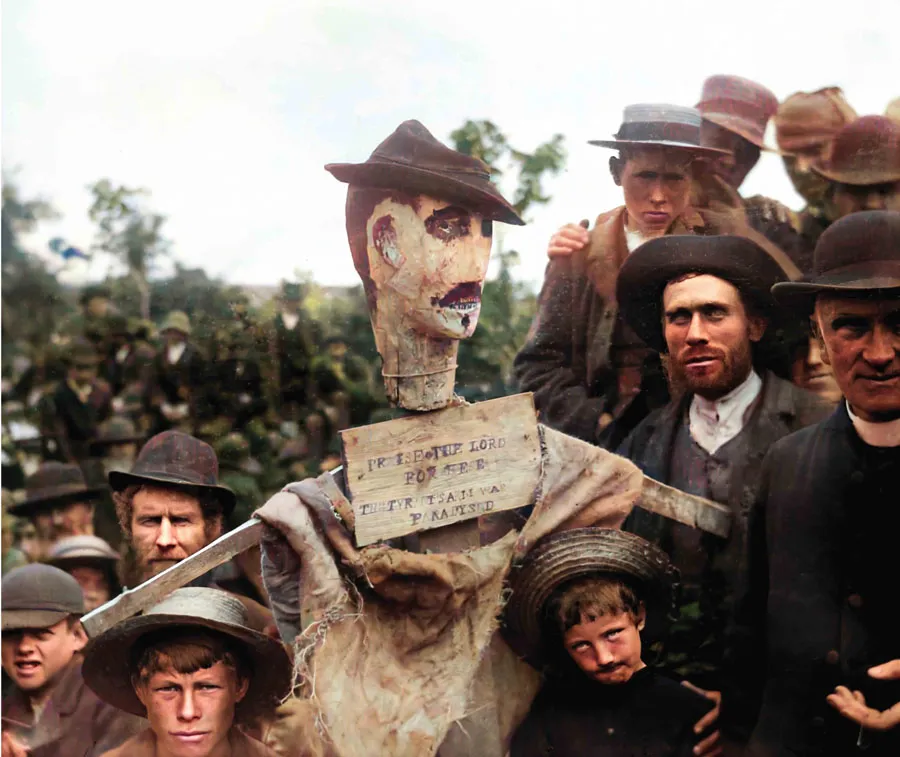
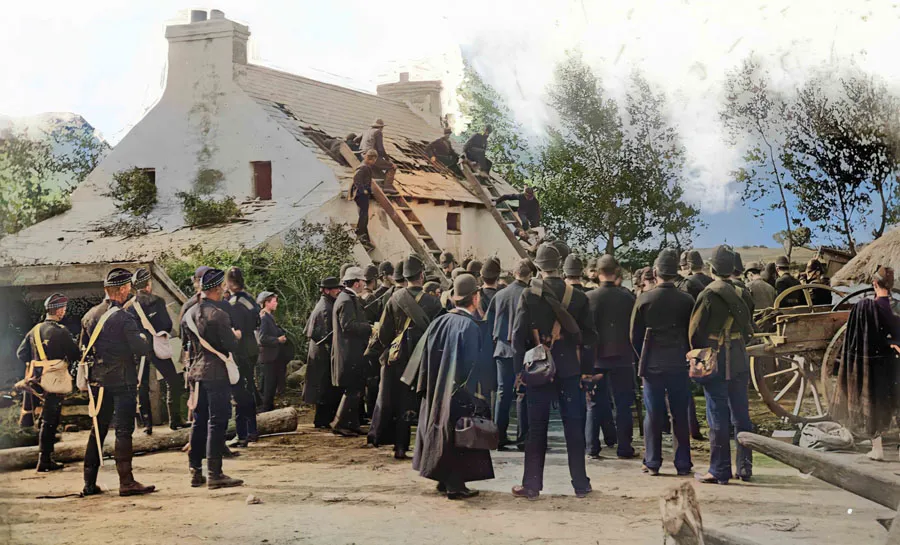
3 June 1887, Bodyke, Co. Clare
This photograph was taken at the Bodyke evictions. Father Murphy, who wrote an account of the evictions, is pictured on the right. This image was taken one day after Mrs MacNamara, a widow, was evicted from her home, one of a number of evictions to take place in the area. Commenting on the background to the picture, the photographer claimed the first sheriff, McMahon, had turned up with a large force several days earlier but had an epileptic fit and the police withdrew. The tenants saw this as divine intervention and made this effigy of him:
PRAISE THE LORD
FOR HERE
THE TYRANT’S ARM WAS
PARALYSED
RESTING
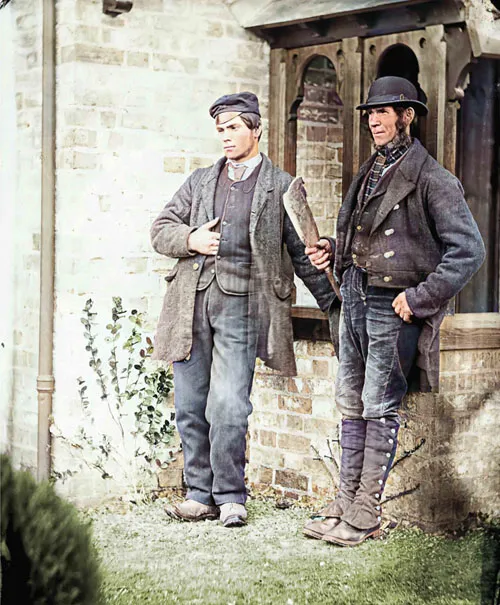
12 February 1870, Clonbrock Estate, Ahascragh, Co. Galway
Two Clonbrock workmen – one with a billhook, a traditional cutting tool used widely in agriculture and forestry for cutting smaller woody material such as shrubs and branches. Lord Clonbrock was listed as a resident proprietor in Co. Galway in 1824, and in the 1870s the Clonbrock estate in Galway amounted to over 28,000 acres.
EVICTION
1 September 1888, Woodford, Co. Galway
An eviction on the land of the Marquis of Clanricarde. Pictured is Francis Tully, known locally as ‘Dr Tully’, an activist for the Plan of Campaign in Galway. The Plan of Campaign was an attempt to gain lower rents through collective bargaining after prices for agricultural exports had fallen dramatically in the 1880s. Maud Gonne agitated for change by projecting images like this one onto a building in Parnell Square, Dublin.
YOU’VE GOT MAIL
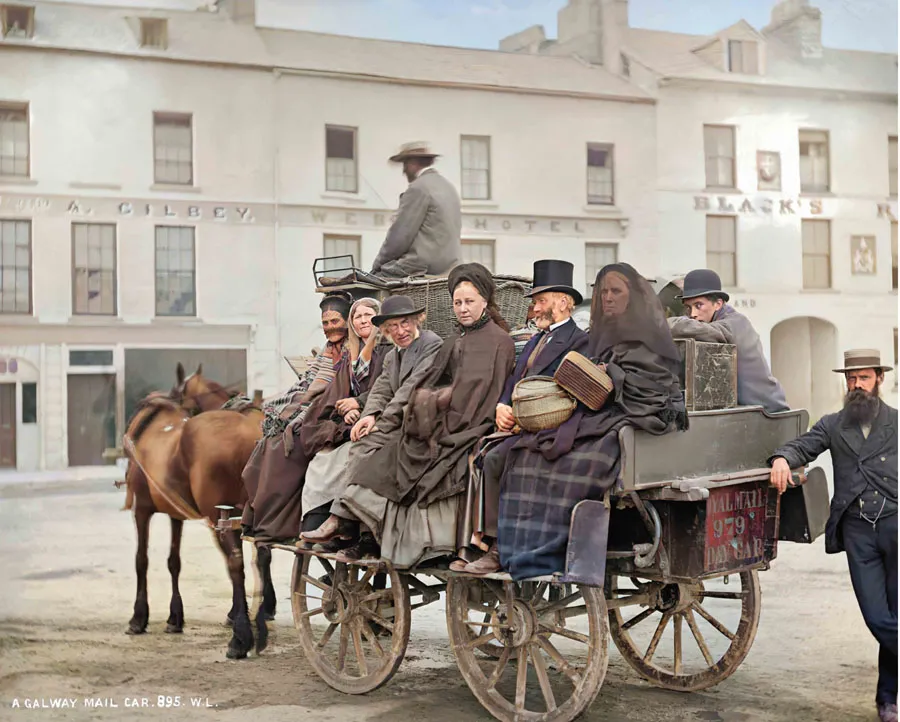
27 August 1886, Eyre Square, Galway City
A Royal Mail 979 Day Car, or a Bianconi mail car, near Webb’s Hotel (now the Imperial Hotel) and Black’s Royal Hotel in Eyre Square. Black’s Royal Hotel was a noted Galway landmark. An advertisement published in 1879 announced that it was ‘established 70 years’, that it was ‘patronised by nobility and gentry’, and that it offered guests ‘Free omnibuses to and from trains and steamers’. Tourism had received a boost with the opening of the railway from Dublin in 1851, but the city of Galway struggled economically, which is reflected in the decline of its population – from 23,744 in 1851 to 13,255 in 1911.
THE BALLAD SINGER
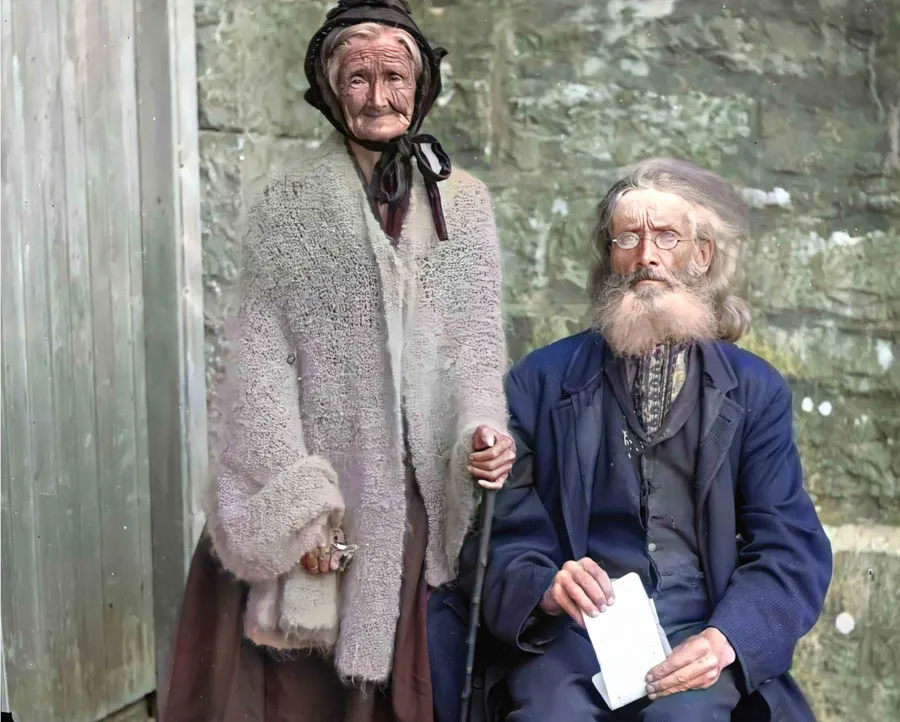
c.1890, Newtown Castle, Ballyvaughan, Co. Clare
A ballad singer pictured here with his mother. The paper the son is holding is a printed verse with the heading ‘Lines on the Scenery round St. Bridget’s Well in County Clare’. Newtown Castle is a sixteenth-century fortified tower house, built originally for a branch of the O’Briens and passing thereafter into the possession of the O’Loghlens.
WEIGHED
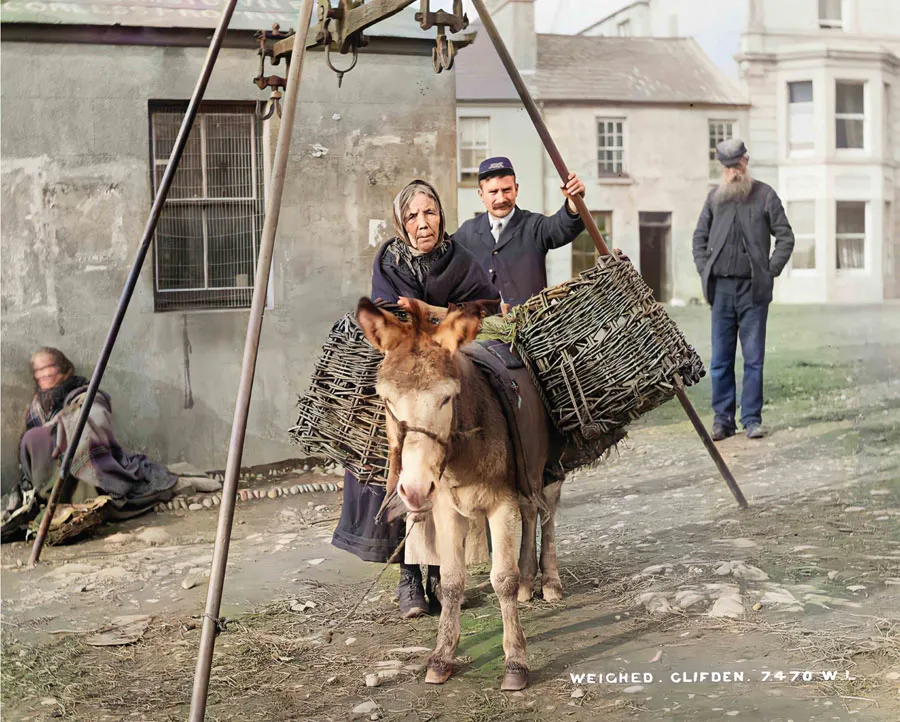
c.1908, Clifden, Co. Galway
A weigh station, where the contents of a woman’s panniers are being calculated. Foyle’s Hotel is in the background, on the right. Foyle’s is Connemara’s longest established hotel, having been owned and managed by the Foyle family for nearly
a century.
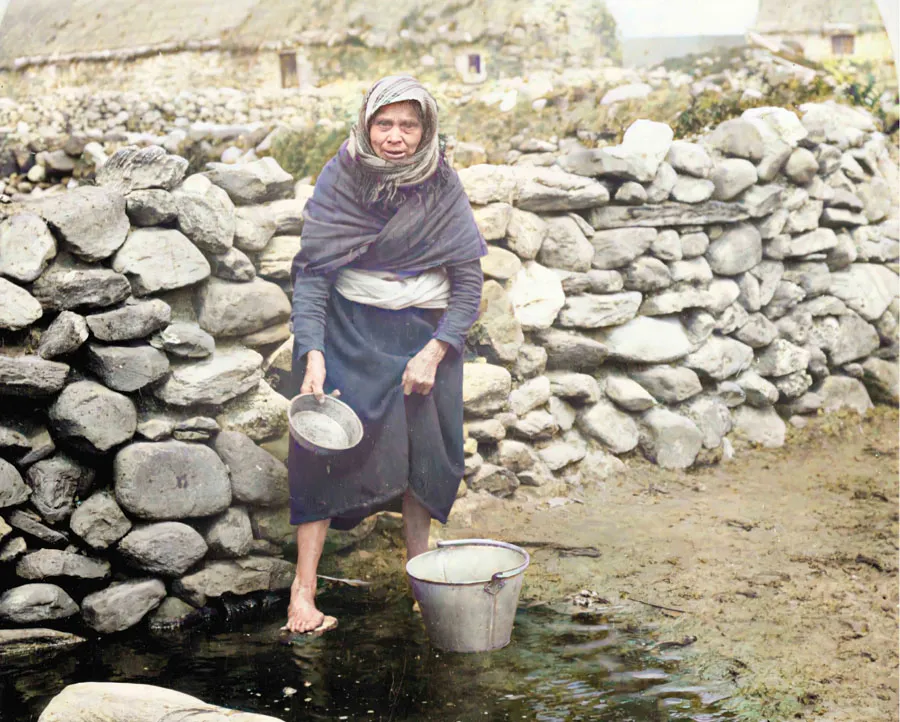
WOMAN FROM KEEL
c.1903, Achill Island, Co. Mayo
The woman is standing with a bucket in front of a stone wall. She is barefoot. Achill Island mostly survived on seasonal migrants in the nineteenth and early twentieth centuries. Conditions were harsh, particularly in the winter months. In the early twentieth century, Achill had a population of approximately 4800–5000 people.
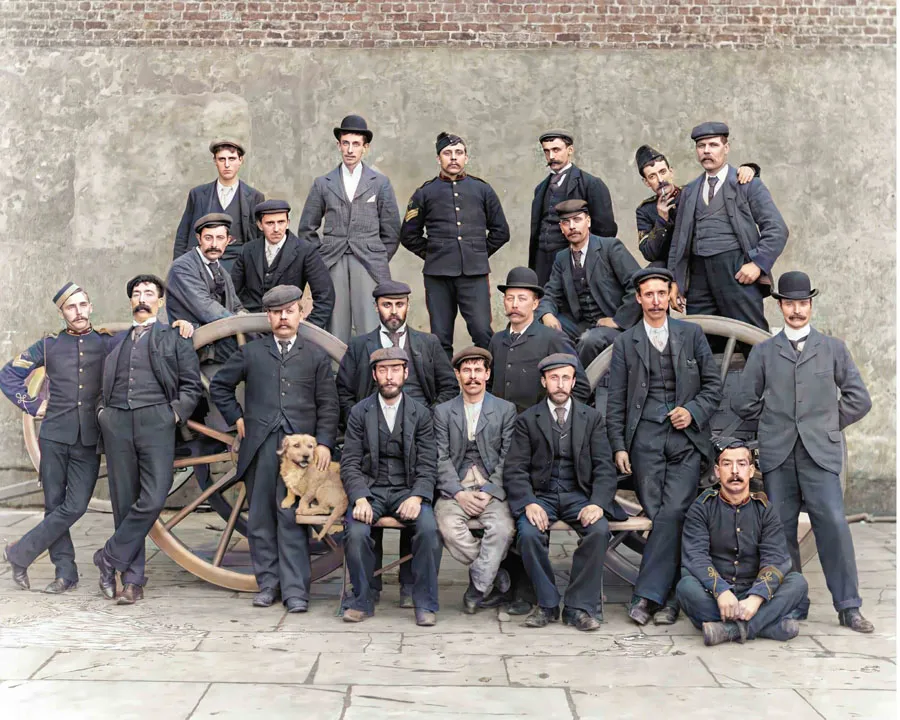
BRIGADE TRADESMEN
3 November 1899, Co. Waterford
This photograph includes three soldiers from the Royal Field Artillery and one from the Army Ordnance Corps, as well as tradesmen and possibly reservists. We consulted British military uniform experts and discovered that the soldiers would have worn dark blue uniforms with red collars and golden yellow on the badges, buttons, trefoil knots, shoulder straps and chevrons.
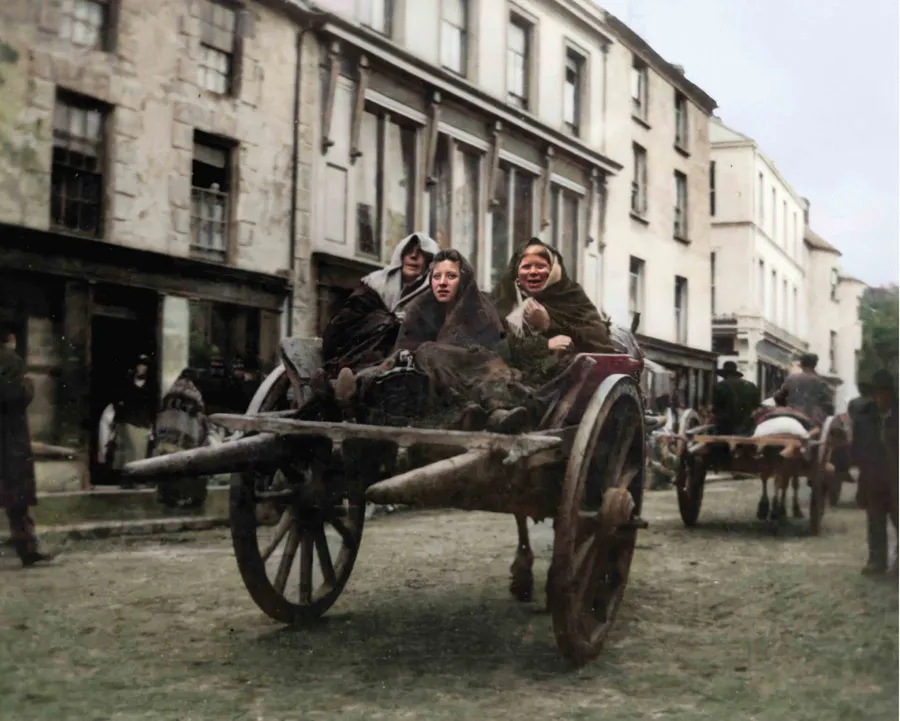
GOING TO A FUNERAL
c.1899, Killarney, Co. Kerry
This image is titled ‘Irish women going to a funeral’ in its original collection. The three women are in a hors...