eBook - ePub
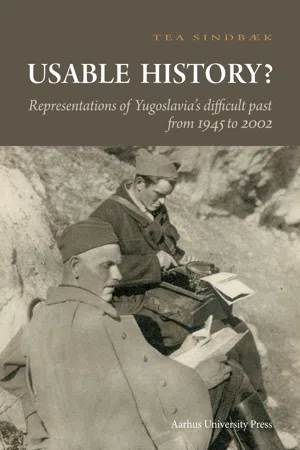
Usable History?
Representations of Yugoslavia's difficult past - from 1945-2002
- 248 pages
- English
- ePUB (mobile friendly)
- Available on iOS & Android
eBook - ePub
Usable History?
Representations of Yugoslavia's difficult past - from 1945-2002
About this book
When Yugoslavia was invaded by Nazi Germany and its allies in April 1941, what followed was as much a Yugoslav civil war as a war of occupation and liberation. Several hundred-thousand Yugoslav civilians were killed by other Yugoslavs in large-scale massacres or concentration camps, and the horrific events left the country ruined and deeply divided. Usable History? examines the way in which the history of Yugoslavia's internal problematic past was presented and used politically and ideologically, and asks how a society can cope with such an "unmasterable" history. How did Yugoslav historians and politicians represent and explain their own history and how did these representations interact with the cultural developments, political demands and societal needs? By investigating political documents, historiography and popular representations of history such as films, songs and literature, the book's author reveals a deeply disturbing narrative of historical (mis)inter-pretation and (mis)use.
Information
Table of contents
- Cover
- Title
- Preface
- Kapitel 1: Introduction Thematization and cardinal theme
- Kapitel 2: The Second World War in Yugoslavia
- Kapitel 3: Establishing an official narrative, 1945-1948
- Kapitel 4: Massacres in memoirs and fiction, 1945-1952
- Kapitel 5: Titoist institutional historiography, 1945-1960
- Kapitel 6: New perspectives on wartime history, 1960-1980
- Kapitel 7: Public commemorations and popular culture, 1960-1980
- Kapitel 8: The breakdown of communist history and the theme of genocide, 1980-1986
- Kapitel 9: Genocide as a cardinal theme, 1984-1989
- Kapitel 10: National conflicts and national historical cultures, 1990-2002
- Conclusion
- Literature
- Copyright
Trusted by 375,005 students
Access to over 1.5 million titles for a fair monthly price.
Study more efficiently using our study tools.
Frequently asked questions
Yes, you can cancel anytime from the Subscription tab in your account settings on the Perlego website. Your subscription will stay active until the end of your current billing period. Learn how to cancel your subscription
No, books cannot be downloaded as external files, such as PDFs, for use outside of Perlego. However, you can download books within the Perlego app for offline reading on mobile or tablet. Learn how to download books offline
Perlego offers two plans: Essential and Complete
- Essential is ideal for learners and professionals who enjoy exploring a wide range of subjects. Access the Essential Library with 800,000+ trusted titles and best-sellers across business, personal growth, and the humanities. Includes unlimited reading time and Standard Read Aloud voice.
- Complete: Perfect for advanced learners and researchers needing full, unrestricted access. Unlock 1.5M+ books across hundreds of subjects, including academic and specialized titles. The Complete Plan also includes advanced features like Premium Read Aloud and Research Assistant.
We are an online textbook subscription service, where you can get access to an entire online library for less than the price of a single book per month. With over 1.5 million books across 990+ topics, we’ve got you covered! Learn about our mission
Look out for the read-aloud symbol on your next book to see if you can listen to it. The read-aloud tool reads text aloud for you, highlighting the text as it is being read. You can pause it, speed it up and slow it down. Learn more about Read Aloud
Yes! You can use the Perlego app on both iOS and Android devices to read anytime, anywhere — even offline. Perfect for commutes or when you’re on the go.
Please note we cannot support devices running on iOS 13 and Android 7 or earlier. Learn more about using the app
Please note we cannot support devices running on iOS 13 and Android 7 or earlier. Learn more about using the app
Yes, you can access Usable History? by Tia Sindbaek,Tea Sindbæk in PDF and/or ePUB format, as well as other popular books in History & Eastern European History. We have over 1.5 million books available in our catalogue for you to explore.