eBook - ePub
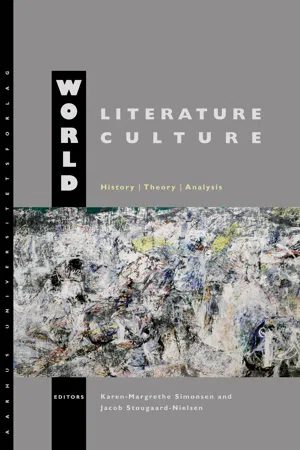
World Literature, World Culture
- 283 pages
- English
- ePUB (mobile friendly)
- Available on iOS & Android
eBook - ePub
World Literature, World Culture
About this book
In a global age where people, goods and cultural products transcend the boundaries of geography and temporality as never before, it is only natural that literary and cultural studies turn their attention to Goethe's nineteenth-century notion of a Weltliteratur. Offering their own Twenty-First Century perspectives - across generations, nationalities and disciplines - the contributors to this anthology explore the idea of world literatue for what it may add of new connections and itineraries to the study of literature and culture today. Covering a vast historical material from witness accounts of the fall of Constantinople to Hari Kunzru's contemporary representations of multicultural London, these essays, by a diverse group of scholars, examine the pioneers of world literature (Juan Andres Morell, Goethe and Hugo Meltzl), and the roles played by translation, migration and literature institutions in the circulation and reception of both national and cosmopolitan literatures. They illustrate how literary analysis can be enriched by attention to the border-crossing itineraries followed by migrants, writers, publishers, translators and texts; thereby yielding new discoveries about writers and artists such as Catullus, Manuel Vicent, Jean-Luc Godard, Dubravka Ugresic, Derek Walcott, Cabral do Nascimento, Thomas Pynchon, Asger Jorn and Louis Paul Boon.
Information
CANONIZATION AND WORLD LITERATURE: THE NOBEL EXPERIENCE
Horace Engdahl, Permanent Secretary of the Swedish Academy
Is the writing of Nobel Prize winners different from that of other good writers? Sound scepticism answers: no, why should it be? In what way would a book be altered because its author has a new entry in his CV? But since a literary oeuvre consists not only in a body of texts but also in the mental preconditions for their reading, something undeniably changes as a result of the award.
Ivan Bunin, the Russian émigré writer who was awarded the Nobel Prize in 1933, described in his diary how after receiving the celebrated telephone call from Stockholm he was assailed by a counter-reaction, an instinctive suspicion. Walking home to his little house in Grasse, Provence, he began to have doubts and to believe it was all self-suggestion. But on approaching the house, at that time of day normally nestling unlit in deserted olive groves, he saw lights in every window and was brought back to reality. Everyone was there, waiting to congratulate him, and “[a] quiet sorrow settled on my heart”, he writes (Bunin 39). He understood that his life was forever changed and his previous existence unattainable. It was the same for his writing. From that moment on, his work would be regarded as belonging to an elite order and ranked accordingly, whatever one might think of the order itself. His books still risked not being read but Bunin no longer risked being forgotten. The Nobel lamp would forever burn in the window of his authorship, like a quiet welcome.
Because of the attention that the literature prize attracts across the world and because of its prestige, the Nobel laureates have inevitably come to be seen as forming a kind of canon, which has provoked the critical reproach that many of the twentieth century’s greatest writers are missing from the list, that it includes too few women, too few non-Europeans and too many mediocrities. I believe that the Academy members who commenced work in that first Nobel Committee of 1901 would have been terrified had they realized what they were about to set in train. Certainly in those first few years no one thought of the prize as a means to define a canon. Nor was the concept of a canon applied to contemporary literature. Alfred Nobel’s will talks of rewarding a literary work published in the previous year and obviously refers to a single book, not a body of writing. The donor clearly intended the literature prize to act in the present rather than to crown masters for all time. But the Swedish Academy exploited the wording of the of the Nobel Foundation’s statutes, stating that the phrase “during the preceding year” should be understood principally as a demand for the continued viability of a work; older works may therefore be rewarded, but “only if their significance has not become apparent until recently”.1 As things turned out, it immediately became a principle to consider the writing of a lifetime rather than an individual work. From the Academy’s point of view, this was wise. Carrying out Alfred Nobel’s orders to the letter would have greatly diminished the importance of the prize.
If canonization, then, was not the purpose of the prize, it was nevertheless apparent that the donor wanted it to have international reach. Literary prizes are generally limited to a single country or language. Why did Alfred Nobel bequeath to the Swedish Academy the daunting task of choosing prizewinners from the literature of the entire world? Nobel was a cosmopolitan with business interests in many countries. He spoke and corresponded in five languages. He is known to have said: “My country is where I work, and I work everywhere.” But this is only half an explanation. Nobel’s idea of literature was founded on a particular intellectual tradition. When he was in the process of drawing up his famous will, he was given by his friend Bertha von Suttner, the peace activist and writer, the first issue of Magazine International, a journal published by an international artists’ union which began appearing in December 1894. His copy is preserved in the Nobel Library of the Swedish Academy. On the cover is a quotation from Goethe that Nobel could not have missed: namely, the famous passage from Goethe’s conversations with Eckermann where the term “Weltliteratur” appears for the first time. The quotation goes as follows: “Nationalliteratur will jetzt nicht viel sagen, die Epoche der Weltliteratur ist an der Zeit, und jeder muss jetzt dazu wirken, diese epoche zu beschleunigen” (National literature has no great meaning today; the time has come for world literature, and each and every one of us should work to hasten the day) (Eckermann 214).
In his will, Nobel declared that it was his “express wish that in awarding the prizes no consideration whatsoever shall be given to the nationality of the candidates.”2 The prize is intended as an award for individual achievements and is not given to writers as representatives of nations or languages nor of any social, ethnic or gender group. There is nothing in the will about striving for a “just” distribution of the prize, whatever that could be. Such an aim would clearly contradict the donor’s philosophy. What was vital for him was that the prize-winning author should have contributed to humanity’s improvement (“conferred the greatest benefit to mankind”), not that the prize should flatter the self-esteem of one or other human herd.
The deficiency of a strictly nation-based concept of literature is evident-from a mere glance at the list of prize-winners from 1901 to the present day. For several of the winners, exile, whether internal or external, has been the inescapable condition of their work. The reading public and literary opinion-makers in their home countries have generally preferred other writers to those selected by the Academy. In authoritarian or strongly traditional societies laureates have often been perceived as outsiders or dissidents. The issue of a writer’s representativeness or authenticity tends to be voiced in terms of a suspicion of some sort of ideological crime. Two recent examples: in 2000, the Chinese government announced that Gao Xingjian was not a genuinely Chinese writer and congratulated France on the prize. Conservative nationalists in Turkey expressed similar sentiments in the case of Orhan Pamuk in 2006. They branded his work as being too strongly influenced by Western values. Oddly enough, the same demand for a writer to be loyal to his origins is voiced by Western intellectuals of the post-colonial school of thought. Critics of that leaning have argued that in giving the prize to writers such as V.S. Naipaul, Gao Xingjian and Orhan Pamuk, the Academy was actually rewarding European literature in an exotic guise, thereby joining forces with cultural imperialism.
But writing always in some sense means deserting one’s kind. Great authors are quite often nomadic beings, hard to classify ethnically or linguistically. It is striking how many prize-winners, especially in recent years, have had uncertain or problematic nationalities. Beckett was an Irishman who wrote in French, Canetti a British subject of Jewish origin from Bulgaria whose literary language was German. The Brodsky who won the prize no longer called himself Iosif but Joseph and was bilingual as a poet. Nelly Sachs belongs to German literature but not to Germany – nor to Sweden, where she spent most of her life. Singer was anchored in Yiddish and in English, and his imaginative recreation of the vanished Jewish culture of Eastern Europe presupposed the distance of a foreign shore and a modern, secular society.
Two anecdotes: when Naipaul was given the prize in 2001, the British foreign service at first refused to accept that the award had gone to Great Britain. Congratulations were extended to Trinidad! But at the time Naipaul was born on that island, it was still part of the British empire and Naipaul, who moved to England early in life, has never been anything but a British subject, in recent times even knighted by the Queen. Despite this, the British ambassador in Stockholm only reluctantly and belatedly accepted this intensely English writer as a compatriot. And an even more sinister example: the first question I was asked by Hungarian journalists when Imre Kertész arrived in Stockholm to receive his prize was: why don’t you give the prize to a real Hungarian instead of a Jew?
Going further back in the list of literature laureates, one finds the above-quoted Ivan Bunin, a stateless refugee with a Nansen passport. It has been my experience as a permanent secretary, when looking at the reactions to the announcement of the prize, that the hostile comments usually come from the writer’s own country. Great authors are a great annoyance. Nations are happiest with their geniuses when they are dead.
ROMANTICISM AND WORLD LITERATURE
Despite the time it took for the Academy’s Nobel Committee to accept literary modernism, the Nobel Prize for Literature has from the very first been an expression of modernity. The pre-conditiona for the award of the prize are the freedom of thought and the cosmopolitanism that are the progeny of the Enlightenment. In the field of scientific research, a kind of international republic of learned people developed as early as the seventeenth century, with Latin as its mother tongue. Bacon and Descartes were among the republic’s legislators. Perhaps Goethe, in minting the term Weltliteratur in 1827, believed the time had come to establish a similar cross-border community for literature. Earlier, in her essays and novels, Mme de Staël had attempted to interpret the great European cultural nations for each other. Prejudices were destroyed and literary news was suddenly transported at a speed that not even modern media can match. This was the internationalism lauded by Georg Brandes in the first part of his Main Currents of the Nineteenth Century, “The Emigré literature” of which Mme de Staël is the heroine. If we study the relevant part of Eckermanns Gespräche mit Goethe it transpires that Goethe’s “world literature” did not signify a huge compendium of all literature written by all peoples but rather the possibility of dialogue between different cultures through their great writers. In West-östlicher Divan, Goethe had himself set an example by playing with a double identity as a German and a Persian poet.
The intellectual underpinning for the views expressed by Mme de Staël and Goethe had been created around 1800 by the extraordinary circle of German geniuses that centred on the brothers Friedrich and August Wilhelm Schlegel and included Novalis, Schleiermacher, Caroline Böhmer/Schlegel/ Schelling, Dorothea Veit/Schlegel and others. For the first time, the idea was expounded that Western literature comprised a spiritual whole with an autonomous, historical development. In his lectures, Friedrich Schlegel described literature as an enormous organism in which every part interacts with every other. In this magnificent historical-philosophical construct he found room for the poets of antiquity as well as those of the Middle Ages and of the new age, and for both the Roman and the German peoples. (there was as yet little coming from the Slavic peoples.) Thus he delineated what we regard as our Western canon, stretching from Homer to Goethe and onward. Sometime later, German scholars tackled the gigantic chore of charting the literary development of all civilised peoples even beyond the Western sphere. The first “history of world literature” appears to be Karl Rosenkranz’s Handbuch einer allgemeinen Geschichte der Poesie, published in three volumes in Halle, 1832-33 (Pettersson 3).
Alfred Nobel, himself a decent amateur poet, was very much a child of Romanticism. His literary idols were Byron and Shelley, he read Goethe and Pushkin in the original languages, and he was friendly with Victor Hugo. His extensive library also contained writings by Mme de Staël, another reason to bring up her name. The numerous underlinings in his copy of De l’Allemagne testify to his interest.
In the nineteenth century, the humanistic belief in literature as a spiritual and transnational totality, found among the Schlegels, Mme de Staël and Goethe, conflicted with another concept of literature that originated with Johann Gottfried Herder and was based on the notion of Volksgeist, the individuality of nations. When Herder spoke of “the voices of peoples in poetry” he meant principally archaic voices that represented the spirit of these peoples at a time when they were still uninfluenced by a common civilisation. In the nineteenth century, most of the countries of Europe created narratives of literary history that described their own country’s writing as though it sprang from its own root, absorbing only superficial impulses from outside. Alien tendencies such as foreign influence on the mother tongue were seen as harmful.
It is clear that Alfred Nobel in his will takes a stand in the conflict between these two warring concepts. In his conception of a literature prize he chose the cosmopolitan view of literature and rejected the nationalistic view that dominated his era. His initiative aroused protest in his homeland. Sweden’s King Oscar II tried to prevent the will from being implemented. The king wanted the Nobel Prizes to be given exclusively to Swedes and possibly Norwegians (who were also His Majesty’s subjects at the time).
THE BIRTH OF LITERATURE
Nobel’s will and the statutes of the Nobel Foundation assume that the meaning of the word ‘literature’ is commonly known and uncontroversial. The only explanation comes in a supplementary paragraph not found in the will, stating that the term “literature” shall comprise “not only belles-lettres but also other writings which, by virtue of their form and style, possess literary value.”3 The term belles-lettres (“schöne Literatur”) was coined by August Wilhelms Schlegel to describe verbal texts created with an artistic intention as opposed to writing with a practical or theoretical aim. Thus the Nobel process employs an approximately two-hundred-year-old concept of literature that has only fairly recently been adopted outside the cultural sphere of Europe, even though today it seems to have achieved currency in most parts of the world. The concept is nonetheless neither obvious nor very ancient.
Although we often convince ourselves of the opposite, what we call literature was just as alien to Europe’s ancestors, the Greeks and Romans, as it still is for ethnic groups in the Third World without a written language. The French scholar Florence Dupont demonstrates in her book L’Invention de la littérature: de l’ivresse grecque au livre latin (1998) how radically the poetry and narrative art of antiquity differed from what we call literature today. Romans did not read books – or if they did, it was not for pleasure. Their poetry was a function of convivial gatherings of friends and lovers. Their “novels” were really a kind of compendia for oral narrators.
Dupont traces the birth of the idea of literature to the curatorial approach to poetry taken by officials of the Hellenic archives. When Ptolemy Soter founded the museum and library of Alexandria, material had to be catalogued, so scholars divided the works into genres and attributed them to writers, at times rather arbitrarily. They made chronological lists that had authors following each other in a kind of genealogy of master and pupil; they supplied each with a biography; they decided that a work must consist of a single text, and they dated, edited and corrected the manuscripts to create unity among numerous versions and to remove the repetitions characteristic of oral forms of expression. Meanwhile, philologists began writing commentaries on the works and making value judgements of their authors. In the world outside the archives, everything continued as before. For Greeks and Romans, poetry was above all a vital element of parties and social occasions. The performance, not the text, was the poem’s primary mode of existence. Poets’ scrolls were not intended for a reading audience. And yet, an elite of ambitious Roman writers was affected by the archivists’ curatorial approach. Their works could be described as updated classics. The Aeneid and Horace’s Odes were originally museum texts transcribed by clerks for clerks, for the purpose of securing continuity between the Greek and Roman cultures.
This is not yet literature as we understand it. For something like our modern concept of literature to arise, the reader must first be invented. Not primarily in an exterior but in an interior sense: the reader as an element in the completion of the text. To achieve what we call literature, the author has to conclude a pact with a stranger who is granted a shadowy presence in his book: an unknown ally, at once distant and close, a “you” that can almost be mistaken for the writing “I”. The change demands writers who break loose from the immediate community of society and who seek a confidant without individual features, with no real intimacy involved. The transparency of shared song is replaced by solitary reading, which acts as an initiation into the creator’s singular universe. Having been but the imperfect registration of an event, the text from now on becomes an autonomous reality.
The source of this innovation is obscure. It happened through a number of successive mutations from antiquity ...
Table of contents
- Cover
- Titel
- INTRODUCTION: WORLD LITERATURE AND WORLD CULTURE
- HISTORIES
- TRANSLATIONS
- MIGRATION
- INSTITUTIONS
- Afterword
- Authors
- Kolofon
Trusted by 375,005 students
Access to over 1.5 million titles for a fair monthly price.
Study more efficiently using our study tools.
Frequently asked questions
Yes, you can cancel anytime from the Subscription tab in your account settings on the Perlego website. Your subscription will stay active until the end of your current billing period. Learn how to cancel your subscription
No, books cannot be downloaded as external files, such as PDFs, for use outside of Perlego. However, you can download books within the Perlego app for offline reading on mobile or tablet. Learn how to download books offline
Perlego offers two plans: Essential and Complete
- Essential is ideal for learners and professionals who enjoy exploring a wide range of subjects. Access the Essential Library with 800,000+ trusted titles and best-sellers across business, personal growth, and the humanities. Includes unlimited reading time and Standard Read Aloud voice.
- Complete: Perfect for advanced learners and researchers needing full, unrestricted access. Unlock 1.5M+ books across hundreds of subjects, including academic and specialized titles. The Complete Plan also includes advanced features like Premium Read Aloud and Research Assistant.
We are an online textbook subscription service, where you can get access to an entire online library for less than the price of a single book per month. With over 1.5 million books across 990+ topics, we’ve got you covered! Learn about our mission
Look out for the read-aloud symbol on your next book to see if you can listen to it. The read-aloud tool reads text aloud for you, highlighting the text as it is being read. You can pause it, speed it up and slow it down. Learn more about Read Aloud
Yes! You can use the Perlego app on both iOS and Android devices to read anytime, anywhere — even offline. Perfect for commutes or when you’re on the go.
Please note we cannot support devices running on iOS 13 and Android 7 or earlier. Learn more about using the app
Please note we cannot support devices running on iOS 13 and Android 7 or earlier. Learn more about using the app
Yes, you can access World Literature, World Culture by Karen-Margrethe Simonsen, Jakob Stougaard-Nielsen, Karen-Margrethe Simonsen,Jakob Stougaard-Nielsen in PDF and/or ePUB format, as well as other popular books in Literature & Literary Criticism. We have over 1.5 million books available in our catalogue for you to explore.