eBook - ePub
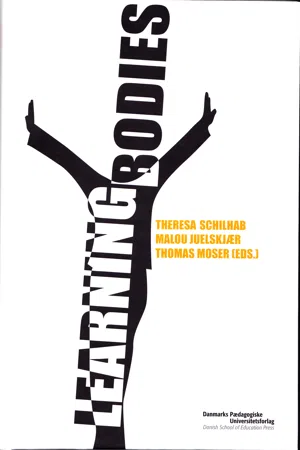
Learning Bodies
- 320 pages
- English
- ePUB (mobile friendly)
- Available on iOS & Android
eBook - ePub
About this book
Is the body a mere container of learning processes? Or can we, in a productive way, develop an approach to learning that includes learning as a bodily phenomenon? The authors all work with the development or refinement of theories of 'learning bodies,' and in this anthology they present the state of the art to anybody with an interest in current scientific discussions about the interplay between body, movement and learning. A full understanding of learning in all its complexity requires that the body is taken into account - regardless of whether we are dealing with the neurological foundations of learning processes, skill acquisition, mental health and illness, aesthetics or the physical setting where the learning takes place. Body, movement and senses (in short: corporeality), provide the necessary experiences for change and development in relation to life-long learning. This anthology presents a range of theoretical approaches to learning; neuroscience, psychiatry, sociology, psychology, phenomenology and pedagogy. By presenting this range of approaches, the anthology raises a central question in the philosophy of science: the need for incorporation of different approaches to achieve further insights. The first section of the book, The Learning Body, concerns the learning process from a psychological, neuroscience and phenomenological point of view. In part two, The Encultured Body, gender and aesthetics will be analysed in relation to the body and the community of practice. The third section, The Educated Body, sheds light on various aspects of the body in educational contexts and different body-related conditions for learning. The anthology is of particular interest to researchers and students of education, development, and psychology, and to those interested in body and movement, both biomedical and the relation to social science and the humanities.
Information
Topic
EducationSubtopic
Education GeneralThe knowing body
Chapter 1
Embodiment, corporeality and neuroscience
By Theresa S.S. Schilhab & Christian Gerlach1
The legacy of the cognitive revolution, with its neglect of the human body, has prevailed until recently. Today it is clearer than ever, at least within cognitive neuroscience, that our bodies shape/constrain the way we function cognitively. In this chapter we address the idea of embodiment from the biological perspective. We jump start the analysis by a philosophical stipulation of what embodiment could imply. To this end we make use of two different thought experiments and discuss the concept of interactional expertise. Then we introduce some empirical research to exemplify how the body – in more than just a trivial sense – is a co-determiner of cognitive architecture. We will argue that the body is an active component that adds uniquely and indispensably to cognition.
Thought experiments
Knowledge of execution
Some kinds of cognition rely heavily on bodily instantiation. This pertains to the ability to balance a bicycle2. Simply reading about how to ride a bike rather than actually doing it does not make one a biking expert. Moreover, any verbal report on bike balancing is likely to be subsequent rationalizing for the simple reason that biking involves body knowledge. In order to count as biking, bodily involvement is needed. This is why we could not have robots bike for us and still name the activity biking (even though robots could be said to bike themselves).
What is body knowledge and to what extent is it responsible for biking? To answer these questions, let us first try to capture what elements biking is composed of to find out if and in what respect the body3 could be dispensed with.
First, the skill of merely balancing activates certain bodily components, the actual position of the joints, the position of hands on the handles, the bodily force with which the pedals are moved to make the bike roll. Neurobiologically, these abilities are stored in cortices responsible for the execution of motor knowledge. Clearly, if these cortices were injured, cycling could not be carried out, because the neural correlates of accomplishing the act would have been wiped out. The body would not know how physically to carry out the action, since such fundamentals as muscle tension and appropriate combinations of muscular activity would be impossible to achieve. There would be no possibility of execution. But is this an adequate description of how we conceive of bodily involvement in biking? Surely, there is more to balancing a bike than just simple motor knowledge (knowledge of execution). Elaborating the analysis of body knowledge seems essential.
Knowledge of sensation
First, one cannot employ the same amount of force or utilize the same joint position on every occasion, since balancing is not the same in all conditions. If the road is slippery, the weight of the body must be distributed slightly differently to maintain grip. For example, the way to cut a curve changes considerably in dry and wet weather and on irregular or smooth tarmac. To meet the challenge of different environments (such as changing weather conditions or road surfaces), the biker must obtain information that makes him able to determine, adjust and execute his actions appropriately. To what extent does that depend on body knowledge?
Part of this knowledge is just more motor knowledge such as new constellations of muscle weight, muscle tone and positions of joints appropriate to new settings. Yet part of the knowledge seems to be of another quality.
Knowing about current conditions and picking out the appropriate muscular combination surely involves the body, simply because it accommodates sense organs that provide the information on which such judgements are based. This is not to say that manipulation of sensory information is all there is to judgement, but here we are concerned with obvious bodily contributions and neglect propositional thinking for the moment.
Sensory cells sustaining sight, hearing, kinaesthetic sense, sense of equilibrium, etc., are the gates to the surroundings and the first station in the cascade of processes sustaining appropriate navigation in changing environments.
Is the body dispensable?
Thus far, we can conclude that the body perceives information about the versatility of the conditions throughout the biking activity, and it executes (mechanically) the activity.
But apart from these obvious contributions to the activity, the question remains: is the body decisive for biking; i.e., does it add processes without which biking could not be accomplished? To sharpen our focus, we are not interested in the imperative of the body as a provider of energy and nourishment and the mechanical device by which we subsist. Though undoubtedly vital to existence, as various illnesses teach us, we want to analyse whether the body is imperative to cognition. Accordingly, we are intentionally questioning the primacy of the mind/head in cognition. We are specifically interested in the body as an active component that adds uniquely and indispensably to cognition.
To rephrase the question: is it unproblematic to replace that part of the body involved in biking with prostheses to carry out the simple task of conveying information about stimuli? Suppose a person born without limbs could be interfaced with a computer that simulated stimulation of all senses at the neural level in the same way that natural biking would do4 – that is, all neurons concerned with learning, understanding and maintaining biking were fed with information the normal novice biker would acquire to sustain the illusion of activity in normal limbs. What would happen if a person, after being exposed to huge amounts of simulated bike learning, became an expert biker (in this rather artificial sense of the term) and went through a successful leg and arm operation that miraculously gave him full functionality? Would he use his arms and legs as nimbly as if he had had normal ones during training? Or if anything went lost because of the new limbs’ lack of history, what kind of knowledge would it be?
If he behaved normally, we could conclude that the limbs are merely conveyors of information and we would endorse the idea of information as propositional and symbolic (Collins 2000). In that sense, the body would be a mere remedy for – and incidental to – our learning ability. Since we could circumvent the body by using prostheses, it would be a sufficient, but not necessary, condition for our ability to ride a bike.
To spell it out, if nothing was lost, it would make no difference to biking skill if the artificial expert had an operation or prostheses as long as both solutions were operable at the same level as normal limbs. On the other hand, if knowledge was somehow lost, we would have to conclude that the limbs (and thus the body) play a more active part in developing skills.
The body transplant – mismatch between sensing and execution
To take the point even further and explore the black box between sensing and execution by focussing on the actual constraints entailed by the body, let us go through another mind-bending example.
Suppose for a moment that future neurosurgeons have the skills and knowledge necessary to amputate the head of one man and restore it, fully functional, on the neck of another.
They would thus have the technical and scientific scope of knowledge about how to line up, connect and preserve neurons from different organic sources. And suppose that the paramount ideal of society was to be strong, muscular and fit. Moreover, the ideal – due to stressful living and perhaps the repulsiveness of being sweaty during exercise – was to invest as little time as possible in accomplishing that goal5. Would it then be possible, while accepting the minor inconveniences of losing one’s own body and personal signs such as tattoos and nostalgic scars, to move comfortably and agilely with the donor body? The question is: would the “transplanted” person function immediately and perfectly since all action is directed by certain cortical areas, and they have not changed. If so, we can safely conclude that the body offers nothing substantial to the effect.
Apparently, such amputations could not work out in reality. According to Collins (2000)6, the transplanted person would not be able to engage the muscles flawlessly or smoothly adapt to the change in bone structure on the spot. He would have huge amounts of information to learn about his new body, probably in the same way as someone learning how to walk on stilts. The new body would be an extension that has to become implemented before he would feel at ease with it.
What should we make of this? If one cannot have a body transfer without spending much time on adaptation, the body seems to be crucial in a more fundamental way, and these bodily constraints seem relevant to the discussion of bodily knowledge.
Naturally, the new body gives new sensations. Perhaps, the new body has lost a finger giving rise to a different configuration of the inflicted hand and the deformity is painstakingly apparent whenever grasping a cup. Or, perhaps, the feet make more contact with the ground when treading and the shoulders take up more space than before. Insofar as these bodily differences cause new experiences, immediate adaptation is unlikely. When walking by obstacles or other people in the street, the transplanted person will have to adjust to his new dimensions. Is there more to it than getting in sync with the new body?
If we granted the transplanted man a period of habituation, would he then achieve complete adjustment? In fact, he might, since he could become an expert at using the new body. But admitting perfect adjustment does not mean that he would be able to take up his “old” form of life, and that irreversibility makes the imperative of the body manifest in at least three ways.
The first and second approaches – the argument from the perspective of bodily construction and delegation of knowledge, respectively – take an individual stance on embodied cognition. Any bodily contribution depends on idiosyncratic experiences and circumstances in the life of the individual. Thus, any intra-species variability is due to ontogenetic development. The third approach, the argument from the perspective of evolution, on the other hand, is species specific in the sense that every species has it own bodily history. It claims the irreducibility of bodily cognition on the basis of evolution. In a sense, the evolutionary approach demarcates the nature and the extent of bodily cognition.
The argument from the perspective of bodily construction
The first argument has to do with bodily construction. Literally speaking, the body defines the perspective of the perceiver by restricting the outlook as to what can and what cannot be attended to. To pick a telling example: to a child, the adult world is situated above his or her head. Thus, the sphere of interesting things such as candy and matches can be kept below the child’s focus (for instance, on tables). And the child is never aware of the temptation, until he or she realizes that adults have a way of keeping things out of sight.
In the same manner, if one loses a finger, other bodily strategies will have to evolve to grasp a cup, and with new bodily strategies new interfaces develop. We take the argument from bodily construction to be congenial to the notion of “the social embodiment thesis” (Collins 2004), which states that “the language developed by a society is related to the bodily form of its members because bodily form affects the things they can do in the world.” Insofar as language is verbal behaviour, it is a token of a particular outlook in just the same way as biking.
In line with the argument from the perspective of bodily construction is the emphasis on movement as advanced by Sheets-Johnstone (1998; 1999). Moving about enforces environmental changes in organisms and perceptions thereby also change (see also Churchland 1986).
To conclude, bodily construction influences cognition in the loose sense of actually defining the outlook.
The argument from the perspective of delegation of knowledge
A second argument of the imperative of the body rests on the principle of decentralization and biofeedback. To grasp what this means: how would the old and new bodies, respectively, contribute to biking? Let us assume that the old body had hours and hours of training, year after year, while the new body, though slim and fit, had never experienced life from a bicycle saddle. How does the number of bike experiences affect the old body as compared to the new? Doubtless, the configuration of leg muscles, muscle tone and litheness would be completely different, and the new body would simply have to catch up through heavy training. But would the history of the old body play any other role than that of physical constitution in the differences?
Almost certainly the body played an active part in taking up biking to begin with. Some bodies are just born to bike and, in that sense, natural abilities are indispensable. But the question of history addresses the question of the body being integral to and then part of former experiences. For instance, does increased use of whatever sensors are used in biking (for instance, the organ of equilibrium) feed back on them and improve their performance (making bikers’ organs of equilibrium dynamic participators in the activity)?
Is the employment of senses stimulated by use? The idea is not farfetched, as the mechanism is improved by muscular activity, which simultaneously prepares the muscle for dealing with an augmented load in the future.
However, other examples of processes that are delegated to the body can also be found. By surgically disconnecting the spinal cord from the brain in rats, it has been shown that alleged cognitive abilities remain intact (Grau 2002).
Here we touch upon the real issue: if the body accommodates processes of causal relevance to cognition, amputation with non-negligible effects is very unlikely.
The argument from the perspective of evolution
The third argument has to do with the biological filtering of information. However compelling, the argument questions the idea of circumventing the body and directing certain combinations of stimuli straight to the brain. It may be logically appealing, but to allow one self to think of bypassing the body is, in fact, a mistake.
To comprehend and imitate the complexity of signals that impinges on the body is impossible.
We meet our environment at the surface of our body. Our senses (and their location in the body) have evolved and become susceptible to environmental features over time in a close race in the best interests of organisms7. Senses cannot be studied without taking into account the environment they were shaped by. Intertwined development is carved into the delicate constitution of the body from the lowest molecular level of co-operative second messenger cascades to idiosyncratic features of sense organs. Every subtle cellular mechanism consists of elements that can be traced back to tricks that have worked since the beginning of life. The sophistication of each mechanism is so formidable that it may prove impossible to disentangle.
In that understanding, the body is indispensable because it literally carries with it examples of processes that make evolutionary sense and that ultimately dictate the workings of the brain.
The intricacy of the visual system in primates8, including humankind, is composed of mi...
Table of contents
- Cover
- Titlepage
- Introduction
- Part 1: The knowing body
- Part 2: The encultured body
- Part 3: The educated body
- Post Scriptum – on ‘Learning bodies’
- Contributors
- Copyright
Trusted by 375,005 students
Access to over 1.5 million titles for a fair monthly price.
Study more efficiently using our study tools.
Frequently asked questions
Yes, you can cancel anytime from the Subscription tab in your account settings on the Perlego website. Your subscription will stay active until the end of your current billing period. Learn how to cancel your subscription
No, books cannot be downloaded as external files, such as PDFs, for use outside of Perlego. However, you can download books within the Perlego app for offline reading on mobile or tablet. Learn how to download books offline
Perlego offers two plans: Essential and Complete
- Essential is ideal for learners and professionals who enjoy exploring a wide range of subjects. Access the Essential Library with 800,000+ trusted titles and best-sellers across business, personal growth, and the humanities. Includes unlimited reading time and Standard Read Aloud voice.
- Complete: Perfect for advanced learners and researchers needing full, unrestricted access. Unlock 1.5M+ books across hundreds of subjects, including academic and specialized titles. The Complete Plan also includes advanced features like Premium Read Aloud and Research Assistant.
We are an online textbook subscription service, where you can get access to an entire online library for less than the price of a single book per month. With over 1.5 million books across 990+ topics, we’ve got you covered! Learn about our mission
Look out for the read-aloud symbol on your next book to see if you can listen to it. The read-aloud tool reads text aloud for you, highlighting the text as it is being read. You can pause it, speed it up and slow it down. Learn more about Read Aloud
Yes! You can use the Perlego app on both iOS and Android devices to read anytime, anywhere — even offline. Perfect for commutes or when you’re on the go.
Please note we cannot support devices running on iOS 13 and Android 7 or earlier. Learn more about using the app
Please note we cannot support devices running on iOS 13 and Android 7 or earlier. Learn more about using the app
Yes, you can access Learning Bodies by Malou Juelskjaer, Thomas Moser, Theresa Schilhab, Malou Juelskjaer,Thomas Moser,Theresa Schilhab in PDF and/or ePUB format, as well as other popular books in Education & Education General. We have over 1.5 million books available in our catalogue for you to explore.