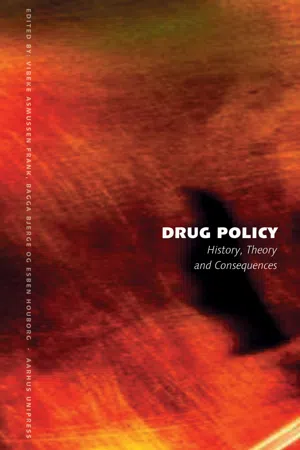
eBook - ePub
Drug Policy
History, Theory, and Consequences
- 259 pages
- English
- ePUB (mobile friendly)
- Available on iOS & Android
eBook - ePub
Drug Policy
History, Theory, and Consequences
About this book
In this book, anthropologists, criminologists and sociologists analyse different aspects of drug policy. The articles approach drug policy from new angles, focusing in particular on the history and consequences of drug policy in practice. How can we understand and explain the increasingly complex puzzle that we call drug policy? The authors explore in different ways how drug policy has spread into new areas of society, how new players are engaged in drug policy, and what consequences this has for drug users, citizens, or society in general. Taking a point of departure in drug policy as a way of regulating drugs - including control, treatment, prevention and harm reduction - the book shows how drug policy has become increasingly diverse and evident at many levels of society. A very wide range of drug policies are implemented in contemporary societies - not only by governments, but also by local communities, organisations, public institutions, private enterprises, sports clubs etc. Using examples from both Denmark and the USA, drug policy is analysed on an international, national and local level. This book will be of great value to advanced undergraduate and graduate students with an interest in drug policy, as well as to academics, practitioners and policy makers in the drug policy field.
Information
Part I
Drug policy in institutional settings
Charlotte Siiger
CAUGHT IN-BETWEEN: DILEMMA MANAGEMENT AT A HOSTEL FOR THE HOMELESS
Social work is subject to a state of conflict caused by the incompatibility of two overall rationalities: individual client treatment and compassion on the one hand, and mass processing and rule-application on the other (Lipsky 1980: 44-45). These conflicts are mirrored in daily dilemmas when ideals and goals collide with the complex and ambiguous reality of staff-client encounters. Using a Danish hostel for the homeless as an example, this article explores the nature of such dilemmas and the processes involved in trying to solve them.
Roughly speaking, hostels in Denmark can be divided into two categories in terms of drug and alcohol rules: either the use of drugs and alcohol is tacitly accepted in certain areas (e.g. residents’ own rooms and outdoors), or it is not accepted on the premises at all1. In both cases, hostels are constantly confronted with the issue because the use of alcohol and illicit drugs like cannabis, heroin, cocaine and various kinds of pills is an integral part of homelessness.
In a larger perspective, the difference between rules corresponds to a difference between two competing approaches to drugs: zero tolerance versus harm reduction. Policies of zero tolerance, if interpreted rigidly, maintain that drugs should be prohibited and eradicated through tough-on-crime police actions, and also (something which is important in this context) focus on abstinence when offering drug treatment. In contrast, harm reduction is a pragmatic approach based on the argument that the war on drugs has failed, consequently taking as a starting point that drugs are here to stay. Instead of only one goal of abstinence in treatment, goals should be differentiated and based on individual wishes and realistic assessments. Harm reduction may or may not lead to abstinence in the long run, but the first priority is to treat the harmful consequences of use. Substitution treatment and free delivery of needles are examples of harm-reduction initiatives (Jepsen 1993; Ege 1997; Narkotikarådet 1999; Asmussen & Dahl 2002; Houborg 2007).
To some degree, this difference in policies is reflected in the rules of hostels: zero tolerance translates into a non-acceptance rule, and harm reduction into an acceptance rule. As a basis for analysis, this article focuses on a hostel that pursues a non-acceptance rule because doing so makes dilemmas engendered by the conflicting rationalities of harm reduction and zero tolerance stand out with specific clarity – there is an obvious paradox in being a provider of services for homeless people who are known to be heavy users, while forbidding them from using drugs at the same time. The paradoxical nature of this rule is also displayed by the fact that forbidding residents to take drugs and drink alcohol, implying a degree of control, collides with a basic idea in social work: that social workers should try to establish a relationship based on confidence with clients. The establishment of such a relationship is considered to be basic if clients are to change or develop in directions that are believed to be better for them.
An equally important aspect of social work is that clients should be treated in a universalistic way – i.e. without discriminating. Despite sincere attempts to live up to this ideal, work is nevertheless, as Michael Lipsky (1980) rightly points out, influenced by worker bias: some clients are preferred to others. Lipsky draws attention to three circumstances in which street-level bureaucrats display biased behaviour: first, some clients simply evoke more sympathy than others; second, some clients are believed to be more worthy of services than others; and, third, some clients are preferred because they respond well to treatment (Lipsky 1980: 108-111).
These biases can also be viewed as elements of a model of social exchange which was developed by Marshall Sahlins (1972). According to this model, social exchange can be categorised in three analytically distinct forms: generalised reciprocity, balanced reciprocity, and negative reciprocity. The difference between the three is in the ‘spirit’ of exchange, and can be placed on an imagined continuum between two poles with the positive at one end (‘people we like’), the negative at the other (‘people we do not like’), with balanced reciprocity in the middle (‘people we have agreements with, almost independently of likes and dislikes’) (Sahlins 1972: 194-195). Applying Sahlins’ model to the categorisation processes of social work, it appears that generalised reciprocity includes clients who evoke sympathy, who are viewed as worthy, and/or who are responding well to treatment. In contrast, clients who are disliked or who do not respond well to treatment are subjected to negative reciprocity. Third, balanced reciprocity includes clients who are considered to be worthy and who respond well to treatment, while issues of likes and dislikes are scaled down.
This article argues that it is not the rule of non-acceptance in itself that causes dilemmas, but the conflicts between several overall rationalities that cannot be united into one unambiguous way of acting. It is at the point of trying to translate these conflicting policies into practice that dilemmas arise. Specific attention is paid to the conflict between rule application and individual client treatment because it seems to permeate all other dilemmas. Furthermore, this article argues that dilemma management in social work has a lot to do with classification processes. Placing relationships and people in categories reduces complexity, thereby engendering more straightforward solutions to problematic situations. Despite its dilemma-ridden nature, everyday life at the hostel nevertheless runs pretty smoothly. This may be partly explained by a pragmatic approach sometimes employed by staff in which they prevent a dilemma arising by not gaining knowledge about offences committed by clients – or by ignoring knowledge they have already obtained.
These arguments are based on an analysis of views and opinions shared by staff when they discuss the consequences of violating the rule of non-acceptance of drug and alcohol. Since meetings among staff constitute the structural frame for the exchange of views and decision-making, these are central objects of analysis. Here certain themes stand out: first, the resident’s possible benefits from the services provided by the hostel; second, the worthiness of the resident; and, third, the nature of the relationship between the resident and staff. This analysis has wider relevance for other hostels independently of the nature of their rules, as well as for social work in general.
Analytical frame
This article draws on Michael Lipsky’s (1980) classic study of street-level bureaucracy as a main frame of reference. One of Lipsky’s important contributions is that he, on the one hand, recognises that practice is influenced by overall rationalities and cultural assumptions in society at large, and, on the other, argues that the actual patterns of actions performed by street-level bureaucrats are the policies of an organisation (ibid: 107, 144). Inspired by this approach, policy is here analysed by looking at the way staff react to problematic situations, while at the same time paying attention to the fact that hostels are part of a larger context. For instance, when some clients are favoured at the expense of others even though they should ideally be treated equally, this may be due to limited resources and general ideas of worthiness rather than the likes or dislikes of the social worker concerned (Lipsky 1980: 109). From this perspective it is possible to regard preferential treatment as engendered by organisational constraints and societal values rather than by attributes of human nature.
Along the lines of Lipsky, one common explanation of why street-level bureaucrats diverge from rules is that they feel compassion for an individual resident. In order to explain how staff legitimise the fact that some residents are exempted from the rules while others are not, I supplement Lipsky’s analysis with Michel Foucault’s (2006) concepts of confession and forgiveness.
To explain how Foucault defines these concepts, a few words about his genealogical strategy of analysis are necessary. He examines the lineage of phenomena and how they have developed and either been transformed or disappeared through history. The genealogical method takes as its starting point a problem or an event in present time, and explores historically how it has become the way it ‘is’. Foucault emphasises that the genealogist actively creates a historical problem or event – it is not waiting out there to be discovered independently of its observer. Instead the genealogist selects a point in history at which there seems to be a break in the way power and knowledge interplay; whereby he or she makes a strategic move that gives rise to specific events. In this way, historical events are largely products of the work of the historian rather than being ‘true facts’ (Foucault 1983b, Villadsen 2003).
Confession is one of the practices that Foucault has examined genealogically. It can be traced back to at least medieval times, when it became an important ritual to produce truth. Over the years the meaning of confession has been transformed, but as a practice it is still very much alive and has spread widely into most fields of society (Foucault 2006: 65-66), including the field of social work. In this analysis, the practice of confession appears in the way staff try to push residents to tell the so-called truth about their use of drugs and alcohol. According to Foucault’s analysis, confession is seen as a way to remove restraints and liberate truth. A characteristic feature of confession, Foucault continues, is that it takes place in a relation of power: one cannot confess without having somebody, at least virtually, to confess to. Relief from mistakes, liberation and forgiveness, is the reward for anyone speaking the truth (Foucault 2006: 69-70). In this respect, the relationship between confessor and forgiver can be termed as one of reciprocity, which points to the relevance of Sahlins’ three forms of exchange.
The deployment of Sahlins’ model makes it possible to understand how solutions to dilemmas in social work are connected to the way clients are categorised in terms of a reciprocity scale. Roughly speaking, staff at a hostel for the homeless may categorise residents as ‘good’, ‘bad’ or ‘somewhere in-between’. Note that it is predominantly staff and not clients who determine how the nature of reciprocity should be interpreted. This observation coheres to the asymmetric power relation which is a general condition of relations between a helper and one in need of help. Seen from this perspective, at least, reciprocity of any nature is ultimately never a ‘purely’ horizontal relation between equal partners. In this context, this is clearly evident in the fact that staff possess the truth and access to salvation, which is, again, conditioned by clients’ subordination through confession. The better clients are believed to be, the better their chances of being forgiven for an offence. This point, combined with the fact that staff at the hostel being studied devote some time to discussing drug dealing, makes it pertinent to include Ross Coomber’s (2006) study of ‘pusher myths’ in the analysis. As Coomber explains in his study, drug dealers play the part of ultimate enemies of society, which makes them obvious candidates to enter into a negative form of reciprocity with staff.
Hostels in Denmark
Based on reports from 65 Danish hostels and other services included in the same statistics, 7,291 people (2005 figures) annually live for a short or a long period of time at a hostel. A small number, however, are not homeless in that the statistics cover a slightly broader category (e.g. hostels for battered women). Out of the total from 2005, 56 % are between 30 and 49 years of age; 74 % are men; and 26 % are women (National Social Appeals Board 2006).
The hostels studied are regulated by the Danish Law of Social Services (‘Lov om Social Service’ in Danish), which stipulates that they are meant for people who have nowhere else to go, and who are experiencing complex social problems. An important element of the work is to prepare residents for a more independent life, possibly with support from outreach workers. The purpose is to create better life conditions and increase the chance of such people being integrated into society. In daily work the idea of integration is reflected in the way staff operate with three categories of integration: occupation, treatment (e.g. for drug and alcohol use or diseases), and housing.
The law also states that the homeless should only stay at hostels on a temporary basis – unlike the law from before 1998, which said nothing about time duration. The shift in 1998 marked an attempt to make efforts more goal-oriented: residents should not only receive care at a hostel; they should also be met with expectations of changing their way of behaving and living. However, the term ‘temporary residence’ is not a very specific guideline, being open to a variety of interpretations at local levels. Some hostels interpret ‘temporary’ to mean no more than three months; while others regard it as meaning more than a year. In all cases, staff argue that the time duration depends on an assessment of each individual resident, and on the range of services provided at hostel facilities. Some hostels do not provide many kinds of services because they aim to produce rapid referrals. Others provide a wider range of services, like in-house training, teaching in health-related issues, and art groups. Country Side Hostel, which constitutes the concrete example in this article, belongs to the latter kind. Such hostels distinguish more openly between their clients in terms of inclusion and exclusion: if clients are considered to be possible beneficiaries of hostel services they are allowed to stay; if not, they are soon referred to another facility. In all cases, ‘temporary residence’ is a condition of work that urges staff to think and act in terms of making residents move on.
The idea is that each resident has a right as well as a responsibility to make his or her own decisions and plans. Staff perform the task of guiding residents in directions that are believed to be realistic and best for them. This is reflected in the way much staff effort revolves around attempts to establish the identity, true will, and potential for change of each individual resident. In this sense social workers are involved in partially unintentional processes of trying to define and shape the way residents express themselves, rather than residents making their own free choices.
While using one hostel as a concrete example; this article is based on ethnographic fieldwork at three Danish hostels for the homeless. The fieldwork took place from March 2006 to December 2006, including short breaks. The fieldwork consisted of participant observation and conversations with various players: superintendents, mid-level managers, other staff members, and residents. Most time was spent with staff, specifically social workers. I use this term to refer to a broad category of staff, most of them formally trained, who have the responsibility of caring for, supporting, educating and planning with and for residents. In addition, I interviewed 57 people: 44 staff members in various positions, 3 superintendents, and 10 residents.
Country Side Hostel
Country Side Hostel has room for just under 40 residents ranging from the age of 18 to 70, with a majority aged between 25 and 45. 85 % are men, and 15 % are women. It employs just over 30 social workers, who cover day, evening and night shifts (Driftsaftale 2005-2006). They are divided into two teams, each covering approximately half of the residents. Within each team, social workers are key workers for a small number of residents. Key workers have the main responsibility for creating confidence, responding to needs, and solving problems together with the residents allocated to them. Each team holds a meeting once a week. But this is only one of many kinds of meeting: a good deal of hostel work is organised as meetings as well as at meetings.
Compared to other hostels, Country Side Hostel makes use of a relatively extensive control and support strategy. For instance, staff wake up reluctant residents in the morning to make them attend workshops or other programmes, and, if possible, check if they stay as long as they should. This is based on the idea that residents need stability and structure in order to gain control of an otherwise chaotic life.
If staff find that residents are using too much alcohol or too many drugs, they may demand that they submit to urine tests, an alcohol meter, Antabuse2 treatment or other kinds of technology to detect and control use. Residents who are determined to stay accept these technologies, but rarely without ambiguity or protest. Staff spend quite a lot of their working day observing which residents are willingly submitting to s...
Table of contents
- Cover
- Title
- Dedikation
- Preface
- Introduction: Danish drug policy – history, theory, and the international framework
- Part I: Drug policy in institutional settings
- Part II: Drug policy at local levels
- Part III: History, causes, and consequences of drug policy
- List of Authors
- Copyright
Trusted by 375,005 students
Access to over 1.5 million titles for a fair monthly price.
Study more efficiently using our study tools.
Frequently asked questions
Yes, you can cancel anytime from the Subscription tab in your account settings on the Perlego website. Your subscription will stay active until the end of your current billing period. Learn how to cancel your subscription
No, books cannot be downloaded as external files, such as PDFs, for use outside of Perlego. However, you can download books within the Perlego app for offline reading on mobile or tablet. Learn how to download books offline
Perlego offers two plans: Essential and Complete
- Essential is ideal for learners and professionals who enjoy exploring a wide range of subjects. Access the Essential Library with 800,000+ trusted titles and best-sellers across business, personal growth, and the humanities. Includes unlimited reading time and Standard Read Aloud voice.
- Complete: Perfect for advanced learners and researchers needing full, unrestricted access. Unlock 1.5M+ books across hundreds of subjects, including academic and specialized titles. The Complete Plan also includes advanced features like Premium Read Aloud and Research Assistant.
We are an online textbook subscription service, where you can get access to an entire online library for less than the price of a single book per month. With over 1.5 million books across 990+ topics, we’ve got you covered! Learn about our mission
Look out for the read-aloud symbol on your next book to see if you can listen to it. The read-aloud tool reads text aloud for you, highlighting the text as it is being read. You can pause it, speed it up and slow it down. Learn more about Read Aloud
Yes! You can use the Perlego app on both iOS and Android devices to read anytime, anywhere — even offline. Perfect for commutes or when you’re on the go.
Please note we cannot support devices running on iOS 13 and Android 7 or earlier. Learn more about using the app
Please note we cannot support devices running on iOS 13 and Android 7 or earlier. Learn more about using the app
Yes, you can access Drug Policy by Vibeke Asmussen Frank, Bagga Bjerge, Esben Houborg, Vibeke Asmussen Frank,Bagga Bjerge,Esben Houborg in PDF and/or ePUB format, as well as other popular books in Social Sciences & Sociology. We have over 1.5 million books available in our catalogue for you to explore.