eBook - ePub
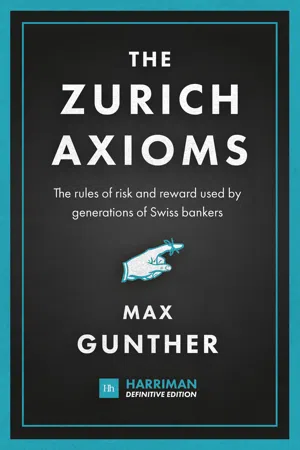
The Zurich Axioms (Harriman Definitive Edition)
The rules of risk and reward used by generations of Swiss bankers
- English
- ePUB (mobile friendly)
- Available on iOS & Android
eBook - ePub
The Zurich Axioms (Harriman Definitive Edition)
The rules of risk and reward used by generations of Swiss bankers
About this book
If you want to get rich, no matter how inexperienced you are in investment, this book can help you. Its message is that you must not avoid risk, nor court it foolhardily, but learn how to manage it - and enjoy it too.
The 12 major and 16 minor Zurich Axioms contained in this book are a set of principles providing a practical philosophy for the realistic management of risk, which can be followed successfully by anyone, not merely the 'experts'. Several of the Axioms fly right in the face of the traditional wisdom of the investment advice business - yet the enterprising Swiss speculators who devised them became rich, while many investors who follow the conventional path do not.
Max Gunther, whose father was one of the original speculators who devised the Axioms, made his first capital gain on the stock market at the age of 13 and never looked back. Now the rest of us can follow in his footsteps. Startlingly straightforward, the Axioms are explained in a book that is not only extremely entertaining but will prove invaluable to any investor, whether in stocks, commodities, art, antiques or real estate, who is willing to take risk on its own terms and chance a little to gain a lot.
Information
Topic
CommerceThe Fifth Major Axiom: On Patterns
Chaos is not dangerous until it begins to look orderly.
Irving Fisher, a distinguished professor of economics at Yale, made a bundle on the stock market. Impressed by his combination of impeccable academic credentials and practical investment savvy, people flocked to him for advice. “Stock prices have reached what looks like a permanently high plateau”, he announced in September 1929, just before he was wiped out by the worst crash in Wall Street history.
It just goes to show you. The minute you think you see an orderly design in the affairs of men and women, including their financial affairs, you are in peril.
Fisher believed he had beaten the market by being smart, when what had really happened was that he had been lucky. He thought he saw patterns amid the chaos. Believing that, he believed it should be possible to develop formulas and strategies for the profitable exploitation of those patterns – and he believed, further, that he had in fact developed just such formulas and strategies.
Poor old Fisher. Fate let him ride high for a while so he would have farther to fall. For a few years his illusion of order seemed to be justified by the facts. “See!” he would say. “It is as determined. The stock market is behaving just the way I calculated it would.”
And then – whomp! The bottom dropped out. Clinging to his illusion of order. Fisher was unprepared for his streak of luck to end. He and a lot of other misguided investors went tumbling down the drain.
The trap that caught Professor Fisher, the illusion of order, has caught millions of others and will go on catching investors, speculators, and gamblers for all eternity. It awaits the unwary not only around Wall Street but in art galleries, realty offices, gambling casinos, antique auctions: wherever money is wagered and lost. It is an entirely understandable illusion. After all, what is more orderly than money? No matter how disarrayed the world gets, four quarters always make a buck. Money seems cool, rational, amenable to reasoned analysis and manipulation. If you want to get rich, it would seem that you need only find a sound rational approach. A Formula.
Everybody is looking for this Formula. Unfortunately, there isn’t one.
The truth is that the world of money is a world of patternless disorder, utter chaos. Patterns seem to appear in it from time to time, as do patterns in a cloudy sky or in the froth at the edge of the ocean. But they are ephemeral. They are not a sound basic on which to base one’s plans. They are alluring, and they are always fooling smart people like Professor Fisher. But the really smart speculator will recognize them for what they are and, hence, will disregard them.
This is the lesson of the Fifth Axiom. It may be the most important Axiom of them all. It is the Emperor Axiom. Once you grasp it, you will be a cleverer speculator/investor than Professor Fisher was with all his vast scholarly attainments. This one Axiom, once you make it yours, will by itself lift you above the common herd of hopeful blunderers and losers.
Some of the grandest illusions of order crop up in the world of art. This is a world in which a great deal of money can be made with stunning speed. The trick is to latch on to low-priced artists before they get hot. Like Louise Moillon, a seventeenth century French painter. A woman recently bought a Moillon at a rural auction for $1,500. Within a year Moillon got hot, and the same painting sold in New York for $120,000.
That would be a nice adventure to have. It could give one’s balance sheet an encouraging boost. But how can you get in on the action? How can you tell when an obscure artist is going to attract that kind of attention?
Well, there are experts who say they have art pretty well figured out. They see patterns nobody else sees. They have formulas. They can recognize Great Art while it is still unrecognized and cheap. They can go to a rural auction where everybody else is stumbling around in the dark and say, “Wow! Look at that! It’ll fetch six figures next year in New York!” So your best bet is to consult a lot of these experts, right?
Sure. The Sovereign American Art Fund was founded on that basis. It was essentially a unit trust. It proposed to make its shareholders rich by buying and selling works of art. This buying and selling was to be done by experts, savvy professionals whose superior critical judgment could help them spot emerging trends and future Moillons before the rest of the art-buying world caught the scent.
A lovely illusion of order. It attracted investors big and small. The Fund sold out its initial public offering at $6 a share.
What nobody seems to have thought of is that in any game as dicey as art, a group of professionals can experience bad luck just as easily as a herd of blundering amateurs. The Sovereign Fund’s purchased masterpieces looked promising at first, and a few months after the initial offering the shares were trading over $30. Some of the initial speculators made some money, at least. But then gloom descended. The purchased masterpieces turned out to be less hot than had been supposed. Obscure artists got obscurer. One expensive painting was challenged as a forgery. The shares’ value plummeted. About two years after the Fund had opened for business, the trading price was 75 cents.

Wall Street mutual funds tell the same story. They illustrate with stark clarity how futile it is to seek patterns amid the chaos – and in the end, particularly for the average small-time plunger, how dangerous.
Consider the seemingly limitless promise of mutual funds. These great agglomerations of the public’s money are managed by professionals of the first magnitude. The educational attainments of these men and women are dazzling, and so are their salaries. Platoons of assistants see to their needs. Large libraries of financial fact and theory are at their disposal. Computer and other expensive gadgets take part in their cogitations. They are without a doubt the world’s best-educated, best-paid, best-equipped investment theorists.
And so, if it were possible to discern usable patterns amid the disorder, and develop a market-playing formula that worked, one might suppose these people would be able to do it. Indeed they should have done it long ago.
So far, however, the formula has eluded them.
The sad fact is that mutual fund managers are like all other speculators: they win some and they lose some. That’s the best you can say about them. All the high-voltage brainpower and all that money and all those computers have never been able to make them any cleverer or more successful than a long plunger with an aching head and a $12.98 pocket calculator. Indeed sometimes mutual funds as a group manage to do worse than average. Forbes magazine once charted the performance of funds’ unit prices in some bear markets and found that nine out of ten fell as fast as or faster than stocks as a whole.
Fund managers continue searching doggedly for that magic formula, however. They search because they are paid to, and also – in many cases or most – because they genuinely believe there is a formula out there somewhere, if only they and the computers are smart enough to spot it.
You and I know, of course, that the reason why they can’t find the formula is that there isn’t one.
Oh sure, you can make money by investing in a fund – if you are lucky enough to pick the right one at the right time. What it comes down to is that buying into funds is just as risky as buying individual stocks, or art works, or whatever your chosen game may be.
Some fund managers will be luckier than others in this coming year. Some will be hot. Their unit prices will rise faster (or fall more slowly) than average. But the question is which ones?
So, you see, we are back where we started. If you want to speculate in fund units, you are only dealing with the same kind of chaos you would encounter when speculating directly in stocks, art, commodities, currencies, precious metals, real estate, antiques, or poker hands. The rules of play should be the same for you whether you are in mutual funds or anything else. Particularly with funds, don’t be lulled into perceiving order where none exists. Keep your wits and the Axioms about you.
And keep them about you whenever you read or hear investment advice. Most advisers have some kind of orderly illusion to sell, for that is what sells.
Such an illusion is comforting and seems full of promise. Small-time investors who have been burned or feel they have missed opportunities through ignorance or fear – and who hasn’t? – will flock to an adviser who offers what seems to be a plausible, orderly approach to moneymaking. But you should regard all financial advisers with skepticism, and the more cool and bankerish they seem, the more you should distrust them.
The cooler and more bankerish a man is, the less readily will he admit that he deals with chaos...
Table of contents
- Contents
- Foreword by James P. O’Shaughnessy
- Introduction: What the Axioms are and how they came to be
- The First Major Axiom: On Risk
- The Second Major Axiom: On Greed
- The Third Major Axiom: On Hope
- The Fourth Major Axiom: On Forecasts
- The Fifth Major Axiom: On Patterns
- The Sixth Major Axiom: On Mobility
- The Seventh Major Axiom: On Intuition
- The Eighth Major Axiom: On Religion and the Occult
- The Ninth Major Axiom: On Optimism and Pessimism
- The Tenth Major Axiom: On Consensus
- The Eleventh Major Axiom: On Stubbornness
- The Twelfth Major Axiom: On Planning
- Publishing details
Trusted by 375,005 students
Access to over 1.5 million titles for a fair monthly price.
Study more efficiently using our study tools.
Frequently asked questions
Yes, you can cancel anytime from the Subscription tab in your account settings on the Perlego website. Your subscription will stay active until the end of your current billing period. Learn how to cancel your subscription
No, books cannot be downloaded as external files, such as PDFs, for use outside of Perlego. However, you can download books within the Perlego app for offline reading on mobile or tablet. Learn how to download books offline
We are an online textbook subscription service, where you can get access to an entire online library for less than the price of a single book per month. With over 1.5 million books across 990+ topics, we’ve got you covered! Learn about our mission
Look out for the read-aloud symbol on your next book to see if you can listen to it. The read-aloud tool reads text aloud for you, highlighting the text as it is being read. You can pause it, speed it up and slow it down. Learn more about Read Aloud
Yes! You can use the Perlego app on both iOS and Android devices to read anytime, anywhere — even offline. Perfect for commutes or when you’re on the go.
Please note we cannot support devices running on iOS 13 and Android 7 or earlier. Learn more about using the app
Please note we cannot support devices running on iOS 13 and Android 7 or earlier. Learn more about using the app
Yes, you can access The Zurich Axioms (Harriman Definitive Edition) by Max Gunther in PDF and/or ePUB format, as well as other popular books in Commerce & Investissements et valeurs mobilières. We have over 1.5 million books available in our catalogue for you to explore.