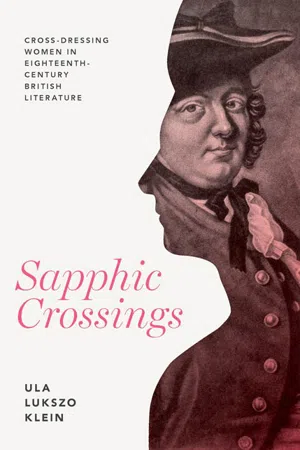
Across the eighteenth century in Britain, readers, writers, and theater-goers were fascinated by women who dressed in men's clothing—from actresses on stage who showed their shapely legs to advantage in men's breeches to stories of valiant female soldiers and ruthless female pirates. Spanning genres from plays, novels, and poetry to pamphlets and broadsides, the cross-dressing woman came to signal more than female independence or unconventional behaviors; she also came to signal an investment in female same-sex intimacies and sapphic desires. Sapphic Crossings reveals how various British texts from the period associate female cross-dressing with the exciting possibility of intimate, embodied same-sex relationships. Ula Lukszo Klein reconsiders the role of lesbian desires and their structuring through cross-gender embodiments as crucial not only to the history of sexuality but to the rise of modern concepts of gender, sexuality, and desire. She prompts readers to rethink the roots of lesbianism and transgender identities today and introduces new ways of thinking about embodied sexuality in the past.
eBook - ePub
Sapphic Crossings
Cross-Dressing Women in Eighteenth-Century British Literature
- 248 pages
- English
- ePUB (mobile friendly)
- Available on iOS & Android
eBook - ePub
About this book
Information
Subtopic
Early Modern HistoryIndex
Literature1

EIGHTEENTH-CENTURY FEMALE CROSS-DRESSERS AND THEIR BEARDS
In eighteenth-century narratives of cross-dressing women, the facial beard is a marker of maleness and masculinity, and its lack can be disguised by successful courtship of other women.1 In the female soldier Hannah Snell’s history, The Female Soldier; or, The Surprising Life and Adventures of Hannah Snell (1750), the narrator reports that her fellow sailors “began to declare her to be a Woman on account of her smooth Face, seeing she had no Beard.”2 Sarah Scott’s narrator in “The Story of Leonora and Louisa,” in the novel A Journey through Every Stage of Life (1754), explains that the older ladies who see Leonora in her disguise as a young clergyman “would frequently ridicule her want of Beard.”3 Even Daniel Defoe’s Moll Flanders (The History and Misfortunes of the Famous Moll Flanders, 1722), who disguises herself as a man only briefly, worries about her ability to portray a masculine character successfully, as she believes she is “a little too smooth-faced for a man.”4 In these examples, narratives emphasize the facial beard as an important component of masculinity, one whose absence draws attention to the cross-dresser’s femaleness. These texts clearly draw on eighteenth-century expectations for embodied masculinity and visible markers of maleness via facial hair at a time when beards were unfashionable. At the same time, the cross-dresser’s feminine features are often what makes her so attractive to other women. Thus, female cross-dressing narratives in the eighteenth-century link gender and desire, only to disrupt this connection by suggesting that other women desire the cross-dresser for her feminine qualities as much as for her masculine ones. The women who desire the female cross-dresser become her “beards,” metaphorically taking the place of the facial beard and supplementing the missing marker of masculinity. The textual emphasis on the facial beard builds on constructions of maleness and masculinity, suggesting how masculinity might be troubled in the eighteenth-century imaginary. The ambiguous gender presentation of the cross-dresser in these texts, their emphasis on embodied markers of maleness, and their final rejection of these embodied markers, also suggests a trans reading of these texts that highlights the in-betweenness of the cross-dresser’s body.
Today’s readers may be familiar with the term “beard” as one that references a woman who appears with a gay man to disguise his homosexuality or refute allegations of it. In this sense, “beard” is an apt term for the women who desire the female cross-dresser.5 These women camouflage the female cross-dresser’s perceived dearth of masculinity or maleness, just as homosexual men who acquire a beard do so partly because of a perceived lack of (normative) masculinity that they wish to disguise. The person in the position of beard becomes a marker of masculinity and heterosexuality. The idea of the beard, in its many meanings and its cultural attachment to erotic discourses—masculinity, homosexual hiding, sexual virility, female pubic hair, and rampant female sexuality—emerges as a term whose meaning may vacillate, yet its historically-constructed genealogy indicates its persistence. The term “beard,” therefore, can be read through Valerie Traub’s idea of the “cycles of salience,” as one whose ideological functioning asserts itself over and over in discourses of sexuality, marking it as a site of sexual difference and gender performance throughout Western culture.6 The notion of the metaphorical beard—the woman who desires the cross-dresser—suggests that gender is defined through an array of different, at times contradictory, components that can be manipulated by an individual. The women who function as beards also function as indicators of the possibility of same-sex desires that are legible to eighteenth-century readers of these texts, regardless of the cross-dresser’s purported intentions. These narratives allude to the titillating possibility of lesbian sex acts and sapphic possibilities by representing women attracted to the cross-dresser for her androgynous/feminine qualities as much as for her masculine ones. Readers of these narratives, whether of the eighteenth century or today, are made aware of the possibilities for same-sex desires and acts in the relationships between the cross-dresser and her beards, even as trans identities are also made legible in the text.7 Though many of these narratives explicitly deny that the cross-dresser is attracted to the women she courts, the desires of the other women are ambiguous.8 The focus on the beard therefore demonstrates how textual representations make female same-sex desires legible to readers as not only possible, but also as pleasurable and even preferable to heterosexual couplings.
Indeed, Theresa Braunschneider posits that a more nuanced reading of the cross-dresser and her female admirers might focus on the “question of how these texts construct knowledge. . . . Each of these narratives establishes an epistemological drama in which the narrator and readers ‘know’ that the body in question is really female while the characters within the narrative ‘know’ it is really male.”9 In other words, even if female soldiers, for example, were historically and uncritically accepted as male by their female companions, a reader’s knowledge actively shapes his or her interpretations of a cross-dressing heroine in a text. The narratives often emphasize that the cross-dressing woman is female, and the text represents her as such: the texts consistently place the femaleness of her body at the forefront of the narratives, often alluding to her sex in the title, such as The Female Soldier or The Female Husband. These texts portray the female cross-dresser’s ability to solicit female desires, not as a man but, rather, as a woman, and the reader inhabits the privileged position of being able to see the metaphorical beards in the context of same-sex desires: women who desire women. Cross-dressing narratives scrutinize the cross-dresser’s physical body, often portraying lack of facial hair as a flaw in these women’s performance of maleness and masculinity. Thus, in literary texts the absence of beard comes to represent a weakness in the cross-dresser’s disguise for which the metaphorical “beard” of feminine desire compensates. Yet these beards who are meant to establish the cross-dresser’s appropriated masculine gender, in turn, demonstrate to eighteenth-century readers the exciting possibility of same-sex desire, as readers are privy to the fact that the cross-dresser is a woman desired by other women. The attraction the cross-dresser holds for other women, her beards, as well as for the reading public of the eighteenth century marks her as a figure that emblematizes eighteenth-century debates about the boundaries of bodies, gender, sexuality, and desire.
More recent scholarship has indeed examined the homoerotic tensions in the stories of female cross-dressers, emphasizing how the cross-dresser embodies “a provocatively fluid, performative and transgendered construction of human sensibility” in which “the ongoing play of homoeroticism within the story’s frame constitutes a vivid, characteristic feature of the female hero’s cultural power.”10 Similarly, in her discussion of the breasts of the female pirates Anne Bonny and Mary Read, Sally O’Driscoll has argued that the women’s “ability to pass could be interpreted as an acknowledgment that gender is malleable and performative, rather than essential and naturalized.”11 The notion of the beard as a marker of masculinity that is inadequate yet replaceable suggests the fluidity of gender that both Dianne Dugaw and O’Driscoll identify in the representations of female cross-dressers. The metaphorical beard disrupts notions of binary sex and gender, as the beard, whether literal or figurative, never fully defines maleness or femaleness. Similarly, the focus on the beard and representations of embodiment complicate previous arguments about the progressive “desexualization of fictional heroines” in eighteenth-century literature.12 The beard keeps gender and desire linked to the body, demonstrating how eighteenth-century representations of lesbian desires function in discursive, affective, and embodied modes. By looking at the attraction of other women for the cross-dresser, the metaphorical beards who come to take the place of the facial beard, we render a larger picture of how cross-dressing narratives responded to and shaped eighteenth-century discourses of gender, desire, and sexuality. Further, the gender fluidity of the cross-dresser also opens the possibility for reading transgender identities and bodies in eighteenth-century texts. The desires of the “beards” for the cross-dressed character disrupt binary notions of gender and desire, even as these relationships thematize a “butch-femme” paradigm.
Cross-dressers and their beards in popular texts are also indicators of how female same-sex relations and sex acts, as well as gender fluidity, became of interest to eighteenth-century readers and makers of culture. If indeed, as Susan Lanser argues in The Sexuality of History, female same-sex desire took on a greater cultural prominence in this time, it can be said to have happened only in tandem with a broader interest in defining and defying gender roles.13 The narratives of female cross-dressers thus reflect eighteenth-century writers’ interests in both female same-sex desires and gender fluidity and the body. As a tool of critical inquiry, the term “beard” is one that acknowledges the indeterminacy and ephemerality of sexual pasts, as suggested by Traub, as well as the fluidity and possibility of textual representation. In looking at representations of the female cross-dresser’s body, her beards, and their erotic attractions toward one another, this chapter, like this larger project, seeks to bridge studies of the sapphic as a discursive feature of modernity with material, historical approaches to the body and sex. The narratives about beards thus also intersected with the growing discourses on masculinity in the eighteenth century, which were, in turn, also discourses that helped define and categorize humanity through embodied notions of civilization, as we shall see.
This chapter on the beard and female cross-dressing considers, first, how facial beards helped define masculinity and, by extension, “civilized” humanity before turning to three narrative case studies that specifically link the problem of the missing facial beard to passing as a man and courting women’s affections. These three texts clearly illustrate the importance, as well as the ambiguity, of the beard in its many meanings, and they each represent different genres in which the female cross-dresser often features: the woman warrior story, the novel, and the criminal biography. The texts are, respectively, The Female Soldier; “The History of Leonora and Louisa,” in Scott’s A Journey through Every Stage of Life; and Henry Fielding’s The Female Husband (1746). Together, these texts reveal a pattern of representation regarding female cross-dressing and same-sex desire: they emphasize that female cross-dressers need other women to complete their masculine performance and represent the positive reaction of other women to the cross-dresser. The last section widens the purview of this analysis by adding texts that do not specifically mention a missing facial beard yet clearly contain metaphorical beards who help the cross-dresser pass as a man. The previous texts, as well as the popular memoirs of the female soldier Christian Davies, The Life and Adventures of Mrs. Christian Davies, the British Amazon, Commonly Called Mother Ross (1741), and the actress Charlotte Charke, A Narrative of the Life of Mrs. Charlotte Charke (1755), present the cross-dresser’s masculine performance as superior to actual maleness. The depictions of female cross-dressing in the narratives of Davies and Charke demonstrate metaphorical bearding and further possibilities for representing the reality and pleasurableness of same-sex desire.
Although the intended audience for these works may seem disparate—The Female Soldier draws on lower-class balladry traditions and archetypes while Scott’s novel presents a middle-class heroine for a middle-class readership—this variety of representation and genre underscores the degree to which the concept of bearding contributed to the discourses of desire and embodiment in the eighteenth century while also intersecting with discourses of masculinity and effeminacy. Working-class women often cross-dressed “in order to secure some of the economic and social advantages accorded to men,” while “plays and novels depicted cross-dressing as either a whimsical or a vicious activity,” but it is also likely that bourgeois readers and consumers of plays and novels had access to more positive representations of lower-class female cross-dressing.14 The narratives of Christian Davies and Hannah Snell were reprinted several times in popular publications such as the London Magazine, the Gentlemen’s Magazine, the Daily Advertiser, and the Scots Magazine. Fielding’s The Female Husband also appeared in those three publications.15 Many of these publications regularly published smaller notices of instances of female cross-dressing throughout the eighteenth century. As Fraser Easton explains, “These press reports draw on a variety of generic modes, including romance, melodrama, rogue narrative, jestbook anecdote, the picaresque, and patriotic adventure.”16 Such various modes clearly intersect and influence novelistic representations and further, as popular and regularly featured news items they would have reached a large number of eighteenth-century readers.17 The Female Soldier and The Female Husband, with their middle-class audience and influence from the novel genre, represent a new type of ephemeral literature—the “middling class texts”—that O’Driscoll identifies as crucial to the evolving attitudes toward women’s sexuality in the middle of the century.18 Thus, while narratives of working-class heroines often contain archetypal representations of the cross-dresser and her struggles, her body exceeds these representations in fascinating and exciting ways that, like novels, demonstra...
Table of contents
- Cover
- Title Page
- Copyright Page
- Dedication
- CONTENTS
- acknowledgments
- Introduction: Imagining Sapphic Possibility
- 1. Eighteenth-Century Female Cross-Dressers and Their Beards
- 2. Sapphic Breasts and Bosom Friends
- 3. Penetrating Discourse and Sapphic Dildos
- 4. Putting on Gender, One Leg at a Time
- Coda: Future Crossings
- notes
- bibliography
- index
Trusted by 375,005 students
Access to over 1.5 million titles for a fair monthly price.
Study more efficiently using our study tools.
Frequently asked questions
Yes, you can cancel anytime from the Subscription tab in your account settings on the Perlego website. Your subscription will stay active until the end of your current billing period. Learn how to cancel your subscription
No, books cannot be downloaded as external files, such as PDFs, for use outside of Perlego. However, you can download books within the Perlego app for offline reading on mobile or tablet. Learn how to download books offline
Perlego offers two plans: Essential and Complete
- Essential is ideal for learners and professionals who enjoy exploring a wide range of subjects. Access the Essential Library with 800,000+ trusted titles and best-sellers across business, personal growth, and the humanities. Includes unlimited reading time and Standard Read Aloud voice.
- Complete: Perfect for advanced learners and researchers needing full, unrestricted access. Unlock 1.5M+ books across hundreds of subjects, including academic and specialized titles. The Complete Plan also includes advanced features like Premium Read Aloud and Research Assistant.
We are an online textbook subscription service, where you can get access to an entire online library for less than the price of a single book per month. With over 1.5 million books across 990+ topics, we’ve got you covered! Learn about our mission
Look out for the read-aloud symbol on your next book to see if you can listen to it. The read-aloud tool reads text aloud for you, highlighting the text as it is being read. You can pause it, speed it up and slow it down. Learn more about Read Aloud
Yes! You can use the Perlego app on both iOS and Android devices to read anytime, anywhere — even offline. Perfect for commutes or when you’re on the go.
Please note we cannot support devices running on iOS 13 and Android 7 or earlier. Learn more about using the app
Please note we cannot support devices running on iOS 13 and Android 7 or earlier. Learn more about using the app
Yes, you can access Sapphic Crossings by Ula Lukszo Klein in PDF and/or ePUB format, as well as other popular books in Literature & Early Modern History. We have over 1.5 million books available in our catalogue for you to explore.