eBook - ePub
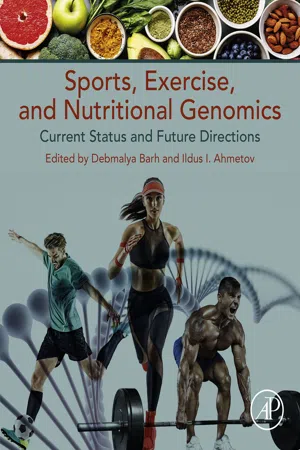
Sports, Exercise, and Nutritional Genomics
Current Status and Future Directions
- 606 pages
- English
- ePUB (mobile friendly)
- Available on iOS & Android
eBook - ePub
Sports, Exercise, and Nutritional Genomics
Current Status and Future Directions
About this book
Sports, Exercise, and Nutritional Genomics: Current Status and Future Directions is the first reference volume to offer a holistic examination of omics-driven advances across different aspects of exercise and sports physiology, biochemistry, sports medicine, psychology, anthropology, and sports nutrition; and highlighting the opportunities towards advance personalized training and athlete health management. More than 70 international experts from 14 countries have discussed key exercise and sport-related themes through the prism of genomics, epigenomics, transcriptomics, proteomics, metabolomics, telomere biology, talent in sport, individual differences in response to regular physical activity, that in the future may empower coaches, sports physicians, fitness experts, genetic counselors, and translational scientists to employ various omics data and approaches in improving health and physical performance of people participating in sports and exercise activities.
Contributors address current knowledge of genetic influence on athletic performance, individual responses to exercise training, as well as the genetics of musculoskeletal phenotypes, exercise-related injuries, flexibility, and neurodegenerative disorders in athletes.
Finally, performance-related and psychological traits associated with epigenetic, transcriptomic and metagenomic biomarkers are also considered, along with nutritional and pharmacogenomic aids in sports medicine and personalized nutrition.
- Effectively synthesizes key themes across molecular aspects of exercise and sports sciences
- Provides a knowledge base for future translation of omics solutions to talent identification, individualized training, and nutrition
- Features contributions from international experts (researchers and clinicians) in the subject area
Information
Section I
Sports genetics
Chapter One
Introduction to genetics of sport and exercise
João Paulo L.F. Guilhermea; Alejandro Lucíab a School of Physical Education and Sport, University of Sao Paulo, São Paulo, Brazil
b School of Health Sciences, European University, Madrid, Spain
b School of Health Sciences, European University, Madrid, Spain
Abstract
There is a large interindividual variance in the response to training in several phenotypes relevant to physical performance—a complex phenomenon, which is the result of the interaction of numerous intrinsic and extrinsic factors. The relative contribution of genetic or environmental factors to this phenotypic variation has long been a topic of discussion. Although both are undoubtedly critical to performance achievement, accumulated evidence suggests an important relative contribution of genetics. Studies that compare DNA structural variations have suggested that certain gene variants may be involved in the interindividual variance of performance achievement, however, the understanding of the influence of genetics on performance have been challenging due to its complex nature. In the last decades, traditional genetic association studies have had limited success, but more robust methodological approaches have been now introduced in order to better evaluate the potential influence of genetics on performance phenotypes.
Keywords
Genome; DNA variants; Polymorphisms; Athletes; Performance; Trainability
1.1 Nature vs nurture influence
It is acceptable to assume that any individual who is highly committed and dedicated to physical training is able to improve performance provided that the stimulus is adequate. However, some individuals appear to be naturally gifted with superior baseline traits or better responses to training than others (Tucker and Collins, 2012). It has been common to observe in the scientific literature a large interindividual variance in the response to training in several phenotypes relevant to physical performance (Bouchard 2012). Even among elite athletes, there may be a wide phenotypic variation—the curve distribution of individual performances for a given sport discipline will certainly show a normal distribution with a limited number of individuals at the extremities. Few individuals seem to be exceptionally gifted and demonstrate extraordinarily high-performance levels. A number of variables can contribute to explain this interindividual variance in response to training (Mann et al., 2014). Human physical performance expresses at a given time point a complex phenomenon, which is the result of the interaction of numerous intrinsic and extrinsic factors (Guilherme et al., 2014). Indeed, many of the intrinsic factors known to contribute to performance-related traits are within their own complex phenotypes determined by both nature and nurture (Tucker and Collins, 2012).
The relative contributions of genetics and environment to phenotypic variation in numerous behavioral and biological traits have long been a topic of interest (Bouchard and Malina, 2014). The degree to which performance potential is predetermined by inherited traits against the degree influenced by environmental factors (training, nutrition, motivation, development opportunities, and overall health conditions) has excited much debate, that is often framed as “nature vs nurture” (Gibson, 2016). The terms nature and nurture were first used in the late 19th century (Galton, 1875). Based on twins and pedigree records, Francis Galton proposed that there is no escape from the conclusion that nature prevails enormously over nurture when the differences of nurture do not exceed what is commonly to be found among persons of the same rank of society and in the same country (Galton, 2012). This implies that the upper limit for an individual performance among persons exposed to the same environment is predetermined by heritable characteristics which no amount of practice or other natural environmental factor could overcome. However, there is also evidence that environmental factors have remarkable influence on performance (Davids and Baker, 2007).
Most of the understanding about environmental influences on exercise performance comes from social and psychological research, which claims that performance in a given task is learned and achieved through extended practice of a given skill (Yan et al., 2016). In 1993, it was proposed that when individuals engage in practice activities with full concentration on improving some specific aspect of performance, the so-called deliberate practice, there is a linear improvement of an individual performance through repetition and successive refinement (Ericsson et al., 1993, 2009). Thus, as a consequence of the accumulated deliberate practice, performance in many areas of expertise considerably increases and can bring out the best in you. In fact, top-level athletes accumulate years of a rigid and organized training schedule on the road to sports excellence, in which quality rather than the amount of training can differentiate athletes of different competitive levels (Ericsson, 2013). Moreover, it was proposed that expert (i.e., top-level) athletes accumulate more hours of training than nonexperts; in particular, they devote more time in activities deemed most relevant for their respective disciplines (Davids and Baker, 2007). Therefore, the deliberate practice appears to be an important contributing factor to performance achievement, but it is not the only one.
A recent metaanalysis showed that deliberate practice accounted for only 18% of the variance in sports performance, leaving 82% of the variance explained by other factors (Macnamara et al., 2016). In fact, the environment influence on sports performance also includes motivation, family support, coaches’ influence, local culture, relative age effect, and birthplace effect (Davids and Baker, 2...
Table of contents
- Cover image
- Title page
- Table of Contents
- Copyright
- Contributors
- About the Editors
- Preface
- Section I: Sports genetics
- Section II: Exercise genetics and molecular physiology
- Section III: Genetics of musculoskeletal exercise-related phenotypes
- Section IV: Genetics of sport-related diseases and medical conditions
- Section V: Nutrigenetics, pharmacogenetics and metabolomics in sport and exercise
- Index
Trusted by 375,005 students
Access to over 1.5 million titles for a fair monthly price.
Study more efficiently using our study tools.
Frequently asked questions
Yes, you can cancel anytime from the Subscription tab in your account settings on the Perlego website. Your subscription will stay active until the end of your current billing period. Learn how to cancel your subscription
No, books cannot be downloaded as external files, such as PDFs, for use outside of Perlego. However, you can download books within the Perlego app for offline reading on mobile or tablet. Learn how to download books offline
Perlego offers two plans: Essential and Complete
- Essential is ideal for learners and professionals who enjoy exploring a wide range of subjects. Access the Essential Library with 800,000+ trusted titles and best-sellers across business, personal growth, and the humanities. Includes unlimited reading time and Standard Read Aloud voice.
- Complete: Perfect for advanced learners and researchers needing full, unrestricted access. Unlock 1.5M+ books across hundreds of subjects, including academic and specialized titles. The Complete Plan also includes advanced features like Premium Read Aloud and Research Assistant.
We are an online textbook subscription service, where you can get access to an entire online library for less than the price of a single book per month. With over 1.5 million books across 990+ topics, we’ve got you covered! Learn about our mission
Look out for the read-aloud symbol on your next book to see if you can listen to it. The read-aloud tool reads text aloud for you, highlighting the text as it is being read. You can pause it, speed it up and slow it down. Learn more about Read Aloud
Yes! You can use the Perlego app on both iOS and Android devices to read anytime, anywhere — even offline. Perfect for commutes or when you’re on the go.
Please note we cannot support devices running on iOS 13 and Android 7 or earlier. Learn more about using the app
Please note we cannot support devices running on iOS 13 and Android 7 or earlier. Learn more about using the app
Yes, you can access Sports, Exercise, and Nutritional Genomics by Debmalya Barh,Ildus I. Ahmetov in PDF and/or ePUB format, as well as other popular books in Biological Sciences & Genetics & Genomics. We have over 1.5 million books available in our catalogue for you to explore.