eBook - PDF
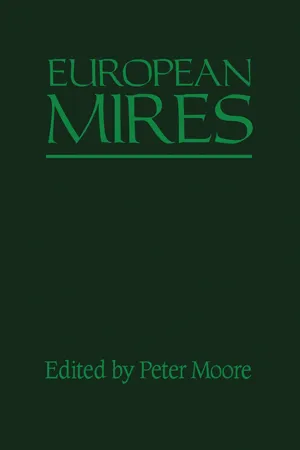
European Mires
About this book
European Mires brings together in a single volume the various ideas and approaches to the classification and nomenclature of mire types, set out in a single language, namely English. It provides a set of clear explanations of how ecologists view their mires in different parts of Europe. In addition, each account provides a summary and a survey of relevant literature in a variety of languages, which should prove of great value to English speaking students of mire systems. The book contains nine chapters and begins with a discussion of the classification of mires in Europe. This is followed by separate chapters on Finnish mires types, Estonian bogs, the mire types of the German Democratic Republic; and the vegetation and development of Central European mires. Subsequent chapters deal with the vegetation and development of blanket mires, British fens, Welsh mires, and wetland communities in Ireland. It is hoped that this present volume will assist in the dismantling of some international barriers and will provide a basis for further work. It may also help foster a global climate of scientific understanding in such a way as to permit the recrudescence of international mire research.
Information
Table of contents
- Front Cover
- European Mires
- Copyright Page
- Table of Contents
- List of Contributors
- Preface
- Chapter 1. The Classification of Mires: an Introduction
- Chapter 2. Key to Finnish Mire Types
- Chapter 3. Estonian Bogs: Plant Cover, Succession and Classification
- Chapter 4. The mire types of the German Democratic Republic
- Chapter 5. The Vegetation and Development of Central European Mires
- Chapter 6. The Vegetation and Development of Blanket Mires
- Chapter 7. British Fens: A Review
- Chapter 8. Welsh Mires: their range of form— a descriptive account
- Chapter 9. Wetland communities in Ireland: a phytosociological review
- Appendix
- Index
Trusted by 375,005 students
Access to over 1.5 million titles for a fair monthly price.
Study more efficiently using our study tools.
Frequently asked questions
Yes, you can cancel anytime from the Subscription tab in your account settings on the Perlego website. Your subscription will stay active until the end of your current billing period. Learn how to cancel your subscription
No, books cannot be downloaded as external files, such as PDFs, for use outside of Perlego. However, you can download books within the Perlego app for offline reading on mobile or tablet. Learn how to download books offline
Perlego offers two plans: Essential and Complete
- Essential is ideal for learners and professionals who enjoy exploring a wide range of subjects. Access the Essential Library with 800,000+ trusted titles and best-sellers across business, personal growth, and the humanities. Includes unlimited reading time and Standard Read Aloud voice.
- Complete: Perfect for advanced learners and researchers needing full, unrestricted access. Unlock 1.5M+ books across hundreds of subjects, including academic and specialized titles. The Complete Plan also includes advanced features like Premium Read Aloud and Research Assistant.
We are an online textbook subscription service, where you can get access to an entire online library for less than the price of a single book per month. With over 1.5 million books across 990+ topics, we’ve got you covered! Learn about our mission
Look out for the read-aloud symbol on your next book to see if you can listen to it. The read-aloud tool reads text aloud for you, highlighting the text as it is being read. You can pause it, speed it up and slow it down. Learn more about Read Aloud
Yes! You can use the Perlego app on both iOS and Android devices to read anytime, anywhere — even offline. Perfect for commutes or when you’re on the go.
Please note we cannot support devices running on iOS 13 and Android 7 or earlier. Learn more about using the app
Please note we cannot support devices running on iOS 13 and Android 7 or earlier. Learn more about using the app
Yes, you can access European Mires by Peter D. Moore in PDF and/or ePUB format, as well as other popular books in Biological Sciences & Ecology. We have over 1.5 million books available in our catalogue for you to explore.