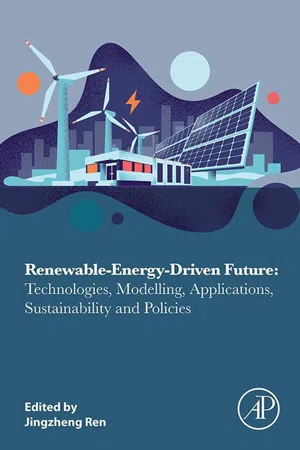
eBook - ePub
Renewable-Energy-Driven Future
Technologies, Modelling, Applications, Sustainability and Policies
- 636 pages
- English
- ePUB (mobile friendly)
- Available on iOS & Android
eBook - ePub
Renewable-Energy-Driven Future
Technologies, Modelling, Applications, Sustainability and Policies
About this book
In order to promote the sustainable development of renewable energy and renewable-energy-driven technologies, Renewable-Energy-Driven Future: Technologies, Modelling, Applications, Sustainability and Policies provides a comprehensive view of the advanced renewable technologies and the benefits of utilizing renewable energy sources.Discussing the ways for promoting the sustainable development of renewable energy from the perspectives of technology, modelling, application, sustainability and policy, this book includes the advanced renewable-energy-driven technologies, the models for renewable energy planning and integration, the innovative applications of renewable energy sources, decision-support tools for sustainability assessment and ranking of renewable energy systems, and the regulations and policies of renewable energy.This book can benefit the researchers and experts of renewable energy by helping them to have a holistic view of renewable energy. It can also benefit the policymakers and decision-makers by helping them to make informed decisions.
- Presents the advanced renewable-energy-driven technologies and the innovative applications of renewable energy sources
- Develops the models for the efficient use of renewable energy, decision-making and the investigation of its climate and economic benefits
- Investigates the sustainability of renewable energy systems
- Features the regulations and policies of renewable energy
Information
Part I
Technologies
Outline
Chapter 1
Solar energy technologies: principles and applications
D. Sakthivadivel1, K. Balaji1, D. Dsilva Winfred Rufuss1, S. Iniyan2 and L. Suganthi2, 11Vellore Institute of Technology, Vellore, Tamil Nadu, India, 22College of Engineering Guindy, Anna University, Chennai, Tamil Nadu, India
Abstract
In the past, attention has been created to use solar energy due to increased environmental pollution. Solar energy utilization through photovoltaic (PV) and thermal technologies is required to replace the conventional use of fossil fuels across the globe. Different types of solar PV (SPV) technologies utilizing the photons as input are driving the life of people. On the other hand, utilizing the solar heat for various applications is categorized as the solar thermal application which includes desalination, heating, cooling, cooking and power generation. Hence the objective of this work is to discuss the fundamentals, recent advancements and applications of different solar utilization technologies. The chapter is categorized into two major sections namely solar PV techniques and solar thermal techniques. In the first section SPV techniques, the principle, operation and recent advancements in the SPV system have been covered. In the second section solar thermal techniques, the principle, construction, working mechanism and current state of the art in recent research on solar collectors, solar cooling techniques, solar pond, solar cooking techniques and solar desalination have been addressed.
Keywords
PV technologies; solar collectors; solar cooling technologies; solar pond; solar cooking; solar desalination
1.1 Introduction
The Sun is the primary source of sustenance for all living and nonliving things on this planet earth. Solar energy is the solitary renewable energy source with immense potential of yearly global insolation at 5600 ZJ [1], as compared to other sources such as biomass and wind. The Sun is a large, radiant spherical unit of hot gas which is composed of hydrogen (~70%), helium (~28%) and rema...
Table of contents
- Cover image
- Title page
- Table of Contents
- Copyright
- List of Contributors
- Part I: Technologies
- Part II: Modelling
- Part III: Applications
- Part IV: Sustainability
- Part V: Policy
- Index
Trusted by 375,005 students
Access to over 1.5 million titles for a fair monthly price.
Study more efficiently using our study tools.
Frequently asked questions
Yes, you can cancel anytime from the Subscription tab in your account settings on the Perlego website. Your subscription will stay active until the end of your current billing period. Learn how to cancel your subscription
No, books cannot be downloaded as external files, such as PDFs, for use outside of Perlego. However, you can download books within the Perlego app for offline reading on mobile or tablet. Learn how to download books offline
Perlego offers two plans: Essential and Complete
- Essential is ideal for learners and professionals who enjoy exploring a wide range of subjects. Access the Essential Library with 800,000+ trusted titles and best-sellers across business, personal growth, and the humanities. Includes unlimited reading time and Standard Read Aloud voice.
- Complete: Perfect for advanced learners and researchers needing full, unrestricted access. Unlock 1.5M+ books across hundreds of subjects, including academic and specialized titles. The Complete Plan also includes advanced features like Premium Read Aloud and Research Assistant.
We are an online textbook subscription service, where you can get access to an entire online library for less than the price of a single book per month. With over 1.5 million books across 990+ topics, we’ve got you covered! Learn about our mission
Look out for the read-aloud symbol on your next book to see if you can listen to it. The read-aloud tool reads text aloud for you, highlighting the text as it is being read. You can pause it, speed it up and slow it down. Learn more about Read Aloud
Yes! You can use the Perlego app on both iOS and Android devices to read anytime, anywhere — even offline. Perfect for commutes or when you’re on the go.
Please note we cannot support devices running on iOS 13 and Android 7 or earlier. Learn more about using the app
Please note we cannot support devices running on iOS 13 and Android 7 or earlier. Learn more about using the app
Yes, you can access Renewable-Energy-Driven Future by Jingzheng Ren in PDF and/or ePUB format, as well as other popular books in Technology & Engineering & Energy. We have over 1.5 million books available in our catalogue for you to explore.