- 377 pages
- English
- ePUB (mobile friendly)
- Available on iOS & Android
eBook - ePub
Cardiovascular Implications of Stress and Depression
About this book
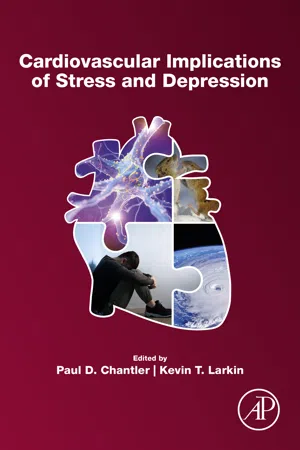
Cardiovascular Implications of Stress and Depression provides an in-depth examination on how exposure to stress influences risk for cardiovascular disease and how depression is associated with this relationship. This authoritative volume examines causal pathways linking stress, depression and cardiovascular disease. In addition, it provides mechanistic insights into how environmental stress can lead to cardiovascular diseases. Current information about mechanistic factors, clinical and epidemiological aspects, and management issues associated with stress/depression are presented. These insights demonstrate how the mechanisms behind chronic stress and depression lead to cardiovascular diseases. In addition, their role in existing diseases (such as obesity, hypertension, and diabetes) is explored.
- Provides the latest information on how stress leads to depression and how stress/depression interacts to accelerate cardiovascular diseases, including stroke
- Delivers insights on how mechanisms of stress/depression affect vasculature
- Explores how to best research this topic from human and pre-clinical models
Information
Chapter 1
Stress, depression, and cardiovascular disease
Kevin T. Larkina; Paul D. Chantlerb a Department of Psychology, West Virginia University, Morgantown, WV, United States
b Division of Exercise Physiology, Robert C. Byrd Health Sciences Center, School of Medicine, West Virginia University, Morgantown, WV, United States
b Division of Exercise Physiology, Robert C. Byrd Health Sciences Center, School of Medicine, West Virginia University, Morgantown, WV, United States
Abstract
Psychological factors have long been hypothesized to increase risk for numerous medical diseases, including cardiovascular disease (CVD). Because the physiological mechanisms through which psychological factors lead to disease pathology are unknown, psychological factors have not been granted the status as recognized risk factors. In 2014, the American Heart Association recommended that depression be granted the status as a risk factor for CVD. Based upon the extensive body of literature that has revealed an association between depression and CVD, this chapter introduces a collection of scholarly works by depicting both causal and corollary models linking stress and depression with CVD. The various physiological mechanisms that explain how the nervous system transduces environmental stress into depression and CVD are also outlined and serve to organize the remaining chapters of this book.
Keywords
Stress; Depression; Cardiovascular disease; Type A behavior pattern
Cardiovascular disease (CVD) has held the unenviably position of being the leading cause of death in industrialized nations for almost a century (Heron and Anderson, 2016). Today, CVD accounts for 1 out of every 4 deaths for men and women in the United States (Centers for Disease Control and Prevention, 2017), and even higher mortality rates worldwide (Mendis et al., 2011). Coupled with cerebrovascular disease (stroke), the third leading cause of death, diseases of the circulatory system account for considerably more morbidity and mortality in the world than any other health condition. Not surprisingly, these diseases represent one of the world’s largest health care concerns, leading to significant costs to the health care system, lost productivity among workers, and serious restrictions to life activities and mobility for those affected by them. Despite gains made in the assessment and treatment of diseases of the circulatory system over the latter half of the 20th century that resulted in reductions in morbidity and mortality, we are again noticing an increased incidence of CVD (Heron and Anderson, 2016).
The vast majority of cases of diseases of the circulatory system are associated with the underlying process of atherosclerosis. Atherosclerosis is the progressive blockage of blood flow through arteries that occurs over decades as the body responds to regular injuries to endothelial cells comprising artery walls caused by perturbed blood flow, heightened arterial pressure, and/or exposure to toxins circulating in the bloodstream. Based upon our understanding of atherosclerosis, it is not surprising that the earliest risk factors for CVD identified were variables that influenced the atherosclerotic process. For example, the diagnosis of essential hypertension presumably promotes endothelial injury through the impact of having chronically elevated arterial pressures throughout daily life. High levels of circulating blood lipids (i.e., hypercholesterolemia), result in coating the endothelium with fatty streaks and eventually fatty plaques, also promoting cellular injury and an impaired bodily response to that injury. Finally, recognizing that tobacco smoke contains many chemicals toxic to the endothelium, one can easily identify biologically plausible mechanisms through which these risk factors for CVD exert their negative health effects by promoting atherosclerosis and eventually the onset of CVD.
Unfortunately, smoking tobacco products, having high cholesterol, and exhibiting high blood pressure accounts for less than half of the variance in predicting onset of CVD (Centers for Disease Control and Prevention, 2017). In this regard, many nonsmokers with perfectly normal cholesterol and blood pressure levels can succumb to a myocardial infarction (i.e., heart attack) and/or stroke, and many individuals who have extensive smoking histories accompanied by untreated hypertension and hypercholesterolemia show no evidence of CVD, even at advanced ages. Our inability to predict onset of CVD accurately from recognized risk factors has led to a search for additional variables that may indeed capture some unique explanatory variance in making these sorts of predictions.
The influence of psychological factors on medical health conditions has been a fertile ground for research for some time, so it was only natural that scientists began examining potential psychological risk factors for CVD. In fact, one could trace theories linking medical conditions to temperaments back to the Greek physician, Hippocrates (460–375 BC), who proposed that medical conditions resulted from an imbalance of various humors in the body that were each associated with specific personality profiles. Although contemporary personality theory traces its roots back to some of the beliefs of early scientists like Hippocrates, adoption of the belief that personality type influenced specific medical disease progression was never fully adopted, partly because a biologically plausible mechanism for such associations was lacking.
In the early part of the 20th century, physiologist Walter Cannon (1915) and endocrinologist Hans Selye (1955) made significant contributions in outlining how exposure to various environmental stimuli, mainly those that elicited strong emotional reactions, led to a cascade of physiological responses that affected most organ systems in the body. Borrowing the terms “stress” and “strain” from mechanical engineers, they described how exposure to environmental events (i.e., stress) was met with an expected and predictable physiological response of the organism (i.e., strain). The importance of their work cannot be understated in providing clues to the potential mechanisms for explaining how stressful events encountered in life could alter the physiological processes that affected blood flow and ultimately the process of atherosclerosis. If indeed the brain transduces environmental events into the physiological sequelae of atherosclerosis, much like it transduces sound or light waves to neural signals, organisms exposed to certain types of toxic environments may be at greater risk for developing CVD. Consequently, if individual differences existed in the magnitude or pattern of these physiological responses to stress, then these specific personality or behavioral profiles could be assessed and identified as potential psychological risk factors for CVD.
One of the initial forays into the search for specific psychological risk factors for CVD was done by cardiologists Friedman and Rosenman (1959) who coined the term Type A Behavior Pattern (TABP) to refer to a constellation of highly prevalent behaviors observed among their cardiac patients. This pattern of behaviors was characterized by a chronic sense of time urgency and impatience, showing competitiveness even in non-competitive situations, and easily-aroused hostility, and was detected using a structured interview designed to evoke behavioral displays of these traits (Rosenman, 1978). Although showing initial promise as a recognized behavioral risk factor, subsequent trials failed to corroborate initial reports (e.g., Dimsdale et al., 1978; Johnston et al., 1987; Shekelle et al., 1985) and TABP was never uniformly accepted as an established risk factor for predicting CVD onset. Subsequent investigations focused on other psychosocial constructs that might enhance our ability to comprehend how exposure to stress increased risk for CVD and functioned as a behavioral risk factor for CVD. Among those that were examined, depression emerged as the one that is most strongly associated with onset of CVD among initially healthy adults as well as for subsequent cardiac events among patients diagnosed with coronary heart disease (for meta-analytic reviews, see Rugulies, 2002; Barth et al., 2004, respectively). In fact, it has been argued that presence of a diagnosis of depression or its less severe counterpart, dysphoric mood, was as strongly associated with CVD as having high blood pressure, high cholesterol, or smoking tobacco. In recognition of this status, the American Heart Association published a statement recommending that depression be considered an established risk factor for poor prognosis among patients with CVD in 2014 (Lichtman et al., 2014).
Despite evidence linking depression to CVD, it is still not given the same status as treating high blood pressure and high cholesterol or encouraging smoking cessation in most medical settings. One reason that depression screening has not been readily adopted in these health care settings pertains to our lack of knowledge pertaining to how exposure to environmental stress can lead to the neuropsychiatric sequelae of depression or perturbations in blood flow that lead to atherosclerosis within the cardiovascular system. If the mechanisms linking stress with depression and CVD were established and understood, it might result in greater adoption of strategies to assess psychological risk factors for CVD in contemporary health care settings. This edited volume aims to provide readers with a comprehensive appraisal of the literature linking stress and depression with CVD, with special attention to the various physiological mechanisms through which stress exerts its negative health effects on both the nervous and circulatory systems.
Basic definitions
Prior to introducing conceptual models of potential relations among these variables, it is important to consider basic definitions of key terms. Although we have already introduced a brief description of the process of atherosclerosis as the underlying mechanism for CVD, it is important to recognize that there are other cardiovascular problems that occur that also lead to significant health consequences, including death. These include disturbances in the pacing of the heart’s contractions (e.g., arrhythmias), compromised mechanical functioning of the four valves of the heart, infections that invade the pericardium that surrounds the heart, and genetic physical abnormalities of the heart itself. Because atherosclerosis underlies the majority of cases of coronary heart disease, stroke, and peripheral vascular disease, we will use the term CVD synonymously with cardiovascular problems caused by atherosclerosis. When other cardiovascular conditions are considered and discussed throughout this volume, we will refer to them by name rather than lumping them together with cardiovascular conditions caused by atherosclerosis.
As noted above, Selye (1955) differentiated stress from strain by referring to stress as the environmental precipitant of the disease and strain as the physiological processes that occur as the body adapted to or attempted to adapt to the precipitating event or circumstance. In this regard, stress is the stimulus and strain is the response. We will make the same distinction here. It needs to be said, however, that not all researchers make this distinction, as many measures of stress used in clinical and research settings actually measure the magnitude of the response to the stress (i.e., strain) or one’s perception of the severity of the stressful event. For purposes of this volume, the term “stress” will refer to the specific stimuli or alterations in environmental contexts to which an organism is exposed, much like Selye’s usage of this term. Although our use of the term “stress” typically refers to stimuli external to the organism, i...
Table of contents
- Cover image
- Title page
- Table of Contents
- Copyright
- Contributors
- Chapter 1: Stress, depression, and cardiovascular disease
- Section 1: Evidence linking stress with depression and cardiovascular disease
- Section 2: Mechanisms linking stress and depression with cardiovascular disease
- Author index
- Subject index
Trusted by 375,005 students
Access to over 1.5 million titles for a fair monthly price.
Study more efficiently using our study tools.
Frequently asked questions
Yes, you can cancel anytime from the Subscription tab in your account settings on the Perlego website. Your subscription will stay active until the end of your current billing period. Learn how to cancel your subscription
No, books cannot be downloaded as external files, such as PDFs, for use outside of Perlego. However, you can download books within the Perlego app for offline reading on mobile or tablet. Learn how to download books offline
Perlego offers two plans: Essential and Complete
- Essential is ideal for learners and professionals who enjoy exploring a wide range of subjects. Access the Essential Library with 800,000+ trusted titles and best-sellers across business, personal growth, and the humanities. Includes unlimited reading time and Standard Read Aloud voice.
- Complete: Perfect for advanced learners and researchers needing full, unrestricted access. Unlock 1.5M+ books across hundreds of subjects, including academic and specialized titles. The Complete Plan also includes advanced features like Premium Read Aloud and Research Assistant.
We are an online textbook subscription service, where you can get access to an entire online library for less than the price of a single book per month. With over 1.5 million books across 990+ topics, we’ve got you covered! Learn about our mission
Look out for the read-aloud symbol on your next book to see if you can listen to it. The read-aloud tool reads text aloud for you, highlighting the text as it is being read. You can pause it, speed it up and slow it down. Learn more about Read Aloud
Yes! You can use the Perlego app on both iOS and Android devices to read anytime, anywhere — even offline. Perfect for commutes or when you’re on the go.
Please note we cannot support devices running on iOS 13 and Android 7 or earlier. Learn more about using the app
Please note we cannot support devices running on iOS 13 and Android 7 or earlier. Learn more about using the app
Yes, you can access Cardiovascular Implications of Stress and Depression by Paul D. Chantler,Kevin T. Larkin in PDF and/or ePUB format, as well as other popular books in Biological Sciences & Biology. We have over 1.5 million books available in our catalogue for you to explore.