eBook - PDF
Paleoecology of Beringia
- 503 pages
- English
- PDF
- Available on iOS & Android
eBook - PDF
Paleoecology of Beringia
About this book
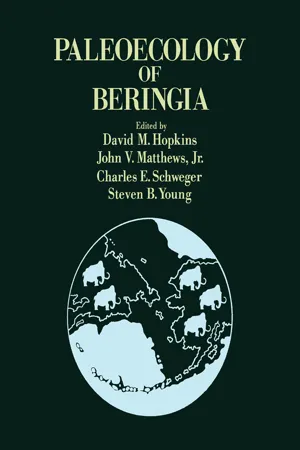
Paleoecology of Beringia is the product of a symposium organized by its editors, sponsored by the Wenner-Gren Foundation for Anthropological Research, and held at the foundation's conference center in Burg Wartenstein, Austria, 8-17 June 1979. The focus of this volume is on the paradox central to all studies of the unglaciated Arctic during the last Ice Age: that vertebrate fossils indicate that from 45,000 to 11,000 years BP an environment considerably more diverse and productive than the present one existed, whereas the botanical record, where it is not silent, supports a far more conservative appraisal of the region's ability to sustain any but the sparsest forms of plant and animal life. The volume is organized into seven parts. Part 1 focuses on the paleogeography of the Beringia. The studies in Part 2 explore the ancient vegatation. Part 3 deals with the steppe-tundra concept and its application in Beringia. Part 4 examines the paleoclimate while Part 5 is devoted to the biology of surviving relatives of the Pleistocene ungulates. Part 6 takes up the presence of man in ancient Beringia. Part 7 assesses the paleoecology of Beringia during the last 40,000 years
Information
Table of contents
- Front Cover
- Paleoecology of Beringia
- Copyright Page
- Table of Contents
- CONTRIBUTORS
- PREFACE
- ACKNOWLEDGMENTS
- PART 1: PALEOGEOGRAPHY
- PART 2: ANCIENT VEGETATION–THE FOSSIL RECORD
- PART 3: THE STEPPE-TUNDRA CONCEPT AND ITS APPLICATION IN BERINGIA
- PART 4: PALEOCLIMATE
- PART 5: PRIMARY PRODUCTION AND THE PLEISTOCENE UNGULATES-THE PRODUCTIVITY PARADOX
- PART 6: MAN IN ANCIENT BERINGIA
- PART 7: PALEOECOLOGY OF BERINGIA – A SYNTHESIS
- REFERENCES
- GENERAL INDEX
- INDEX TO FAUNAL AND FLORAL TAXA
Trusted by 375,005 students
Access to over 1.5 million titles for a fair monthly price.
Study more efficiently using our study tools.
Frequently asked questions
Yes, you can cancel anytime from the Subscription tab in your account settings on the Perlego website. Your subscription will stay active until the end of your current billing period. Learn how to cancel your subscription
No, books cannot be downloaded as external files, such as PDFs, for use outside of Perlego. However, you can download books within the Perlego app for offline reading on mobile or tablet. Learn how to download books offline
Perlego offers two plans: Essential and Complete
- Essential is ideal for learners and professionals who enjoy exploring a wide range of subjects. Access the Essential Library with 800,000+ trusted titles and best-sellers across business, personal growth, and the humanities. Includes unlimited reading time and Standard Read Aloud voice.
- Complete: Perfect for advanced learners and researchers needing full, unrestricted access. Unlock 1.5M+ books across hundreds of subjects, including academic and specialized titles. The Complete Plan also includes advanced features like Premium Read Aloud and Research Assistant.
We are an online textbook subscription service, where you can get access to an entire online library for less than the price of a single book per month. With over 1.5 million books across 990+ topics, we’ve got you covered! Learn about our mission
Look out for the read-aloud symbol on your next book to see if you can listen to it. The read-aloud tool reads text aloud for you, highlighting the text as it is being read. You can pause it, speed it up and slow it down. Learn more about Read Aloud
Yes! You can use the Perlego app on both iOS and Android devices to read anytime, anywhere — even offline. Perfect for commutes or when you’re on the go.
Please note we cannot support devices running on iOS 13 and Android 7 or earlier. Learn more about using the app
Please note we cannot support devices running on iOS 13 and Android 7 or earlier. Learn more about using the app
Yes, you can access Paleoecology of Beringia by David M. Hopkins, John V. Matthews, Charles E. Schweger, David M. Hopkins,John V. Matthews,Charles E. Schweger in PDF and/or ePUB format, as well as other popular books in Biological Sciences & Natural History. We have over 1.5 million books available in our catalogue for you to explore.