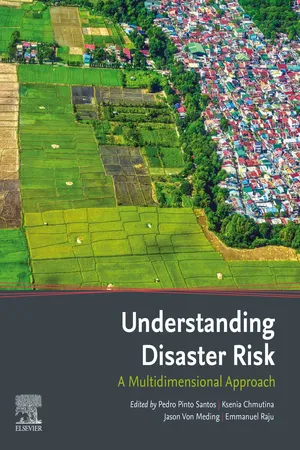
eBook - ePub
Understanding Disaster Risk
A Multidimensional Approach
- 370 pages
- English
- ePUB (mobile friendly)
- Available on iOS & Android
eBook - ePub
Understanding Disaster Risk
A Multidimensional Approach
About this book
Understanding Disaster Risk: A Multidimensional Approach presents the first principle from the UNISDR Sendai Framework for Disaster Risk Reduction, 2015-2030. The framework includes a discussion of risk and resilience from both a theoretical and governance perspective in light of ideas that are shaping our common future. In addition, it presents innovative tools and best practices in reducing risk and building resilience. Combining the applications of social, financial, technological, design, engineering and nature-based approaches, the volume addresses rising global priorities and focuses on strengthening the global understanding of vulnerability, displaced communities, cultural heritages and cultural identity.
Readers will gain a multifaceted understanding of disaster, addressing both historic and contemporary issues. Focusing on the various dimensions of disaster risk, the book details natural and social components of risk and the challenges posed to risk assessment models under the climate change paradigm.
- Addresses the current challenges in policy and practice for building resilience strategies
- Follows the global frameworks for disaster risk reduction and sustainability, specifically the UNISDR Sendai Framework for DRR, 2015-2030
- Aids in understanding the natural and social components of risk in a diverse and globalized world
- Presents the challenges posed to risk assessment models under the climate change paradigm
Information
Topic
Ciencias biológicasSubtopic
Ciencia medioambientalChapter 0.1: Resilience in the Anthropocene
Fronika de Wita; Astrid Catharina Mangnusb; Carolina Giraldo Nohrac a Institute of Social Science, University of Lisbon, Lisboa, Portugal
b Copernicus Institute of Sustainable Development, Utrecht University, Utrecht, The Netherlands
c Department Architecture and Design, Politecnico di Torino, Turin, Italy
b Copernicus Institute of Sustainable Development, Utrecht University, Utrecht, The Netherlands
c Department Architecture and Design, Politecnico di Torino, Turin, Italy
Abstract
The Anthropocene emphasizes an epoch of increased human impact on our planet. It is filled with uncertainty and complexity and asks for a transformative and interdisciplinary response. The objective of this study is to bridge the gap between disciplines working on resilience and draw lessons for improved governance of vulnerable communities. We use a systematic literature review to examine how the Anthropocene and resilience are conceptualized in the fields of human geography, futures studies, and systemic design. In human geography, the focus is on increasing cultural understanding and exploring how explanations coexist in complex ways within and across cultures. The futures field uses the concept as an opportunity to push for sustainability transformations, by inviting communities to futures workshops where they can develop scenarios rooted in their own practices. The field of systemic design emphasizes the need for systemic solutions to build new relations among territorial entities, visualize hidden potentialities, and boost proactive collaboration among local actors. These disciplinary insights show that, although they all hold different perspectives, combining them brings insightful lessons for resilience thinking. We conclude that the Anthropocene needs transformative resilience that combines knowledge from different scientific disciplines with local knowledge and experiences, in a transdisciplinary way.
Keywords
Anthropocene; Adaptive capacity; Transdisciplinarity; Multilevel governance; Resilience
0.1.1: Introduction
High anthropogenic pressures on the earth system are exceeding the planetary boundaries on various scales. We are hitting the planetary ceiling: research shows that if humanity continues living the way it is doing, human well-being is at risk (Rockstrom, 2009) and irreversible changes to the earth system are impending (Lenton et al., 2008; Schellnhuber, 2009). The Great Acceleration has led us to a new geological epoch, the Anthropocene (Crutzen and Stoermer, 2000), in which humans are the dominating force that hold the future in their hands.
The main complicating factors to living in the Anthropocene are that all of its issues are interconnected and that there is a high level of uncertainty, which demands planetary stewardship: an alteration of the relationship between people and planet (Steffen et al., 2011). With the Sustainable Development Goals, adopted by the UN in 2015, we have a universal plan for people and planet—a roadmap for planetary stewardship. However, in order to achieve the SDGs and become planetary stewards, we need a completely new way of thinking that fits the turbulent context of the Anthropocene. Current governance approaches are failing to promote resilience, because of their disciplinary and top-down approach, in which the decision makers are not aware of the complexity of systems and do not take stakeholders’ views into account. Folke (2016), “father” of modern resilience thinking, highlights that being resilient means having strategies and policies in place to deal with the unknown, which is a promising answer to the Anthropocene’s main complicating factors.
Resilience thinking emerged in the 1970s from two different traditions: child psychology and ecosystem ecology. It developed into research streams like community resilience, climate resilience, disaster resilience, and development resilience. Folke et al. (2010) and Folke (2016) describe three forms of resilience: (1) Persistence, or “bouncing back,” which includes continual change and adaptation, but remaining on the same pathways; (2) Adaptability, which is about innovation and change, but also remaining on the same pathways; and (3) Transformability, which is about shifting pathways. Where disaster resilience was more about bouncing back and climate resilience was about adapting to change, the “new” resilience thinking is about transformation: a reconfiguration of systems, values, and beliefs.
An important component of resilience thinking is the features and dynamics of complex systems. Research (Simonsen et al., 2014; Biggs et al., 2015) has provided seven building blocks for applying resilience thinking in order to increase the capacity to deal with unexpected change in complex social-ecological systems. These building blocks are: (1) maintaining diversity and redundancy; (2) managing connectivity; (3) managing slow variables and feedback; (4) treating social-ecological systems as complex systems; (5) encouraging learning; (6) broadening participation; and (7) polycentric governance systems.
This chapter looks at the potential of resilience thinking for addressing the challenges of the Anthropocene by outlining and synthesizing lessons learned in three different academic disciplines: human geography, futures studies, and design studies. How can we combine the insights of these different disciplines and rethink the concept of resilience outside of the “disciplinary box”? By looking at resilience thinking as a dynamic concept, we bring a transdisciplinary and holistic approach for resilience in the Anthropocene and show how this can be applied in practice to decision-making processes. The next section of the chapter outlines the methodology for the multidisciplinary literature review. The third section gives an overview of the results for each of the three disciplines. The fourth section discusses these findings and their relevance for the challenges of the Anthropocene, after which the chapter closes with a conclusion.
0.1.2: Methodology
When discussing a methodology for research that connects the knowledge contained in multiple disciplines, it is of importance to distinguish between three approaches to research: (1) multidisciplinary research; (2) interdisciplinary research; and (3) transdisciplinary research. According to Ramadier (2004), both mult...
Table of contents
- Cover image
- Title page
- Table of Contents
- Copyright
- Contributors
- Preface
- Chapter 0.1: Resilience in the Anthropocene
- Section 1: Risk Assessment
- Section 2: Prevention
- Section 3: Mitigation
- Section 4: Preparedness
- Section 5: Response
- Index
Trusted by 375,005 students
Access to over 1.5 million titles for a fair monthly price.
Study more efficiently using our study tools.
Frequently asked questions
Yes, you can cancel anytime from the Subscription tab in your account settings on the Perlego website. Your subscription will stay active until the end of your current billing period. Learn how to cancel your subscription
No, books cannot be downloaded as external files, such as PDFs, for use outside of Perlego. However, you can download books within the Perlego app for offline reading on mobile or tablet. Learn how to download books offline
Perlego offers two plans: Essential and Complete
- Essential is ideal for learners and professionals who enjoy exploring a wide range of subjects. Access the Essential Library with 800,000+ trusted titles and best-sellers across business, personal growth, and the humanities. Includes unlimited reading time and Standard Read Aloud voice.
- Complete: Perfect for advanced learners and researchers needing full, unrestricted access. Unlock 1.5M+ books across hundreds of subjects, including academic and specialized titles. The Complete Plan also includes advanced features like Premium Read Aloud and Research Assistant.
We are an online textbook subscription service, where you can get access to an entire online library for less than the price of a single book per month. With over 1.5 million books across 990+ topics, we’ve got you covered! Learn about our mission
Look out for the read-aloud symbol on your next book to see if you can listen to it. The read-aloud tool reads text aloud for you, highlighting the text as it is being read. You can pause it, speed it up and slow it down. Learn more about Read Aloud
Yes! You can use the Perlego app on both iOS and Android devices to read anytime, anywhere — even offline. Perfect for commutes or when you’re on the go.
Please note we cannot support devices running on iOS 13 and Android 7 or earlier. Learn more about using the app
Please note we cannot support devices running on iOS 13 and Android 7 or earlier. Learn more about using the app
Yes, you can access Understanding Disaster Risk by Pedro Pinto Santos,Ksenia Chmutina,Jason Von Meding,Emmanuel Raju in PDF and/or ePUB format, as well as other popular books in Ciencias biológicas & Ciencia medioambiental. We have over 1.5 million books available in our catalogue for you to explore.