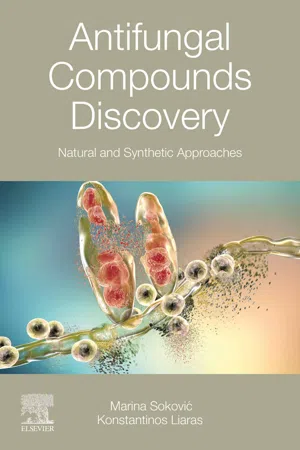
eBook - ePub
Antifungal Compounds Discovery
Natural and Synthetic Approaches
- 290 pages
- English
- ePUB (mobile friendly)
- Available on iOS & Android
eBook - ePub
About this book
Fungi are both the cause of many major health problems and an incredible source of compounds for developing new medicinal treatments, and with the increasing emergence of multidrug resistance, the need for new antimicrobial agents is greater than ever. Antifungal Compounds Discovery provides researchers with a detailed study of both natural and synthetic compounds that can be effective against a variety of fungal species, supporting and encouraging the design of innovative, potent new drug candidates for the treatment of fungal infections.
Beginning with an introduction to both the history and latest developments in this field, the book goes on to provide helpful background information on key fungal species before outlining current antifungal therapies and reasons further development is needed. Detailed chapters then follow reviewing a broad range of natural and synthetic antifungal agents, and discussing the synergistic effect of working with both simultaneously. Finally, the book concludes by considering potential future developments in this important field.
Supported with detailed schemes and key information on the biological activity of all selected compounds, Antifungal Compounds Discovery is a comprehensive guide helping researchers understand the relationship between specific chemical structures and their antifungal potency, and a key tool for all those involved in the identification and development of antimicrobial compounds.
- Provides an overview of the most specific mycotic infections and fungal species as background for compound development
- Presents the chemical formulas of all natural and synthetic compounds reviewed
- Combines detailed information about origin, isolation and possible therapeutic uses of all indexed compounds, including biological activity, mechanism of action and SAR information
Information
Topic
Physical SciencesSubtopic
Organic ChemistryChapter 1: Introduction
Marina Sokovića; Konstantinos Liarasb a Mycological Laboratory, Institute for Biological Research “Siniša Stanković”, University of Belgrade, National Institute of Republic of Serbia, Belgrade, Serbia
b Department of Pharmaceutical Chemistry, School of Pharmacy, Aristotle University of Thessaloniki, Thessaloniki, Greece
b Department of Pharmaceutical Chemistry, School of Pharmacy, Aristotle University of Thessaloniki, Thessaloniki, Greece
Abstract
This chapter introduces the reasons why fungal infections still remain a therapeutic problem with emphasis on the issue of antimicrobial resistance and the causes of its emergence. Facts and ideas, which could be taken into account in future approaches and research projects in the field of antifungals, are mentioned. Terms, which became very important recently concerning fungal infections such as biofilm formation, quorum sensing, and autoinducers, are explained and indicated as potential targets for innovative drugs. A recent update on studies is presented regarding natural and synthetic antifungals. The aims and general content of this book are explained in order to provide some aspects of the following chapters.
Keywords
Fungi; Fungal infections; Antifungal activity; Antimicrobial resistance; Quorum sensing; Biofilm; Antifungals
Infectious diseases in humans have markedly increased during the past 10 years, especially in immunocompromised patients. Consequently, as high as 10% of hospital-acquired systemic infections are caused by fungi (Soković et al., 2006). Fungal infections could be provoked by primary and opportunistic pathogens. Primary pathogens are capable to provoke infection in the healthy population, while opportunistic ones could be responsible for infection in immunosuppressed organisms.
The research efforts concerning antimicrobials were focused mainly to bacterial infections and antibacterial resistance, delaying that way the progress in testing fungal diseases and resistance to antifungal agents. First of all, fungal diseases were for many years neglected and fungi as pathogens were not recognized and accepted as important (Wey et al., 1988). A large increase in fungal infections was noticed in late 1960s, when antibiotic treatments were developed in high extent and fungi started to represent a global health problem and threat (Vandeputte et al., 2012). The increase of fungal diseases is associated with changes in medical practice such as uncontrolled usage of antibiotics (especially broad-spectrum ones), frequent use of therapies that suppress immune system, utilization of indwelling intravenous devices, and spread of chronic immunosuppressive viral infections such as AIDS (Ghannoum and Rice, 1999).
Fungal infections still remain a therapeutic problem despite the availability of a number of treatments and can become an important issue in the care of patients with compromised immune system (Nychas, 1995). This could be a consequence of infectious diseases, chemotherapy, transplantations, and treatment of autoimmune diseases such as rheumatoid arthritis, AIDS, Crohn’s disease, etc., or might be a result of aging, but also as consequence of uncontrolled use of antimycotics. Increased numbers of immunocompromised persons lead to a rise in the number of people that have succumbed to fungal diseases. The frequency of fungal diseases is higher in low socioeconomic status communities: bad living conditions lead more often to skin-to-skin contact and close proximity to animals, while hygiene may be suboptimal (Havlickova et al., 2008).
Diseases provoked by fungi are often more difficult to treat than bacterial infections. Either topical or oral treatments are long term and with limited success in controlling the fungus, or completely ineffective. The majority of infections are chronic, tending to recurrence of the disease. One of the difficulties in antifungal therapy is that existing antifungal drugs usually cause harmful side effects due to similar cellular structure and functions between eukaryotic human and fungal cells.
Fungi are in general being controlled by drugs and the use of antimycotics is limited due to their undesirable effects, including teratogenicity, carcinogenicity, acute but also chronic toxicity and extended degradation period with consequences affecting environmental pollution (Shin and Lim, 2004).
It is obvious that some barriers are present in the effective reduction of mycoses: difficult elimination of fungi due to the fact that they are widespread in the nature; difficult diagnosis because fungi have various clinical manifestations that are host dependent; difficult to establish proper therapy due to restricted access to a number of available drugs; successful treatments are available only for a limited number of fungi (Marković et al., 2016).
Two main populations are in risk to acquire invasive infections by fungi. In the first group are included individuals who are susceptible to infection because of their geographic location and their infections can be referred to as endemic mycoses. In the second group are included individuals who possess increased host susceptibility, developing in that way opportunistic infections (immunocompromised, severely ill, malnourished patients, etc.) (Fridkin and Jarvis, 1996).
There is also some discordance and limitation in the interpretation of results obtained from in vivo and in vitro data; infections provoked by susceptible strains respond to appropriate therapy in ∼ 90% of cases, whereas infections due to resistant strains respond in ∼ 60% of cases (Rex and Pfaller, 2002).
Determination of minimal inhibitory concentration (MIC) in vitro that could inhibit fungal growth is also limited, because MIC levels do not always represent the most optimal measurement of resistance. Knowing that for the majority of fungal species, or at least for those which are important in medicine, there is a determined MIC for a specific studied drug, it is necessary to estimate its average MIC. Consequently, one of the common ways to define a strain as resistant is by observing a MIC higher than the average for the corresponding drug. There are suggestions and considerations that determination of minimum effective concentration of some drug should be done at hyphal cells, not only at spores and that might be a more appropriate end point than MIC obtained by testing the susceptibility of filamentous fungi to echinocandins (Kurtz et al., 1994). In any case, it is widely accepted that testing antifungal activity means determination of MIC and minimal fungicidal concentration (MFC) against conidia rather than sensitivity of clinically more important hyphal structures (Kanafani and Perfect, 2008).
The interpretation and comparison of the results obtained from different research groups are often very difficult due to differences in methodology, fungal strains, control drugs, etc. This has to be adapted at first for in vitro investigation and afterwards for testing antifungal activity in vivo and in clinical trials. Once reproducible methodologies and standards are established, it will be much easier to transfer knowledge from labs to patients.
One of the acknowledged ways to define clinical resistance is by evaluating the persistence of progression of a microbial infection despite administering the appropriate therapy. Especially for fungal infections, characterizing clinical response to therapy as successful, depends not only on the susceptibility of the pathogenic fungus, but also on the immune system condition of the host, patient compliance, drug pharmacokinetics, and absence of a persistent or protected focus of infection (f.i. abscess or catheter).
One of the greatest scientific achievements of 20th century is the development of new, effective, and mass-produced antimicrobial agents. Antibiotics and antimycotics comprised western medicine’s primary defense against infectious diseases for more than 60 years. After a long “antibiotics era,” when millions of lives were saved, our chemical shield has become increasingly leaky. World Health Organization published that “the world is on the brink of losing these miracle cures (antibiotics)” and that “in the absence of urgent corrective and protective actions, the world is heading towards a post-antibiotic era, in which many common infections will no longer have a cure and, once again, kill unabated” (Liljeqvist et al., 2012).
Antimycotic agents are in most of the cases the choice of preference in order to treat this kind of infections, being alongside with antibiotics the most widely used therapeutics around the globe. Despite the successful application of conventional antifungals for many years, their uncontrolled and injudicious use, as mentioned, led to the emergence of numerous resistant fungal species.
It should also be noted that in many countries, the administration of topical antifungal drugs is relatively uncontrolled. The use of dermatological products that contain antifungal drugs, alone or in combination with corticosteroids, has become very familiar to patients, since they consider them as totally safe, giving extreme dimensions to the problem.
Another factor that should be taken into account is the economic status of patients. There are many cases in which due to financial problems, combined with difficult access to public health institutions, patients turn to the dangerous “solution” of self-treatment. This phenomenon has the result of overuse of certain Over-The-Counter (OTC) antifungals with dosage/duration treatment schemes, which are self-defined from the personal experience of each patient. False self-diagnoses and wrong treatment schemes can prove to be even worse than no treatment at all.
We should also take into account some kinds of human behavior that can also potentially promote the emergence of resistance. An excellent example is the case of noncompliance of patients with the appropriate treatments. Noncompliance takes place when patients forget to take their medication, prematurely forfeit treatment when they start to feel better, or are not able to cover the whole cost of their therapeutic scheme.
In a number of countries, the issues of noncompliance and self-medication become even greater due to the fact that a series of the available antimicrobial drugs are not produced under the proper standards, they are counterfeit, or have expired in terms of efficacy (Knobler et al., 2003).
Another key factor that contributes to the resistance issue is the administration of series of antimicrobials in animals that are raised for food (poultry, pigs, cows, etc.). The only thing that has not been clarified yet is the contribution of that kind of agricultural in the emergence and spread of resistance pathogens that are dangerous for humans. While in some studies it was stated that this problem is under control by different programs, in others it was proposed that the level of risk is much higher than we suppose. It was mentioned that by using antimicrobial compounds in animal care, either for growth promotion or for therapeutic rea...
Table of contents
- Cover image
- Title page
- Table of Contents
- Copyright
- Dedications
- Acknowledgments
- Chapter 1: Introduction
- Chapter 2: Fungal infections—Background to specific fungal species
- Chapter 3: Antifungal therapy
- Chapter 4: Natural products as antifungals
- Chapter 5: Synthetic antifungal compounds
- Chapter 6: Future trends
- Chapter 7: Concluding remarks
- Index
Trusted by 375,005 students
Access to over 1.5 million titles for a fair monthly price.
Study more efficiently using our study tools.
Frequently asked questions
Yes, you can cancel anytime from the Subscription tab in your account settings on the Perlego website. Your subscription will stay active until the end of your current billing period. Learn how to cancel your subscription
No, books cannot be downloaded as external files, such as PDFs, for use outside of Perlego. However, you can download books within the Perlego app for offline reading on mobile or tablet. Learn how to download books offline
Perlego offers two plans: Essential and Complete
- Essential is ideal for learners and professionals who enjoy exploring a wide range of subjects. Access the Essential Library with 800,000+ trusted titles and best-sellers across business, personal growth, and the humanities. Includes unlimited reading time and Standard Read Aloud voice.
- Complete: Perfect for advanced learners and researchers needing full, unrestricted access. Unlock 1.5M+ books across hundreds of subjects, including academic and specialized titles. The Complete Plan also includes advanced features like Premium Read Aloud and Research Assistant.
We are an online textbook subscription service, where you can get access to an entire online library for less than the price of a single book per month. With over 1.5 million books across 990+ topics, we’ve got you covered! Learn about our mission
Look out for the read-aloud symbol on your next book to see if you can listen to it. The read-aloud tool reads text aloud for you, highlighting the text as it is being read. You can pause it, speed it up and slow it down. Learn more about Read Aloud
Yes! You can use the Perlego app on both iOS and Android devices to read anytime, anywhere — even offline. Perfect for commutes or when you’re on the go.
Please note we cannot support devices running on iOS 13 and Android 7 or earlier. Learn more about using the app
Please note we cannot support devices running on iOS 13 and Android 7 or earlier. Learn more about using the app
Yes, you can access Antifungal Compounds Discovery by Marina Sokovic,Konstantinos Liaras in PDF and/or ePUB format, as well as other popular books in Physical Sciences & Organic Chemistry. We have over 1.5 million books available in our catalogue for you to explore.