eBook - ePub
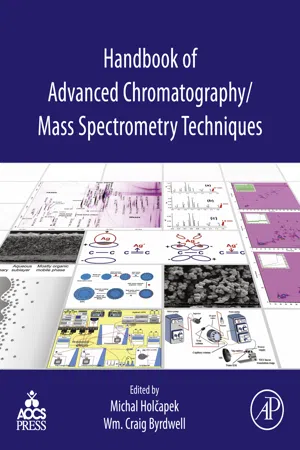
Handbook of Advanced Chromatography /Mass Spectrometry Techniques
- 520 pages
- English
- ePUB (mobile friendly)
- Available on iOS & Android
eBook - ePub
Handbook of Advanced Chromatography /Mass Spectrometry Techniques
About this book
Handbook of Advanced Chromatography /Mass Spectrometry Techniques is a compendium of new and advanced analytical techniques that have been developed in recent years for analysis of all types of molecules in a variety of complex matrices, from foods to fuel to pharmaceuticals and more. Focusing on areas that are becoming widely used or growing rapidly, this is a comprehensive volume that describes both theoretical and practical aspects of advanced methods for analysis. Written by authors who have published the foundational works in the field, the chapters have an emphasis on lipids, but reach a broader audience by including advanced analytical techniques applied to a variety of fields.
Handbook of Advanced Chromatography / Mass Spectrometry Techniques is the ideal reference for those just entering the analytical fields covered, but also for those experienced analysts who want a combination of an overview of the techniques plus specific and pragmatic details not often covered in journal reports. The authors provide, in one source, a synthesis of knowledge that is scattered across a multitude of literature articles. The combination of pragmatic hints and tips with theoretical concepts and demonstrated applications provides both breadth and depth to produce a valuable and enduring reference manual. It is well suited for advanced analytical instrumentation students as well as for analysts seeking additional knowledge or a deeper understanding of familiar techniques.
- Includes UHPLC, HILIC, nano-liquid chromatographic separations, two-dimensional LC-MS (LCxLC), multiple parallel MS, 2D-GC (GCxGC) methodologies for lipids analysis, and more
- Contains both practical and theoretical knowledge, providing core understanding for implementing modern chromatographic and mass spectrometric techniques
- Presents chapters on the most popular and fastest-growing new techniques being implemented in diverse areas of research
Trusted by 375,005 students
Access to over 1.5 million titles for a fair monthly price.
Study more efficiently using our study tools.
Information
Chapter 1
Theory and Practice of UHPLC and UHPLC–MS
Davy Guillarme1,2, and Jean-Luc Veuthey1,2 1University of Geneva, Geneva, Switzerland 2University of Lausanne, Lausanne, Switzerland
Abstract
Ultrahigh-pressure (or performance) liquid chromatography (UHPLC) consists of using columns packed with sub-2 μm particles, in conjunction with a system that withstands very high pressures (up to 1500 bar). The goal of this chromatographic approach is to increase sample throughput and/or peak capacity. This strategy became commercially available in 2004 and since then, a large variety of UHPLC systems and columns packed with sub-2 μm particles have been introduced by numerous providers. In this chapter, various aspects of UHPLC will be discussed, such as the theoretical advantages of working with reduced particle sizes in liquid chromatography (LC), the constraints in terms of instrumentation, the effect of elevated pressure on mobile phase properties, a comparison with other existing strategies to attain ultrafast or highly efficient separations, the rules for method transfer between high-pressure liquid chromatography and UHPLC, and finally some applications of UHPLC–MS in bioanalysis, multiresidue screening, and metabolomics.
Keywords
Bioanalysis; Frictional heating; Metabolomics; Method transfer; Multiresidue screening; UHPLC; UHPLC–MS
1. Introduction
Reversed-phase liquid chromatography (RPLC) is currently one of the most widely used separation techniques. During the last few years, some substantial improvements, such as innovative supports and instrumentation, have been brought forth to perform high-throughput analyses and highly efficient separations in RPLC (Guillarme et al., 2007b; Novakova et al., 2006). Such advances were mainly driven by the need to handle either a growing number of analyses or more complex samples.
Regarding high-throughput separations, there is a growing demand in numerous fields, including toxicology, doping, forensics, clinical chemistry, and environmental analyses, where the delivery time response must be reduced as much as possible. The pharmaceutical field, with its need for enhanced productivity and reduced costs, is certainly the main driving force for faster separations (Wren and Tchelitcheff, 2006). Because of the high number of analyses required for common pharmaceutical applications, such as purity assays, pharmacokinetic studies, and quality control, rapid analytical procedures (less than 5 min including equilibration time) are often mandatory (Al-Sayah et al., 2008).
Highly efficient separations are also necessary for many applications, including proteomics, plant extract analysis, and metabolomics, which all deal with very complex samples, such as biological samples, tryptic digests, or natural plant extracts (Grata et al., 2008; Petricoin and Liotta, 2004). With such difficult samples, conventional high-pressure liquid chromatography (HPLC) systems present some obvious limitations.
Among the different strategies used to achieve fast and high-resolution separations, ultrahigh-pressure liquid chromatography (UHPLC) has been rapidly recognized as a powerful and robust analytical tool. As shown in Fig. 1.1, the number of articles published in the fields of UHPLC and UHPLC–mass spectrometry (MS) has risen very quickly since 2004. Thus, in this chapter, the possibility to speed up and/or attain highly efficient separations will be demonstrated, using the UHPLC strategy in combination with UV as well as MS detectors. This chapter will also discuss the advantages and drawbacks of this approach, in comparison with other existing techniques.

Figure 1.1 Number of papers published each year in the field of ultrahigh-pressure liquid chromatography (UHPLC) and UHPLC–mass spectrometry (MS), since 2004. Before this date, only few papers were published by Jorgenson's and Lee's groups. Blue bars (light gray in print versions) were obtained with keyword “UHPLC”, whereas red bars (dark gray in print versions) were obtained with an additional filter (keyword “MS”). From Scifinder scholar 2016 search of the chemical abstracts database. Date of information gathering: August 2016.
2. Brief Description of Ultrahigh-Pressure Liquid Chromatography and Historical Background
2.1. Interest in Small Particles in Liquid Chromatography
In liquid chromatography (LC), it is well established that a reduction of particle size (dp) provides an important gain in chromatographic performance (Knox, 1977; Knox and Saleeem, 1969; Poppe, 1997). Indeed, the reduction of dp allows faster separations as well as higher plate counts. Since the beginning of LC, there has been a continuing progression in the reduction of particle size that has culminated in the commercialization of columns packed with sub-2 μm particles (Table 1.1). According to Eqs. (1.1) and (1.2), these small particles lead to significant improvements in terms of (1) efficiency because N (number of theoretical plates) is inversely proportional to dp, and (2) time reduction because the optimal mobile phase linear velocity (u) is inversely proportional to particle diameter.

where, L is the column length, h the reduced plate height (generally between 2 and 3), and dp the particle size.

where, v is the reduced linear velocity and Dm the diffusion coefficient of the solute into the mobile phase.
Table 1.1
Evolution of Particles Size in Liquid Chromatography
| Years | Particle Size (μm) | Plates/15 cm |
| 1950s | 100 | 200 |
| 1967 | 50 | 1000 |
| 1972 | 10 | 6000 |
| 1985 | 5 | 12,000 |
| 1992 | 3–3.5 | 22,000 |
| 1996a | 1.5 | 30,000 |
| 2000 | 2.5 | 25,000 |
| 2004 | 1.7 | 30,000 |
Table of contents
- Cover image
- Title page
- Table of Contents
- Dedication
- Copyright
- List of Contributors
- Preface
- Chapter 1. Theory and Practice of UHPLC and UHPLC–MS
- Chapter 2. Advances in Hydrophilic Interaction Liquid Chromatography
- Chapter 3. Chiral Separations. Chiral Dynamic Chromatography in the Study of Stereolabile Compounds
- Chapter 4. Silver-Ion Liquid Chromatography–Mass Spectrometry
- Chapter 5. Porous Monolithic Layers and Mass Spectrometry
- Chapter 6. New Materials for Stationary Phases in Liquid Chromatography/Mass Spectrometry
- Chapter 7. Introduction to Two-Dimensional Liquid Chromatography—Theory and Practice
- Chapter 8. Recent Advances in Comprehensive Two-Dimensional Liquid Chromatography for the Analysis of Natural Products
- Chapter 9. Nano-Liquid Chromatographic Separations
- Chapter 10. Multiple Parallel Mass Spectrometry for Liquid Chromatography
- Chapter 11. Comprehensive Gas Chromatography Methodologies for the Analysis of Lipids
- Chapter 12. Ultra-High Performance Supercritical Fluid Chromatography–Mass Spectrometry
- Index
Frequently asked questions
Yes, you can cancel anytime from the Subscription tab in your account settings on the Perlego website. Your subscription will stay active until the end of your current billing period. Learn how to cancel your subscription
No, books cannot be downloaded as external files, such as PDFs, for use outside of Perlego. However, you can download books within the Perlego app for offline reading on mobile or tablet. Learn how to download books offline
Perlego offers two plans: Essential and Complete
- Essential is ideal for learners and professionals who enjoy exploring a wide range of subjects. Access the Essential Library with 800,000+ trusted titles and best-sellers across business, personal growth, and the humanities. Includes unlimited reading time and Standard Read Aloud voice.
- Complete: Perfect for advanced learners and researchers needing full, unrestricted access. Unlock 1.5M+ books across hundreds of subjects, including academic and specialized titles. The Complete Plan also includes advanced features like Premium Read Aloud and Research Assistant.
We are an online textbook subscription service, where you can get access to an entire online library for less than the price of a single book per month. With over 1.5 million books across 990+ topics, we’ve got you covered! Learn about our mission
Look out for the read-aloud symbol on your next book to see if you can listen to it. The read-aloud tool reads text aloud for you, highlighting the text as it is being read. You can pause it, speed it up and slow it down. Learn more about Read Aloud
Yes! You can use the Perlego app on both iOS and Android devices to read anytime, anywhere — even offline. Perfect for commutes or when you’re on the go.
Please note we cannot support devices running on iOS 13 and Android 7 or earlier. Learn more about using the app
Please note we cannot support devices running on iOS 13 and Android 7 or earlier. Learn more about using the app
Yes, you can access Handbook of Advanced Chromatography /Mass Spectrometry Techniques by Michal Holcapek,Wm. Craig Byrdwell in PDF and/or ePUB format, as well as other popular books in Technology & Engineering & Industrial & Technical Chemistry. We have over 1.5 million books available in our catalogue for you to explore.