eBook - PDF
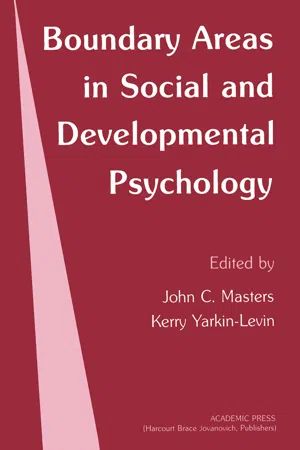
Boundary Areas in Social and Developmental Psychology
- 337 pages
- English
- PDF
- Available on iOS & Android
eBook - PDF
Boundary Areas in Social and Developmental Psychology
About this book
Boundary Areas in Social and Developmental Psychology is based largely on the proceedings of a conference at Vanderbilt University in June 1981. One of the goals is to highlight some examples of research that illustrate facets of the important boundary area between social and developmental psychology. The book opens with a chapter that deals with the broad issues of boundary areas in psychology, ending with specific consideration of the boundary between social and developmental psychology. This is followed by separate chapters that consider general propositions regarding the importance of integrating concepts and methods from social and developmental psychology in the study of social relationships; show how integrating social and developmental considerations can assist in the understanding of relationships between parents and children; and apply developmental and social concepts to identify and study some of the aspects of the marital relationship that may lead to its dissolution. Subsequent chapters deal with boundary area issues focusing primarily on children's social behavior. These include the complexity of social processes inherent in children's peer relationships and the role of social exchange processes in social relationships from infancy to adulthood.
Information
Table of contents
- Front Cover
- Boundary Areas in Social and Developmental Psychology
- Copyright Page
- Table of Contents
- Contributors
- Preface
- Chapter 1. Boundary Areas in Psychology
- Chapter 2. Some Observations on the Study of Personal Relationships
- Chapter 3. Microsocial Process: A View from the Boundary
- Chapter 4. Why Marriages Fail: Affective and Physiological Patterns in Marital Interaction
- Chapter 5. Social Support Processes
- Chapter 6. Children's Peer Relationships: An Examination of Social Processes
- Chapter 7. A Developmental Approach to Social Exchange Processes
- Chapter 8. The Influence of Group Discussions on Children's Moral Decisions
- Chapter 9. Inferences about the Actions of Others: Developmental and Individual Differences in Using Social Knowledge
- Chapter 10. A Distinction between Two Types of Relationships and Its Implications for Development
- Chapter 11. Self-Evaluation Maintenance Processes: Implications for Relationshipsand for Development
- Author Index
- Subject Index
Trusted by 375,005 students
Access to over 1.5 million titles for a fair monthly price.
Study more efficiently using our study tools.
Frequently asked questions
Yes, you can cancel anytime from the Subscription tab in your account settings on the Perlego website. Your subscription will stay active until the end of your current billing period. Learn how to cancel your subscription
No, books cannot be downloaded as external files, such as PDFs, for use outside of Perlego. However, you can download books within the Perlego app for offline reading on mobile or tablet. Learn how to download books offline
Perlego offers two plans: Essential and Complete
- Essential is ideal for learners and professionals who enjoy exploring a wide range of subjects. Access the Essential Library with 800,000+ trusted titles and best-sellers across business, personal growth, and the humanities. Includes unlimited reading time and Standard Read Aloud voice.
- Complete: Perfect for advanced learners and researchers needing full, unrestricted access. Unlock 1.5M+ books across hundreds of subjects, including academic and specialized titles. The Complete Plan also includes advanced features like Premium Read Aloud and Research Assistant.
We are an online textbook subscription service, where you can get access to an entire online library for less than the price of a single book per month. With over 1.5 million books across 990+ topics, we’ve got you covered! Learn about our mission
Look out for the read-aloud symbol on your next book to see if you can listen to it. The read-aloud tool reads text aloud for you, highlighting the text as it is being read. You can pause it, speed it up and slow it down. Learn more about Read Aloud
Yes! You can use the Perlego app on both iOS and Android devices to read anytime, anywhere — even offline. Perfect for commutes or when you’re on the go.
Please note we cannot support devices running on iOS 13 and Android 7 or earlier. Learn more about using the app
Please note we cannot support devices running on iOS 13 and Android 7 or earlier. Learn more about using the app
Yes, you can access Boundary Areas in Social and Developmental Psychology by John C. Masters, Kerry Yarkin-Levin, John C. Masters,Kerry Yarkin-Levin in PDF and/or ePUB format, as well as other popular books in Psychology & History & Theory in Psychology. We have over 1.5 million books available in our catalogue for you to explore.