eBook - ePub
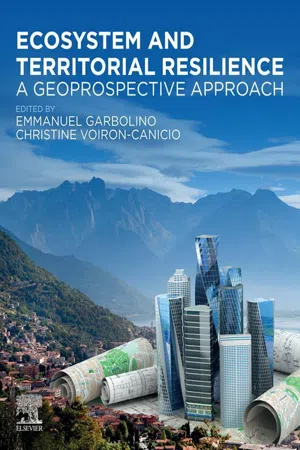
Ecosystem and Territorial Resilience
A Geoprospective Approach
- 400 pages
- English
- ePUB (mobile friendly)
- Available on iOS & Android
eBook - ePub
Ecosystem and Territorial Resilience
A Geoprospective Approach
About this book
Ecosystem and Territorial Resilience: A Geoprospective Approach provides a full review of the geoprospective approach and how it can be used in planning for and implementing environmental and territorial resilience measures. The geoprospective approach is a way to predict and assess for future risks, and is a comprehensive method for identifying and addressing potential change impacts. In addition to the main concepts and methods of this approach, the book presents applications and case studies for different spatio-temporal scales and problems related to the degradation of socio-ecosystems, as well as applying the geoprospective approach to environmental and urban planning.The book offers an interdisciplinary perspective, tying in concepts and techniques from geography, including spatial analysis methods, modelling, and GIS, to address issues of ecological impacts of climate change, urban risk and resilience, land use changes, coastal impacts, and sustainable development and potential of adaptability. This book is a unique and integral resource for policy makers, environmental and territorial managers, scientists, engineers, consultants, and graduate students interested in anticipating future change in socio-ecosystems.
- Introduces the geoprospective approach to assess the impact of global changes on socio-ecosystems, and potential risk situations for ecosystems and society
- Includes geographical techniques such as spatial analysis methods, modeling, and GIS to address various climate change issues and to detect vulnerabilities vs adaptive capacities of spatial systems
- Provides case studies as well as interviews with planners and policy makers regarding their views on territorial planning and expectations of the geoprospective
Information
Table of contents
- Cover image
- Title page
- Table of Contents
- Copyright
- List of contributors
- About the editors
- About the authors
- Preface
- Acknowledgments
- Chapter 1. The origins of geoprospective
- Chapter 2. Anticipating the impacts of future changes on ecosystems and socioecosystems: main issues of geoprospective
- Chapter 3. Knowledge challenges of the geoprospective approach applied to territorial resilience
- Chapter 4. Methods and tools in geoprospective
- Chapter 5. Geoprospective approach for biodiversity conservation taking into account human activities and global warming
- Chapter 6. Assessing the territorial adoption potential of electric mobility: geoprospective and scenarios
- Chapter 7. The touristic model of Valais facing climate change: geoprospective simulations of more environmentally integrated development models
- Chapter 8. Geoprospective assessment of the wood energy supply chain sustainability in a context of global warming and land use change within 2050 in Mediterranean area
- Chapter 9. Simulating together multiscale and multisectoral adaptations to global change and their impacts: A generic serious game and its implementation in coastal areas in France and South Africa
- Chapter 10. Geoprospective as a support to marine spatial planning: some French experience-based assumptions and findings
- Chapter 11. Simulating the interactions of environmental and socioeconomic dynamics at the scale of an ecodistrict: urban modeling of Gerland (Lyon, France)
- Chapter 12. Geodesign for collaborative spatial planning: three case studies at different scales
- Chapter 13. How do public policies respond to spatialized environmental issues? Feedback and perspectives
- Index
Trusted by 375,005 students
Access to over 1.5 million titles for a fair monthly price.
Study more efficiently using our study tools.
Frequently asked questions
Yes, you can cancel anytime from the Subscription tab in your account settings on the Perlego website. Your subscription will stay active until the end of your current billing period. Learn how to cancel your subscription
No, books cannot be downloaded as external files, such as PDFs, for use outside of Perlego. However, you can download books within the Perlego app for offline reading on mobile or tablet. Learn how to download books offline
Perlego offers two plans: Essential and Complete
- Essential is ideal for learners and professionals who enjoy exploring a wide range of subjects. Access the Essential Library with 800,000+ trusted titles and best-sellers across business, personal growth, and the humanities. Includes unlimited reading time and Standard Read Aloud voice.
- Complete: Perfect for advanced learners and researchers needing full, unrestricted access. Unlock 1.5M+ books across hundreds of subjects, including academic and specialized titles. The Complete Plan also includes advanced features like Premium Read Aloud and Research Assistant.
We are an online textbook subscription service, where you can get access to an entire online library for less than the price of a single book per month. With over 1.5 million books across 990+ topics, we’ve got you covered! Learn about our mission
Look out for the read-aloud symbol on your next book to see if you can listen to it. The read-aloud tool reads text aloud for you, highlighting the text as it is being read. You can pause it, speed it up and slow it down. Learn more about Read Aloud
Yes! You can use the Perlego app on both iOS and Android devices to read anytime, anywhere — even offline. Perfect for commutes or when you’re on the go.
Please note we cannot support devices running on iOS 13 and Android 7 or earlier. Learn more about using the app
Please note we cannot support devices running on iOS 13 and Android 7 or earlier. Learn more about using the app
Yes, you can access Ecosystem and Territorial Resilience by Emmanuel Garbolino,Christine Voiron-Canicio in PDF and/or ePUB format, as well as other popular books in Biological Sciences & Environmental Science. We have over 1.5 million books available in our catalogue for you to explore.