- 635 pages
- English
- PDF
- Available on iOS & Android
eBook - PDF
About this book
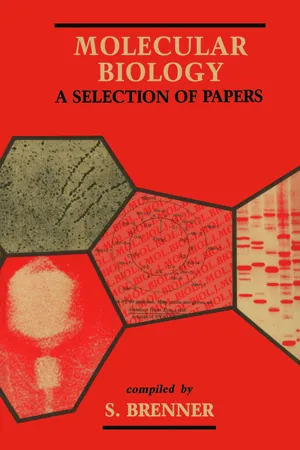
Founded in 1959, by John Kendrew, the Journal of Molecular Biology was the first journal devoted to this new and revolutionary science. To celebrate the thirtieth anniversary of the Journal, the current editor, Sydney Brenner, has selected a number of papers from the first hundred volumes. They include the seminal papers on genetic regulation by Jacob and Monod and on allostery by Monod, Changeux and Jacob. Also included are many important papers on structural biology and molecular genetics and papers reflecting the initial developments in DNA cloning and sequencing.Of value to all biologists with an interest in the molecular basis of living systems, the book is a personal selection by the Editor. Readers are encouraged to compare it with their own choice from the Journal of Molecular Biology.
Information
Table of contents
- Front Cover
- Molecular Biology: A Selection of Papers
- Copyright Page
- Table of Contents
- Preface
- Chapter 1. The Genetic Control and Cytoplasmic Expression of "Inducibility" in the Synthesis of β-galactosidase
- Chapter 2. Ribonucleoprotein Particles from Escherichia Coli
- Chapter 3. Structural Components of Bacteriophage
- Chapter 4. Molecular Homogeneity of the Deoxyribonucleic Acid of Phage T2
- Chapter 5. Structural Considerations in the Interaction of DNA and Acridines
- Chapter 6. The Theory of Mutagenesis
- Chapter 7. Genetic Regulatory Mechanisms in the Synthesis of Proteins
- Chapter 8. The Formation of Hybrid DNA Molecules and their use in Studies of DNA Homologies
- Chapter 9. An Estimate of the Length of the DNA Molecule of T2 Bacteriophage by Autoradiography
- Chapter 10. An Active Cistron Fragment
- Chapter 11. Host Specificity of DNA Produced by Escherichia Coli
- Chapter 12. The Bacterial Chromosome and its Manner of Replication as seen by Autoradiography
- Chapter 13. Allosteric Proteins and Cellular Control Systems
- Chapter 14. Hybrid Protein Formation of E. coli Alkaline Phosphatase Leading to in vitro Complementation
- Chapter 15. Electron Microscope Studies on the Structure of Natural and Synthetic Protein Filaments from Striated Muscle
- Chapter 16. N-Formyl-methionyl-S-RNA
- Chapter 17. On the Mechanism of Genetic Recombination between DNA molecules
- Chapter 18. An Optical Method for the Analysis of Periodicities in Electron Micrographs, and Some Observations on the Mechanism of Negative Staining (1964)
- Chapter 19. The Detachment and Maturation of Conserved Lambda Prophage DNA
- Chapter 20. Molecular Consequences of the Amber Mutation and its Suppression
- Chapter 21. A Two-dimensional Fractionation Procedure for Radioactive Nucleotides
- Chapter 22. Ochre Mutants, a New Class of Suppressible Nonsense Mutants
- Chapter 23. Codon–Anticodon Pairing: The Wobble Hypothesis
- Chapter 24. Specificity of sRNA for Recognition of Codons as Studied by the Ribosomal Binding Technique
- Chapter 25. Structure of Viruses of the Papilloma-Polyoma Type. IV:† Analysis of Tilting Experiments in the Electron Microscope
- Chapter 26. Structure of Crystallin α-Chymotrypsin II.† A Preliminary Report Including a Hypothesis for the Activation Mechanism
- Chapter 27. Mutant Tyrosine Transfer Ribonucleic Acids
- Chapter 28. A General Method Applicable to the Search for Similarities in the Amino Acid Sequence of Two Proteins
- Chapter 29. A Restriction Enzyme from Hemophilus influenzae. II Base Sequence of the Recognition Site
- Chapter 30. Calcium-dependent bacteriophage DNA Infection
- Chapter 31. Repeating Sequences and Gene Duplication in Proteins
- Chapter 32. Studies on Polynucleotides† CIII.‡ Total Synthesis of the Structural Gene for an Alanine Transfer Ribonucleic Acid from Yeast
- Chapter 33. Enzymatic End-to-end Joining of DNA Molecules
- Chapter 34. Site-directed Mutagenesis: Generation of an Extracistronic Mutation in bacteriophage Qβ RNA
- Chapter 35. Molecular Structure Determination by Electron Microscopy of Unstained Crystalline Specimens
- Chapter 36. A Rapid Method for Determining Sequences in DNA by Primed Synthesis with DNA Polymerase
- Chapter 37. Detection of Specific Sequences Among DNA Fragments Separated by Gel Electrophoresis
Trusted by 375,005 students
Access to over 1.5 million titles for a fair monthly price.
Study more efficiently using our study tools.
Frequently asked questions
Yes, you can cancel anytime from the Subscription tab in your account settings on the Perlego website. Your subscription will stay active until the end of your current billing period. Learn how to cancel your subscription
No, books cannot be downloaded as external files, such as PDFs, for use outside of Perlego. However, you can download books within the Perlego app for offline reading on mobile or tablet. Learn how to download books offline
Perlego offers two plans: Essential and Complete
- Essential is ideal for learners and professionals who enjoy exploring a wide range of subjects. Access the Essential Library with 800,000+ trusted titles and best-sellers across business, personal growth, and the humanities. Includes unlimited reading time and Standard Read Aloud voice.
- Complete: Perfect for advanced learners and researchers needing full, unrestricted access. Unlock 1.5M+ books across hundreds of subjects, including academic and specialized titles. The Complete Plan also includes advanced features like Premium Read Aloud and Research Assistant.
We are an online textbook subscription service, where you can get access to an entire online library for less than the price of a single book per month. With over 1.5 million books across 990+ topics, we’ve got you covered! Learn about our mission
Look out for the read-aloud symbol on your next book to see if you can listen to it. The read-aloud tool reads text aloud for you, highlighting the text as it is being read. You can pause it, speed it up and slow it down. Learn more about Read Aloud
Yes! You can use the Perlego app on both iOS and Android devices to read anytime, anywhere — even offline. Perfect for commutes or when you’re on the go.
Please note we cannot support devices running on iOS 13 and Android 7 or earlier. Learn more about using the app
Please note we cannot support devices running on iOS 13 and Android 7 or earlier. Learn more about using the app
Yes, you can access Molecular Biology by Sydney Brenner in PDF and/or ePUB format, as well as other popular books in Biological Sciences & Genetics & Genomics. We have over 1.5 million books available in our catalogue for you to explore.