eBook - ePub
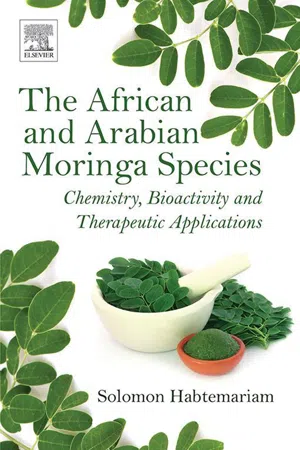
The African and Arabian Moringa Species
Chemistry, Bioactivity and Therapeutic Applications
- 230 pages
- English
- ePUB (mobile friendly)
- Available on iOS & Android
eBook - ePub
The African and Arabian Moringa Species
Chemistry, Bioactivity and Therapeutic Applications
About this book
The African and Arabian Moringa Species: Chemistry, Bioactivity and Therapeutic Applications reviews the botany, socioeconomic significance and underlying chemistry of these interesting plants. The book begins by addressing the botanical and socioeconomic aspect of M. stenopetala, one of the most widely cultivated species within the genus. Next, it reviews the chemistry of the plant, with a systematic presentation covering the seed oil, various secondary metabolites, and issues relating to quality control. Final sections address the chemistry behind the reported use of the plant for the management of various diseases, highlighting potential antioxidant, antimicrobial, antidiabetic, anticancer properties and more.
Other African and Arabian Moringa species, from their botany, to their chemical and pharmacological profiles are also included. Drawing on the author's latest research and the most current literature in the field, this book is an invaluable guide for researchers in medicinal chemistry, herbal medicine, drug discovery/development, and plant derived natural products within both industry and academic environments.
- Outlines the botanical description, traditional uses and socioeconomic significance of the African and Arabian Moringa plants
- Exhaustively discusses the chemistry of these plants to highlight secondary metabolites and methodologies for their isolation, identification and quality control
- Discusses the future potential of the plants and their chemical components for various disease conditions
Information
Topic
Ciencias físicasSubtopic
QuímicaSection III
The Science Behind the Multipurpose Usage of Moringa stenopetala
Outline
Chapter 6
The Pharmacology of Moringa stenopetala
Toxicology Aspects
Abstract
The potential toxicity of Moringa stenopetala drug/food preparations is scrutinized both from available toxicology data in the literature for the crude extracts and pharmacologically active principles identified from the plant so far. Among the compounds of interest are glucosinolates and their derivatives that could be implicated in thyroid dysfunction through goitrogenic effects. The potential of these compounds in modulating plant–animal interactions including herbivore deterrent activities as well as direct toxicity at cellular and organismal levels is discussed.
Keywords
Moringa stenopetala; glucosinolates; isothiocyanates; acute toxicity; glutathione transferases; herbivore deterrent; thyroid hormone; thyroid gland; goiter
6.1 Glucosinolates—Bioavailability
As described in Chapter 4, The Chemistry of Moringa stenopetala—Nonoil Components, Crucifer plants are sources of glucosinolates (GSLs) and the myrosinase products such as isothiocyanates and cyanates. The level of GSLs and their derivatives in the final food products of these vegetables depends on the myrosinase activity brought about by physical disruption of the plant tissues during harvesting, processing, food preparation, and consumption. The breakdown of GSLs by myrosinase can also occur within the alimentary canal and hence the ultimate biological activity of these compounds could be attributed to their breakdown products (Rouzard et al., 2000). Considerable amount of GSLs and their products, isothiocyanates, is however lost during cooking. Heating also inactivates myrosinase and hence cooked vegetables would have a pharmacological profile different from raw vegetables. In fact, some isothiocyanates are volatile and would be lost while cooking. Isothiocyanates are also hydrolyzed at normal temperature let alone while cooking at higher temperatures (Shapiro et al., 1998). For cooked vegetables, the loss of isothiocyanates means that the proportion of intact GSLs is over 100-fold higher than isothiocynates (Shapiro et al., 1998). Even if the plant myrosinase activity is totally eliminated by cooking, however, the microflora of the gut is also known to possess some myrosinase activities leading to the breakdown of significant amount of GSLs (Getahun and Chung, 1999; Shapiro et al., 1998). This further suggests that the pharmacological effect of GSLs is mediated through their breakdown products. Hence, most of the dietary isothiocyanate absorbed by mammals from ingested plant material is formed by the action of myrosinase originating from the gastrointestinal tract bacteria (Rask et al., 2000). There are also some reports that suggest intact GSLs are absorbed from the gut and probably induce some pharmacological effects by their own (Elfoul et al., 2001).
6.2 Glucosinolates and Goiter
A goiter is a swelling of the neck due to enlargement of the thyroid gland. The primary cause of goiter is either overproduction (hyperthyroidism) or underproduction (hypothyroidism) of the hormone. Since thyroid hormone is a primary regulator of metabolism, both cases of overactive and underactive thyroid gland can have severe physiological consequences. These include weight loss or gain, heat intolerance, anxiety, nervousness, tiredness, etc. (NHS-UK, 2016). The thyroid hormone consists of triiodothyronine (T3) and its precursor thyroxine (T4) both of which are formed by incorporating dietary iodine into the protein hormone. At the molecular level, iodine is incorporated in the amino acid tyrosine to make T3 and T4 (Fig. 6.1A). Even though T4 is predominant in its concentration within the blood (about 80% of thyroid hormone), T3 is known to be about four times more potent in its action than T4. Dietary sources of iodine are known to include seafood such as fish, shellfish, or seaweed; plant foods such as cereals and grains and milk. Generally, the primary source of iodine is regarded as seawater and soils in coastal areas. As the iodine content of our common food and drinks is often not sufficient for the required level of thyroid hormone synthesis, fortification through iodized salts is the recommended common practice. In developing countries where such practice is beyond the reach of people, however, iodine deficiency-led goiter development is very common.

The thyroid gland is under the direct control of a hormone from the pituitary gland called thyroid stimulating hormone (TSH). If the level of T3 and T4 is dropped in the blood, more TSH is released from the pituitary gland to stimulate the thyroid gland. The pituitary gland itself is also under the control of the hypothalamus at the base of the brain that produces thyroid releasing hormone (TRH). The overall regulation of thyroid hormone production is managed by the hypothalamus, which acts as a thermostat for monitoring the level of T3 and T4 (Fig. 6.1B). One should, therefore, expect a good correlation between the activity of thyroid gland and the level of TSH/TRH. In the case of iodine deficiency where functional T3 and T4 are not produced (hypothyroidism), the physiological response from the hypothalamus and pituitary gland is to release more stimulating hormones. Excessive stimulation of the thyroid gland results in its progressive enlargement leading to goiter (Fig. 6.1C). The overall hypothyroidism response following dietary iodine deficiency is depicted in Fig. 6.1.
The association between GSLs and goiter has been studied with due respect to the safety evaluation of various Crucifer vegetables such as broccoli, brussels sprouts, cauliflower, collards, kale, mustard greens, and kohlrabi. Over 70 years ago, cauliflower (Blum, 1937; Marine et al., 1929), kale (Blum, 1942), kohlrabi (Blum, 1937), and brussels sprouts (Marine et al., 1929) have all shown to possess the potential to induce goiter. Today, it is widely known that such tendency to induce goiter by these vegetables is associated with the formation of isothiocyanate, thiocyanate, and nitrile compounds from GSLs. For this reason, the presence of GSLs in plants such as rapeseed is a barrier for their extensive utilization as food (Griffiths et al., 1998). Both isothiocyanates and thiocyanates are known to inhibit iodine uptake by the thyroid gland leading to reduced iodination of tyrosine. This means that in the presence of isothiocyanates, thyroxine hormone is not produced and released in sufficient quantities. As the concentration of the thyroid hormone in the blood persistently drops, high level of TSH/TRH is produced resulting goiter formation. Hence, goiter, the classical anatomical symptom of hypothyroidism, can be induced by goitrogenic agents.
The major cause of goiter in the world today remains to be iodine deficiency and mainly overcome by fortifying table salt with iodine (e.g., sodium iodide, sodium to date, potassium iodide, and/or potassium iodate). There is no evidence to show precisely how much GSLs or their products must be consumed to induce goiter. In areas where iodine deficiency and goiter are endemic, however, the intake of GSLs could aggravate goiter formation and caution should be taken while using the GSLs-source plants as food. For example, an association between goiter and Moringa stenopetala consump...
Table of contents
- Cover image
- Title page
- Table of Contents
- Copyright
- About the Author
- Preface
- Acknowledgments
- Section I: Botanical, Ecological & Socioeconomic Perspectives
- Section II: The Chemistry of Moringa stenopetala
- Section III: The Science Behind the Multipurpose Usage of Moringa stenopetala
- Section IV: Other Moringa Species Indigenous to Africa and the Arabian/Persian Region
- Index
Trusted by 375,005 students
Access to over 1.5 million titles for a fair monthly price.
Study more efficiently using our study tools.
Frequently asked questions
Yes, you can cancel anytime from the Subscription tab in your account settings on the Perlego website. Your subscription will stay active until the end of your current billing period. Learn how to cancel your subscription
No, books cannot be downloaded as external files, such as PDFs, for use outside of Perlego. However, you can download books within the Perlego app for offline reading on mobile or tablet. Learn how to download books offline
Perlego offers two plans: Essential and Complete
- Essential is ideal for learners and professionals who enjoy exploring a wide range of subjects. Access the Essential Library with 800,000+ trusted titles and best-sellers across business, personal growth, and the humanities. Includes unlimited reading time and Standard Read Aloud voice.
- Complete: Perfect for advanced learners and researchers needing full, unrestricted access. Unlock 1.5M+ books across hundreds of subjects, including academic and specialized titles. The Complete Plan also includes advanced features like Premium Read Aloud and Research Assistant.
We are an online textbook subscription service, where you can get access to an entire online library for less than the price of a single book per month. With over 1.5 million books across 990+ topics, we’ve got you covered! Learn about our mission
Look out for the read-aloud symbol on your next book to see if you can listen to it. The read-aloud tool reads text aloud for you, highlighting the text as it is being read. You can pause it, speed it up and slow it down. Learn more about Read Aloud
Yes! You can use the Perlego app on both iOS and Android devices to read anytime, anywhere — even offline. Perfect for commutes or when you’re on the go.
Please note we cannot support devices running on iOS 13 and Android 7 or earlier. Learn more about using the app
Please note we cannot support devices running on iOS 13 and Android 7 or earlier. Learn more about using the app
Yes, you can access The African and Arabian Moringa Species by Solomon Habtemariam in PDF and/or ePUB format, as well as other popular books in Ciencias físicas & Química. We have over 1.5 million books available in our catalogue for you to explore.