- 447 pages
- English
- PDF
- Available on iOS & Android
eBook - PDF
About this book
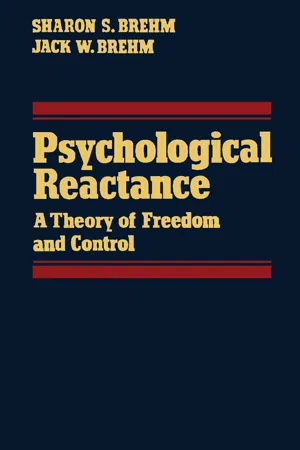
Psychological Reactance: A Theory of Freedom and Control provides information pertinent to the fundamental aspects of reactance theory. This book discusses a number of special topic areas to which the reactance theory seems especially relevant. Organized into five parts encompassing 17 chapters, this book begins with an overview of the relationship between freedom and perceived freedom as conceived by reactance theory. This text then describes the clinical applications, societal problem solutions, and power relations in the real world. Other chapters consider the developmental aspects of reactance. This book discusses as well the reactance theory in a wider theoretical context by examining impression management formulations of the theory and by comparing reactance to other theoretical models whereby the notion of control plays a major role. The final chapter deals with the role of cognitive processes in association with reactance in attitude change phenomena. This book is a valuable resource for social psychologists.
Information
Table of contents
- Front Cover
- Psychological Reactance: A Theory of Freedom and Control
- Copyright Page
- Table of Contents
- Preface
- CHAPTER 1. Introduction: Freedom, Control, and Reactance Theory
- PART I: The Theory
- PART II: Selected Topics
- PART III: Applications of the Theory
- PART IV: Control
- PART V: Conclusion
- References
- Author Index
Trusted by 375,005 students
Access to over 1.5 million titles for a fair monthly price.
Study more efficiently using our study tools.
Frequently asked questions
Yes, you can cancel anytime from the Subscription tab in your account settings on the Perlego website. Your subscription will stay active until the end of your current billing period. Learn how to cancel your subscription
No, books cannot be downloaded as external files, such as PDFs, for use outside of Perlego. However, you can download books within the Perlego app for offline reading on mobile or tablet. Learn how to download books offline
We are an online textbook subscription service, where you can get access to an entire online library for less than the price of a single book per month. With over 1.5 million books across 990+ topics, we’ve got you covered! Learn about our mission
Look out for the read-aloud symbol on your next book to see if you can listen to it. The read-aloud tool reads text aloud for you, highlighting the text as it is being read. You can pause it, speed it up and slow it down. Learn more about Read Aloud
Yes! You can use the Perlego app on both iOS and Android devices to read anytime, anywhere — even offline. Perfect for commutes or when you’re on the go.
Please note we cannot support devices running on iOS 13 and Android 7 or earlier. Learn more about using the app
Please note we cannot support devices running on iOS 13 and Android 7 or earlier. Learn more about using the app
Yes, you can access Psychological Reactance by Sharon S. Brehm,Jack W. Brehm in PDF and/or ePUB format, as well as other popular books in Psychology & Cognitive Psychology & Cognition. We have over 1.5 million books available in our catalogue for you to explore.