eBook - PDF
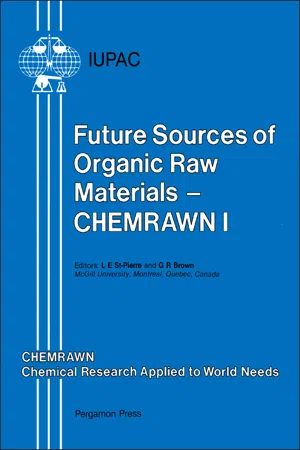
Future Sources of Organic Raw Materials: CHEMRAWN I
CHEMRAWN Chemical Research Applied to Words Needs
- 660 pages
- English
- PDF
- Available on iOS & Android
eBook - PDF
Future Sources of Organic Raw Materials: CHEMRAWN I
CHEMRAWN Chemical Research Applied to Words Needs
About this book
Future Sources of Organic Raw Materials: CHEMRAWN I is a collection of lectures presented at the World Conference on Future Sources of Organic Raw Materials, held in Toronto, Canada, on July 10-13, 1978. The conference focused on potential future sources of organic raw materials such as non-conventional fossil hydrocarbons, coal, industrial and agricultural wastes, and renewable resources like wood and other plant materials. This book is comprised of 52 chapters and opens with an assessment of the likely future availability of conventional oil and gas as they relate to possible demands for petrochemical feedstocks, paying particular attention to the availability and demand patterns for fossil hydrocarbons. The following chapters discuss the reserves and worldwide distribution of oil shale and tar sands; climate and its impact on renewable resources; research and management of natural resources; and production of chemicals directly from synthesis gas. Pyrolysis of solid carbonaceous materials is also considered, along with natural rubber production and biomass for non-food use. This monograph will be a useful resource for organic chemists and energy policymakers.
Information
Topic
Physical SciencesSubtopic
Industrial & Technical ChemistryTable of contents
- Front Cover
- Future Sources of Organic Raw Materials Chemrawn I
- Copyright Page
- Table of Contents
- Foreword
- Chapter 1. Availability and demand patterns for fossil hydrocarbons
- Chapter 2. Oil shale and tar sands
- Chapter 3. Coal and the human need for energy
- Chapter 4. Availability and demand patterns for renewable resources—Forestry
- Chapter 5. Agriculture
- Chapter 6. Availability and demand patterns for renewable resources: Urban and industrialwastes
- Chapter 7. Future of the synthetic chemical industry in Japan
- Chapter 8. Matter: A resource ignored by thermodynamics—Renewable resource economics
- Chapter 9. The reference materials system—a framework for substitution analysis
- Chapter 10. The organic materials system:Toward making practical choices
- Chapter 11. Climate and its impact on renewable resources
- Chapter 12. Changing location of the chemical industry
- Chapter 13. Research and management of natural resources
- Chapter 14. The structure and chemistry of coal: the search for a typical coal molecule
- Chapter 15. Synthesis gas technology
- Chapter 16. Chemicals, feedstocks and fuels from Fischer-Tropsch and related syntheses
- Chapter 17. Chemicals production directly from synthesis gas
- Chapter 18. Homogeneous catalysis
- Chapter 19. Heterogeneous catalysis at the end of the century
- Chapter 20. Extraction, preparation, transport and storage of solid carbonaceous material
- Chapter 21. The liquefaction of solid carbonaceous materials
- Chapter 22. Pyrolysis of solid carbonaceous materials
- Chapter 23. Prospects for photon-induced syntheses of organic raw materials
- Chapter 24. Chemicals from tar processing
- Chapter 25. Carbons from selected organic feedstocks
- Chapter 26. Peat as a source of chemical raw materials
- Chapter 27. Limits to the productive capacity of the biosphere
- Chapter 28. Biomass for non-food use
- Chapter 29. Tropical biomass systems
- Chapter 30. A new look at natural rubber production
- Chapter 31. Organic chemicals from the desert
- Chapter 32. Chemical and biological nitrogen fixation
- Chapter 33. Future challenges and opportunities for agricultural and forestry research
- Chapter 34. Trends in available feedstock composition
- Chapter 35. Future feedstocks from petroleum—oil and gas: new petroleum production technologies
- Chapter 36. New petroleum refining technology
- Chapter 37. Advances in production of olefins from residual oils
- Chapter 38. Tar sands and related products as chemical feedstocks
- Chapter 39. Oil shales as sources of chemical feedstocks
- Chapter 40. New aspects of the production of chemicals from biomass
- Chapter 41. The ethanol based economy—the Brazilian experiment
- Chapter 42. Enzymatic production of chemicals
- Chapter 43. Carbohydrates as renewable feedstocks
- Chapter 44. Anaerobic microbial digestion as a route to methane and renewable carbon sources
- Chapter 45. Organic chemicals from the sea
- Chapter 46. Fibres to meet the world's expanding needs
- Chapter 47. Solar energy use through biology—past and future
- Chapter 48. Photosynthesis and biosynthetic pathways to chemicals
- Chapter 49. A new understanding of the carbohydrate system
- Chapter 50. The challenge of lignin
- Chapter 51. The future of lipids from plant and animal sources
- Chapter 52. Genetic engineering of microorganisms for the production of biomedically and industrially important materials
- Index of Contributors
Trusted by 375,005 students
Access to over 1.5 million titles for a fair monthly price.
Study more efficiently using our study tools.
Frequently asked questions
Yes, you can cancel anytime from the Subscription tab in your account settings on the Perlego website. Your subscription will stay active until the end of your current billing period. Learn how to cancel your subscription
No, books cannot be downloaded as external files, such as PDFs, for use outside of Perlego. However, you can download books within the Perlego app for offline reading on mobile or tablet. Learn how to download books offline
Perlego offers two plans: Essential and Complete
- Essential is ideal for learners and professionals who enjoy exploring a wide range of subjects. Access the Essential Library with 800,000+ trusted titles and best-sellers across business, personal growth, and the humanities. Includes unlimited reading time and Standard Read Aloud voice.
- Complete: Perfect for advanced learners and researchers needing full, unrestricted access. Unlock 1.5M+ books across hundreds of subjects, including academic and specialized titles. The Complete Plan also includes advanced features like Premium Read Aloud and Research Assistant.
We are an online textbook subscription service, where you can get access to an entire online library for less than the price of a single book per month. With over 1.5 million books across 990+ topics, we’ve got you covered! Learn about our mission
Look out for the read-aloud symbol on your next book to see if you can listen to it. The read-aloud tool reads text aloud for you, highlighting the text as it is being read. You can pause it, speed it up and slow it down. Learn more about Read Aloud
Yes! You can use the Perlego app on both iOS and Android devices to read anytime, anywhere — even offline. Perfect for commutes or when you’re on the go.
Please note we cannot support devices running on iOS 13 and Android 7 or earlier. Learn more about using the app
Please note we cannot support devices running on iOS 13 and Android 7 or earlier. Learn more about using the app
Yes, you can access Future Sources of Organic Raw Materials: CHEMRAWN I by L.E. St-Pierre,G. R. Brown in PDF and/or ePUB format, as well as other popular books in Physical Sciences & Industrial & Technical Chemistry. We have over 1.5 million books available in our catalogue for you to explore.