- 142 pages
- English
- PDF
- Available on iOS & Android
eBook - PDF
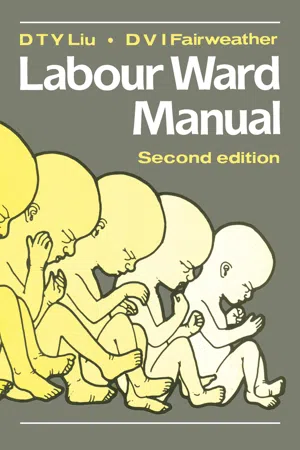
Labour Ward Manual
About this book
Labour Ward Manual, Second Edition provides guidelines for the application of obstetric knowledge to the labor ward environment.
The practice of obstetrics is still an art and as such encompasses alternative approaches to achieve the same welcome end, the safety and wellbeing of both mother and child throughout labor and after delivery. The steps suggested for patient management and presentation concentrate on safety and simplicity. Throughout this book, it is stressed that the laboring woman and the fetus are the most important persons in the labor ward.
This book clearly documents the emphasis on the atmosphere of ready redress by litigation; approach to women with individual needs; special care in the sensitive issue of induction; fetal monitoring; fluid replacement together with a clear protocol for management of fetal and maternal mishaps; and problems and hazards of women in the labor ward of hepatitis B or human immunodeficiency virus (AIDS) infection.
This edition provides a clear concise guidance for all those involved in child birth.
Information
Table of contents
- Front Cover
- Labour Ward Manual
- Copyright Page
- Table of Contents
- Preface
- Acknowledgements
- Chapter 1. Attitudes and conduct
- Chapter 2. Maternal and perinatal mortality
- Chapter 3. Delivery room
- Chapter 4. Admission to the labour ward
- Chapter 5. Admission emergencies
- Chapter 6. Normal labour and delivery
- Chapter 7. Intrapartum nutrition and electrolytes
- Chapter 8. Analgesia and anaesthesia
- Chapter 9. Intrapartum fetal surveillance
- Chapter 10. Episiotomy and tears
- Chapter 11. The newborn
- Chapter 12. Preterm labour and preterm membrane rupture
- Chapter 13. Abnormal labour
- Chapter 14. Induction and augmentation of labour
- Chapter 15. Assisted delivery
- Chapter 16. Caesarean section
- Chapter 17. Emergencies in the immediate puerperium
- Chapter 18. Malpresentation and malpositions
- Chapter 19. Breech
- Chapter 20. Twins and multiple deliveries
- Chapter 21. Medical complications and labour
- Chapter 22. Fetal and maternal misadventure
- Suggested reading
- Index
Trusted by 375,005 students
Access to over 1.5 million titles for a fair monthly price.
Study more efficiently using our study tools.
Frequently asked questions
Yes, you can cancel anytime from the Subscription tab in your account settings on the Perlego website. Your subscription will stay active until the end of your current billing period. Learn how to cancel your subscription
No, books cannot be downloaded as external files, such as PDFs, for use outside of Perlego. However, you can download books within the Perlego app for offline reading on mobile or tablet. Learn how to download books offline
Perlego offers two plans: Essential and Complete
- Essential is ideal for learners and professionals who enjoy exploring a wide range of subjects. Access the Essential Library with 800,000+ trusted titles and best-sellers across business, personal growth, and the humanities. Includes unlimited reading time and Standard Read Aloud voice.
- Complete: Perfect for advanced learners and researchers needing full, unrestricted access. Unlock 1.5M+ books across hundreds of subjects, including academic and specialized titles. The Complete Plan also includes advanced features like Premium Read Aloud and Research Assistant.
We are an online textbook subscription service, where you can get access to an entire online library for less than the price of a single book per month. With over 1.5 million books across 990+ topics, we’ve got you covered! Learn about our mission
Look out for the read-aloud symbol on your next book to see if you can listen to it. The read-aloud tool reads text aloud for you, highlighting the text as it is being read. You can pause it, speed it up and slow it down. Learn more about Read Aloud
Yes! You can use the Perlego app on both iOS and Android devices to read anytime, anywhere — even offline. Perfect for commutes or when you’re on the go.
Please note we cannot support devices running on iOS 13 and Android 7 or earlier. Learn more about using the app
Please note we cannot support devices running on iOS 13 and Android 7 or earlier. Learn more about using the app
Yes, you can access Labour Ward Manual by D T Y Liu,D V I Fairweather in PDF and/or ePUB format, as well as other popular books in Medicine & Gynecology, Obstetrics & Midwifery. We have over 1.5 million books available in our catalogue for you to explore.