- 426 pages
- English
- ePUB (mobile friendly)
- Available on iOS & Android
eBook - ePub
About this book
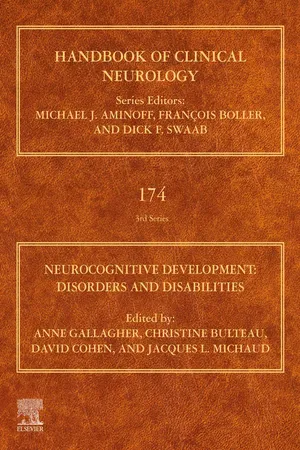
This is one volume of a two-volume work on neurocognitive development, focusing separately on normative and non-normative development. The disorders and disabilities volume focuses on disorders of intellectual abilities, language, learning memory as well as psychiatric developmental disorders. The developmental aspects of neurological diseases in children is also covered. Chapters discuss when and how these disorders develop, the genetics and neurophysiology of their operation, and their evaluation and assessment in clinical practice. Assessment, treatment, and long-term outcome are provided as well as advances in methods and tools for assessment.
This book will serve as a comprehensive reference to researchers in cognitive development in neuroscience, psychology, and medicine, as well as to clinicians and allied health professionals focused on developmental disabilities (child neurologists, pediatric neuropsychologists, child psychiatrists, speech and language therapists, and occupational therapists.)
- Summarizes research on neurocognitive developmental disorders and disabilities
- Includes disorders of intellectual abilities, language, learning, memory, and more
- Separately covers developmental aspects of neurological diseases in children
- Features advances in methods and tools of assessment
- Reviews patient care, rehabilitation, and long-term outcomes
- Provides interdisciplinary information of use to both researchers and clinicians
Section III
Assessment of neurodevelopment: Methods and tools
Chapter 13: Interdisciplinary assessment
Jean-Marc Guilé1,2,3,4,*; Chloé Tissot1; Laure Boissel1,2 1 Service de Psychiatrie de l'Enfant et de l'Adolescent, Centre Hospitalier Universitaire Amiens-Picardie, Salouel, France
2 Psychiatry Residency Program, Faculty of Medicine, Université Picardie Jules Verne, Amiens, France
3 Child and Adolescent Psychiatry Department, Centre Hospitalier Philippe Pinel, Amiens, France
4 Department of Psychiatry, McGill University, Montreal, QC, Canada
* Correspondence to: J.M. Guilé, M.D., FRCPC, Service de Psychiatrie de l'Enfant et de l'Adolescent, CHU Amiens-Picardie, Av. Laënnec, Salouel 80480, France. Tel: + 33-660-250-451 email address: [email protected]
2 Psychiatry Residency Program, Faculty of Medicine, Université Picardie Jules Verne, Amiens, France
3 Child and Adolescent Psychiatry Department, Centre Hospitalier Philippe Pinel, Amiens, France
4 Department of Psychiatry, McGill University, Montreal, QC, Canada
* Correspondence to: J.M. Guilé, M.D., FRCPC, Service de Psychiatrie de l'Enfant et de l'Adolescent, CHU Amiens-Picardie, Av. Laënnec, Salouel 80480, France. Tel: + 33-660-250-451 email address: [email protected]
Abstract
Interdisciplinary assessment (IA) is defined as the integration of clinical contributions by healthcare professionals from distinct disciplines into a comprehensive diagnostic and prognostic evaluation. This process requires the professionals to independently and simultaneously consider and gage clinical information collected via a variety of methods and from a variety of informants. A shared perception of the clinical situation is progressively achieved via team meetings. IA helps clinicians to overcome the many challenges posed in today's context for assessment and treatment planning in the field of neurodevelopmental disorders. Most national and international guidelines recommend the inclusion of IA in the diagnostic workup for complex cases (e.g., autism spectrum and attention deficit hyperactivity disorder). Hence, IA should always be part of the neurodevelopmental disorder diagnostic process in children in general and preterm infants in particular.
Keywords
Interdisciplinary; Assessment; Infant; Child; Neurodevelopmental disorder
Definition
Interdisciplinary assessment (IA) is defined as the integration of clinical contributions by several professionals from distinct clinical disciplines into a comprehensive diagnostic and prognostic evaluation. Appropriate integration of these contributions usually requires team meetings. The precise number of professionals involved and the choice of the relevant clinical disciplines depend on the specific neurodevelopmental disorder under investigation. For example, Canadian guidelines on fetal alcohol syndrome recommended an assessment team composed of a coordinator, a physician, a clinical psychologist, a speech pathologist, and an occupational therapist (Clarren et al., 2011). From a medical standpoint, child specialists (such as developmental/behavioral pediatricians, child neurologists, and child psychiatrists) can perform the developmental evaluation included in the surveillance or screening of children at risk of neurodevelopmental disorders (American Academy of Pediatrics, 2006). In conjunction with the child's treating physician, early childhood professionals (e.g., early childhood educators, child psychologists, speech-language pathologists (SLPs), social workers, and occupational therapists) can also contribute to the developmental evaluation by working as part of an interdisciplinary team, depending on the local health system's organizational structure (American Academy of Pediatrics, 2006). From a public health perspective, the often neglected inclusion of a nurse clinician in the interdisciplinary team helps considerably in obtaining good child and family clinical intake assessments (Rustin and Quagliata, 2000; Mazet et al., 2016) and completing standardized evaluations (Gellasch, 2016).
The interdisciplinary framework of a clinical evaluation helps healthcare professionals to overcome the many challenges posed by today's approaches to assessing neurodevelopmental disorders. The assessment process has to address clinical data collected through a variety of methods, from a variety of informants, and in a variety of cultural contexts (Carter et al., 2004). In addition, the professionals come from distinct but complementary disciplines and have different training backgrounds and subspecialty skills.
Along with the adjective “interdisciplinary,” several other terms (such as “multidisciplinary” and “transdisciplinary”) are found in the literature. IA is not equivalent to a process in which a single clinician consults with other professionals after having performed his/her own evaluation and subsequently summarizes the information. IA requires some form of team meeting, whether face-to-face or over the Internet. After independently gaging the clinical information that has been collected, the professionals are challenged to simultaneously consider the same dataset and achieve a shared perception of the clinical situation.
As early as 1994, the ZERO TO THREE investigating group published the DC:0–3 Diagnostic Classification of Mental Health and Developmental Disorders of Infancy and Early Childhood, which has since been updated (Zero to Three, 2016). The group chose to broaden the clinical observation to the parent–infant dyad, rather than focus solely on the infant's manifestations; this argues for the inclusion of IA in the routine diagnostic workup. Over the past 2 decades, in-depth guidelines have been elaborated for the somatic/genetic/neuroimaging investigations of developmental delay. Today, there are high expectations for alternative evaluations capable of providing an integrated view of diagnosis and geared toward treatment planning.
Clinical IA has many objectives: (1) the elaboration of diagnostic conclusions, including the disentanglement of comorbidities; (2) an evaluation of the infant's functioning and the family's perception of and motivation for treatment; (3) the screening for risk factors (social, psychologic, and biological) for unfavorable outcomes; (4) the identification of potential for developing cognitive abilities; (5) the provision of support and assistance to parents mourning the “ideal baby,” and for developing parenting skills and appropriate educational attitudes; and (6) a monitoring of the therapeutic alliance. Thus this type of clinical assessment should provide a comprehensive view of diagnostic and prognostic issues, including the potential for further learning and avenues for treatment planning.
Clinical Background and Challenges
An integrated developmental model
Reiss's assessment (2009) about therapeutic intervention should be applied to clinical assessment: “Any extrinsic environmental or biological intervention designed to affect behavior must be considered a form of brain therapy.” Indeed, the old way of thinking, marked by dichotomizing mind and brain, as well as environment (nurture) and genes (nature), has been wiped away by the accumulation of results from cognitive, imaging, epigenetic, and psychologic research over the past decade. Consequently, dividing assessments according to the “functional vs organic” dipole is outdated. Assessments should be based on an integrated conception of behavior and brain functioning and depict the interplay between these factors in the context of a child's development and family relationships.
Clinical assessment should be based on a model of brain development. Large structural changes take place early in life, given the doubling of the brain's overall size within the first year of life. Prenatal myelination proceeds rapidly, emerging in the cerebellum and spreading from rearward cortical areas to prefrontal areas (Gilmore et al., 2018). At birth, thalamocortical connections and the primary sensory cortices are already operational. Functional cognitive networks then develop successively over the first 2 years of age: the default mode network by 6 months, the dorsal attention and the salience networks by 2 years, and then ...
Table of contents
- Cover image
- Title page
- Table of Contents
- Copyright
- Handbook of Clinical Neurology 3rd Series
- Foreword
- Preface
- Contributors
- Section I: Specific neurodevelopmental disorders
- Section II: Complex neurodevelopmental disorders
- Section III: Assessment of neurodevelopment: Methods and tools
- Section IV: Patient care, rehabilitation and long-term outcomes
- Index
Trusted by 375,005 students
Access to over 1.5 million titles for a fair monthly price.
Study more efficiently using our study tools.
Frequently asked questions
Yes, you can cancel anytime from the Subscription tab in your account settings on the Perlego website. Your subscription will stay active until the end of your current billing period. Learn how to cancel your subscription
No, books cannot be downloaded as external files, such as PDFs, for use outside of Perlego. However, you can download books within the Perlego app for offline reading on mobile or tablet. Learn how to download books offline
Perlego offers two plans: Essential and Complete
- Essential is ideal for learners and professionals who enjoy exploring a wide range of subjects. Access the Essential Library with 800,000+ trusted titles and best-sellers across business, personal growth, and the humanities. Includes unlimited reading time and Standard Read Aloud voice.
- Complete: Perfect for advanced learners and researchers needing full, unrestricted access. Unlock 1.5M+ books across hundreds of subjects, including academic and specialized titles. The Complete Plan also includes advanced features like Premium Read Aloud and Research Assistant.
We are an online textbook subscription service, where you can get access to an entire online library for less than the price of a single book per month. With over 1.5 million books across 990+ topics, we’ve got you covered! Learn about our mission
Look out for the read-aloud symbol on your next book to see if you can listen to it. The read-aloud tool reads text aloud for you, highlighting the text as it is being read. You can pause it, speed it up and slow it down. Learn more about Read Aloud
Yes! You can use the Perlego app on both iOS and Android devices to read anytime, anywhere — even offline. Perfect for commutes or when you’re on the go.
Please note we cannot support devices running on iOS 13 and Android 7 or earlier. Learn more about using the app
Please note we cannot support devices running on iOS 13 and Android 7 or earlier. Learn more about using the app
Yes, you can access Neurocognitive Development: Disorders and Disabilities by in PDF and/or ePUB format, as well as other popular books in Medicine & Neurology. We have over 1.5 million books available in our catalogue for you to explore.