This book will help you learn practical ways to manage the stress of teaching and avoid burnout. Bestselling author and educational consultant Bryan Harris presents strategies for building resilience, including reframing, understanding the power of "no", focusing on what you can control, building positive relationships, advocating for yourself, and more. Each chapter clearly presents concise and practical applications that you can implement right away. With this guidebook, you'll feel ready to bounce back from challenges and stay focused on the joys of the profession.
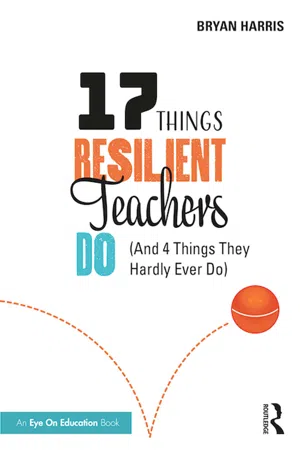
- 124 pages
- English
- ePUB (mobile friendly)
- Available on iOS & Android
eBook - ePub
About this book
Information
Stress Is the Issue
Here Is What You Need to Know
To tackle the concept of stress in one short chapter is a challenge, but we’ll give it a shot. Countless books, articles, research studies, and expert opinions have weighed in on the topic. While we are still learning (and there is still much to learn), there is agreement on a few things that are important for our understanding of how to manage stress and build personal resilience.
To start, let’s figure out what we are talking about – What is stress? Why does it matter? What is the relationship to resiliency?
For our purposes here, we’ll adopt Dr. Eric Jensen’s (2005) definition of stress – the physiological response to a perception of a lack of control over an adverse situation or person. There are two key terms in this definition that you’ll see as reoccurring themes throughout this book: perception and control.
First, stress is perception. And, that perception is highly variable; people can respond very differently to similar situations based on what they believe and perceive (Levitin, 2020). In other words, there is no stress outside of your own perception of it. Think about it this way – is skydiving stressful? Think about strapping on a parachute, getting into a plane, going up to 13,000 feet, and jumping. Is that a stressful event? Some of you are saying, “Heck yeah it’s stressful. There’s no way I’d do that”, while others might say, “Sounds fun. Let’s go”. The key idea is that skydiving is just a thing. Stress is really about what we perceive or believe about a situation and no two people respond the same way (Medina, 2008).
The second reoccurring theme you’ll see throughout this book centers on control. In fact, the concept of control might just be the theme. Most of the experts and organizations who study stress (Bruce McEwan, Robert Sapolsky, The American Institute of Stress, and may others) key in on this very important idea: stress is related to control. Very specifically, it is related to the perception of control. This is one of the central messages of the entire book: in order to manage the stressors that are inherent with the job, get control. The strategies and coping mechanisms I’ll describe center on this idea: to manage stress, take action and focus on what you can control.
Why does all this matter? It’s quite simple, really. Unchecked stress is killing you. It’s wreaking havoc on your physical health, your mental stability, your relationships, and even on your finances and future security. And, oh yeah – unchecked stress makes you miserable at work. It leads to burnout, exhaustion, and has you wondering if the local Piggly Wiggly has any openings for cashiers. We’ll talk more in Chapter 1 about how unchecked stress impacts your physical health, but here is a spoiler alert: it’s not good.
It should be clarified, however, that not all stress is bad. In fact, some stress is good for you. Daniel Amen, in Making a Good Brain Great (2005) reminds us that stress can be either good or bad. Good stress can motivate us to pay attention to something important. In essence, he says, if it stresses you out, you ought to be paying attention to it. That’s the role of stress after all – to focus your attention on something related to your safety or survival. Temporary and manageable stress (we can call that good stress) can motivate us to take action, while long-term unchecked stress can literally kill us. If you think I’m being a bit dramatic here, maybe I am. But keep reading, this stuff is relevant and might very well change your life.
When you feel stress – when you perceive that something is beyond your control – the brain and body respond in a very specific way by releasing a host of chemicals (primarily cortisol and adrenaline) that are designed with one very specific purpose: to equip you with the physical and mental resources necessary to gain a sense of control. The process is started in the brain’s limbic system, which is designed to detect threat and promote survival.
Many researchers describe stress in this manner: it is the body’s response to a situation where the demands exceed the current resources. The American Institute of Stress defines it this way – stress is a “condition or feeling experienced when a person perceives that demands exceed the personal and social resources the individual is able to mobilize”.
Although a bit simplistic, it goes something like this: you find yourself in a situation, relationship, or context where you perceive that you’ll have little or no control. The external demands of the situation are greater than the current resources you have to deal with it. So, your brain and body respond by saying, “OK, we’ve got a problem. We don’t have the kind of control we want. So, let’s open the reserves of adrenaline and cortisol so that we can get some control”. You perceive you don’t have the kind of control you want (that is, you feel stressed) so the brain responds by saying, “Here you go. Here are the resources you need to get some control”.
As your brain “throttles up” and prepares to deal with the stressor (by releasing the likes of cortisol and adrenaline), some cool things happen: your focus and attention is increased, you gain physical energy, your memory improves, and you basically go into problem-solving mode (Sapolsky, 2004). In the short term, this response is great.
The problems occur, as you probably already guessed, when we experience long-term, unchecked stress. Short-term stress is just fine. It’s when stress becomes prolonged that we see problems. We use terms like acute stress, chronic stress, or distress to describe the unhealthy aspects of stress. Basically, stress becomes a problem when it sticks around for too long. When your body and brain are marinating in cortisol for long periods of time, that’s when problems occur.
In Why Zebras Don’t Get Ulcers (the seminal book on the topic of stress), Robert Sapolsky (2004) highlights that stress is not just a brain and body reaction to a challenge or a perception of a lack of control, stress is also the anticipation of a challenge. In other words, the stress response kicks in when we have an experience and when we anticipate that something will be out of whack.
A stressor, says Sapolsky, is anything that knocks us out of homeostasis (the stable, healthy state our body wants to maintain). In other words, a stressor is something that overwhelms the system. When your brain senses that something is beyond your ability to cope, it floods the body with hormones that are designed to tackle the pending challenge. The whole process is designed to get you back to that stable, healthy state that scientists call homeostasis. But for many of us, we never get back to that healthy state because of the constant stressors we are under. As a result, we experience allostasis. That’s a term coined by Dr. Bruce McEwan in the 1990s to describe the phenomenon of the brain’s adaptability to stress. While our brain and body want to get back to a healthy state after dealing with a stressor, it sometimes doesn’t happen. The long-term effect of cortisol changes our brain and causes a “new baseline” called allostasis.
If you’ve read this far, you might be saying, “Bryan, I wasn’t all that stressed out until I read this. Now I’m really stressed out”. OK, now that I’ve stressed you out about stress, let’s talk business.
- Remember that some stress is actually good for you. In short, manageable doses, stress helps you to solve problems and tackle the challenges in front of you. Cortisol (the stress hormone) and adrenaline help with focus, energy, and memory. The problem is when we have un-mediated stress that hangs around for a while. In the short term, cortisol is great. When it stays in your system for a long period of time, it does serious damage.
- The truth is that teaching is a special kind of stressful. What we do matters tremendously for students, for families, and for society in general. A lot rides on how effective we are at our jobs. Part of that effectiveness depends on how well we manage stress.
- As you read the ideas and suggestions throughout the book, keep in mind our two central ideas: perception and control. If you had control over a situation (or you perceived that you did), it wouldn’t be stressful in the first place.
- If stress is the problem, resiliency is the answer. When we build, practice, and refine our resiliency skills, we become better equipped to deal with the challenges that come along with classroom life. Resiliency consists of two things: how we think and what we do. It consists of our mental models, our mindsets, and our beliefs along with a specific set of coping mechanisms.
- The goal is not to have zero stress. The goal is to understand the role stress plays and how to best manage it. When you are balanced and resilient, teaching is the best job in the world. When you are not, it can be miserable.
- If you don’t address the issue of stress management, one of two things is likely to happen. You’ll either leave the profession entirely or (perhaps worse), you’ll stay and be burned out. Resiliency helps us to stay sane and satisfied in a sometimes-insane profession.
- Realize that the suggestions highlighted in each of the 17 things are just that – suggestions. They are not mandates. In fact, if you view these ideas as mandates, as a checklist of things you have to do, you’ve lost control. You’ve lost sight of the very thing that helps you to manage stress. You control what you do, how you think, and the specific steps you’ll take.
1
Resilient Teachers Take Care of Their Health
In a Nutshell: Taking care of yourself – attending to your physical health – is job #1. When you’re healthy, the very best of you can be on display. When you are not healthy, it’s tough to be your best.
Digging Deeper: As I shared in the chapter on stress, if we don’t take care of ourselves, one of two things is likely to happen – we’ll either quit and look for a less stressful job or we’ll stay in the profession and be burned out. Neither is a good choice. Truly, the best place to begin to manage stress and build resiliency is by taking care of your physical health.
There is a lot of talk, rightfully so, about how we can help prevent teacher burnout. Certainly, there are systemic and structural issues (such as workload and long hours) that lead to high levels of burnout among teachers, but the fact is that each of us can help prevent our own burnout. By taking care of yourself – by giving attention to your physical health, you can prevent some of those stressors from getting the best of you. As Elena Aguilar says, “renew yourself” and don’t always rely on others to develop conditions that make your life better. Take charge and take control – manage those stressors and prevent burnout by taking care of your physical health.
The evidence is overwhelming. One of the world’s leading experts on the impact of stress on health, Dr. Robert Sapolsky, offers a stark (if not slightly humorous) summary of what high levels of stress does to your physical health. Among other things, high stress: raises your blood pressure, damages white blood cells, does damage to your brain, lowers libido, and even makes you flatulent (Sapolsky, 2004). And, if you didn’t already know this, stress is contagious (Oberle and Schonert-Reichl, 2016). That’s right, your stress impacts those around you, including your students.
Throughout the book, we’ll make lots of references to the brain and mental health. Why is that? Many researchers who study resilience look at aspects of a person’s mental health in order to gauge their ability to be resilient in the face of life’s challenges. Whether you prefer references to mental health, cognitive health, or overall physical health, the ideas are the same – everything is interconnected. When your brain works well, so does the rest of your life. Dr. Daniel Amen, who has authored over 20 books on brain health, says it succinctly, “When your brain works right, you work right; and when your brain is troubled you are much more likely to have trouble in your life” (Amen, 2005).
For our purposes in this chapter, we’ll focus primarily on the role that physical health plays in building resiliency and managing stress. Certainly, your relational, emotional, and spiritual health are also important, but we start with an understanding of how an individual’s physical health supports every aspect of life. Specifically, we’ll look at three areas: exercise, sleep, and diet.
How Does Exercise Support Resilience?
The first thing we need to realize is that everything is connected, or rather inter-connected. To the brain, there is no separate thing called the body. And vice versa. It is one system that works together - those things that impact our bodies also have an impact on the brain. One of the more exciting findings in recent years concerns the connection between heart and brain health. It turns out that what is good for the heart is also good for the brain (Gardener et al., 2016).
While most of us know the importance of exercise for things like weight management or heart health, it is also important to understand how exercise supports mental health and cognition. For example, adults who regularly exercise have greater mental flexibility (Burzynska et al., 2015). Mental flexibility is needed to thrive as a classroom teacher. It allows us to shift between competing demands, determine which things get our attention, and make decisions regarding the best course of action while under pressure.
Our purpose here isn’t to provide an extensive review of the literature highlighting exercise and mental health, but it is good to know that lots of research has shown a correlation between physical and mental health.
Why Is Sleep Important?
From a biological perspective sleep must be important when you consider the fact that you spend 1/3rd of every day doing it. Described as your brain’s “rinse cycle”, s...
Table of contents
- Cover
- Half Title
- Series Page
- Title Page
- Copyright Page
- Dedication
- Table of Contents
- Acknowledgments
- About the Author
- Introduction
- Stress Is the Issue: Here Is What You Need to Know
- 4 Things Resilient Teachers Hardly Ever Do
- What’s Next?
- References
Trusted by 375,005 students
Access to over 1.5 million titles for a fair monthly price.
Study more efficiently using our study tools.
Frequently asked questions
Yes, you can cancel anytime from the Subscription tab in your account settings on the Perlego website. Your subscription will stay active until the end of your current billing period. Learn how to cancel your subscription
No, books cannot be downloaded as external files, such as PDFs, for use outside of Perlego. However, you can download books within the Perlego app for offline reading on mobile or tablet. Learn how to download books offline
Perlego offers two plans: Essential and Complete
- Essential is ideal for learners and professionals who enjoy exploring a wide range of subjects. Access the Essential Library with 800,000+ trusted titles and best-sellers across business, personal growth, and the humanities. Includes unlimited reading time and Standard Read Aloud voice.
- Complete: Perfect for advanced learners and researchers needing full, unrestricted access. Unlock 1.5M+ books across hundreds of subjects, including academic and specialized titles. The Complete Plan also includes advanced features like Premium Read Aloud and Research Assistant.
We are an online textbook subscription service, where you can get access to an entire online library for less than the price of a single book per month. With over 1.5 million books across 990+ topics, we’ve got you covered! Learn about our mission
Look out for the read-aloud symbol on your next book to see if you can listen to it. The read-aloud tool reads text aloud for you, highlighting the text as it is being read. You can pause it, speed it up and slow it down. Learn more about Read Aloud
Yes! You can use the Perlego app on both iOS and Android devices to read anytime, anywhere — even offline. Perfect for commutes or when you’re on the go.
Please note we cannot support devices running on iOS 13 and Android 7 or earlier. Learn more about using the app
Please note we cannot support devices running on iOS 13 and Android 7 or earlier. Learn more about using the app
Yes, you can access 17 Things Resilient Teachers Do by Bryan Harris in PDF and/or ePUB format, as well as other popular books in Education & Education General. We have over 1.5 million books available in our catalogue for you to explore.