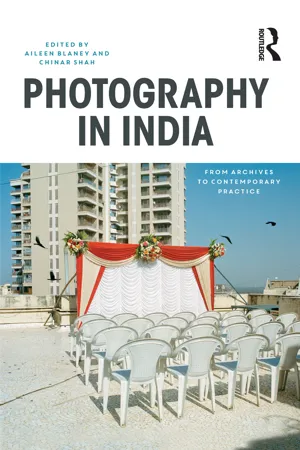
Photography in India
eBook - ePub

Photography in India

From Archives to Contemporary Practice

  1. 256 pages
  2. English
  3. ePUB (mobile friendly)
  4. Available on iOS & Android
eBook - ePub

Photography in India

From Archives to Contemporary Practice

About this book

Photography's prominence in the representation and experience of India in contemporary and historical times has not guaranteed it a position of sustained attention in research and scholarship. For a technology as all pervasive as photography, and a country as colossal as India, this scenario is somewhat of an anomaly.

Photography in India explores elements of the past, present and future of photography in the context of India through speculation and reflection on photography as an artistic, documentary and everyday practice. The perspectives of writers, theorists, curators and artists are selectively brought to bear upon known as well as previously unseen photographic archives, together with changes in photographic practice that have been synchronous with contemporary India's rapid urban and rural transformation and the technological shift from chemistry and light to programming and algorithms.

Essential reading for anyone interested in Indian photography, this book binds insights into a history of photography with its contemporary development, consolidating wide-ranging thinking on the topic and setting the agenda for future research.

Trusted by 375,005 students

Access to over 1.5 million titles for a fair monthly price.

Study more efficiently using our study tools.

Information

Publisher
Routledge
Year
2020
Print ISBN
9781350027886
eBook ISBN
9781000213263
Topic
Art

PART ONE
PHOTOGRAPHIC TIME AND MEMORY

1
IN THE THEATRE OF MEMORY: THE WORK OF CONTEMPORARY ART IN THE PHOTOGRAPHIC ARCHIVE

Raqs Media Collective

Faces within faces

In ‘The Surface of Each Day Is a Different Planet’,1 a video installation that considers, among other things, the dense presences of human beings in archival traces, we find ourselves face-to-face with a haunting archive of faces in the Francis Galton Collection in the Science Library of the University College of London. That encounter finds its way into the text spoken in the work. The silence of hundreds of faces begins to yield.
Faces light up like coal in a brazier. Ablaze, radiant, pensive, troubled, hungry, calm, assured, insane, inflamed. Piling eye upon eye, ear upon ear, wrinkle upon wrinkle, feature upon feature, smile upon grimace, Francis Galton,2 mathematician, statistician, polymath and Victorian colossus, wants to see his picture of the world when he looks at a crowd of faces. His world is small, his laboratory crowded, his assistants are tired, their calipers are falling apart. They have never measured so many in so little time. When Galton files away thousands of faces or fingerprints into numbered and indexed folios he isn’t just creating a repository of physiognomies. He is collecting and classifying the content of souls, turning, he thinks, the keys to the mysteries of the locked cabinet of human character.
This is an expanded and revised version of an essay with the same title originally published in the Lalit Kala Contemporary 52 (2012) in a specially themed issue titled ‘Depth of Field’ dealing with photography as art and practice in India.
But the ‘ghost’ image of a composite of madmen from Bedlam has strangely gentle eyes. Galton’s wager – that if you were to stick the faces of eighty-six inmates of the Bedlam asylum on top of each other you would end up looking into the eyes of madness – has gone oddly awry. Criminal composites produce a saintly icon. A quest for the precise index of what Galton thinks is ugliness in a row of sullen East London Jewish schoolboys yields amazing grace.
‘The individual photographs were taken with hardly any selection from among the boys in the Jew’s Free School, Bell Lane. They were the children of poor parents. As I drove to the school through the adjacent Jewish quarter, the expression of the people that most struck me was their cold, scanning gaze and this was equally characteristic of the schoolboys. The composites were made with a camera that had numerous adjustments for varying the position and scale of the individual portraits with reference to fixed fiduciary lines. But so beautiful the results of these adjustments are, if I were to begin entirely afresh, I should discard them, and should proceed in quite a different way. This cannot be described intelligibly and at the same time briefly.’
The faces and fingerprints whisper a thousand secrets to Galton, but they do not let him in on their greatest mystery. The face of the crowd is a face in the crowd, fleeting, slippery, gone before you blink, always gentle, always calm, always someone you think you can recognize but can never recall.

The absent time between exposures

One of the things that has struck us whenever we have had the opportunity to browse in an archive of early ethnographic and anthropometric photographs, or even portraits, is the time that it would have taken to take an exposure for these images. Daguerreotypes and early glass negatives, which is what a majority of the material that we have looked at are, required the ‘subject’ to sit or stand still for lengths of time that would try our patience today.
The nineteenth century saw an explosion of anthropometric photography. Every ‘race’ was photographed and measured, down to the last fingernail. In some cases, such as the inhabitants of the Andaman Islands,3 there are now more photographs in archives in different parts of the world, than there are actual living people. The population of images has by now outnumbered that of bodies.
When looking at these images, we are always struck by the fact that it would have required an elaborate apparatus of coercion and restraint to ensure that, say, an ‘Andamanese’ would stand still against a grid for a length of time sufficient for an acceptable exposure. In more ways than one, taking such an image is a demand made on the photographed to deliver up a coerced, choreographed passivity. Every photograph in any such archive is a record of the arrested dance of power.
This gets even more interesting when we realize that even several contemporary practices of photography are intimately tied up with the production of legal and illegal presences. Most people have to be photographed in certain ways, for certain purposes. This we know already from the passport photograph, and from forensic photography. Some spaces are prohibited from being photographed (like most public utilities in Delhi, which always exhibit prominent ‘Photography Prohibited’ signs). In many spaces, like on the metro in Delhi, it is impossible not to be photographed, because of the ubiquity of surveillance cameras. In some spaces, like in an unauthorized or illegal urban settlement in Delhi, the presence of a person with a camera is read as an opening gambit in a manoeuvre of surveying that will ultimately end with the flattening of the neighbourhood.
The surface of the photograph then has to be seen as a contested terrain. Appearing on it, or disappearing from it, is not a matter of visual whimsy, but an actual index of power and powerlessness. A careful examination of the photographs that bear portraits of ‘wanted’ and ‘missing persons’ will reveal the strangely blank, intense lack of intensity in the eyes of those who appear in these images. They are there, in the picture, but they look as if they were not there.
The temperature of truth varies, and sometimes, when it is too hot to handle, you need to cool it down with distance and irony. Sometimes, in order to preserve what is true in a document, we have to surround it with an ambient coolness, an archival temperature, control factors such as humidity, so that the truth endures. Naked truth is fragile, brittle and short-lived. Working with facts is sometimes a prelude to a long process of deliberation about the conditions of its storage. Sometimes these deliberations can take on the character of productive fantasy that is a better antidote to amnesia than is the brittle facticity of the archival idem.
Also, often, when we are dealing with facts, we come to realize that the annotations that produce the ‘fact’ in the archive are themselves ruses, often designed to paper over a systematic amnesia. The inscriptions in the archive are also instances of overwriting and erasure. When looking at a face in a photograph in an archive we are sensing the ghosts of several other faces as well. These absences and presences constitute a strange, spectral composite.

The camera as witness and actor

The arts and sciences of memory changed the moment photography entered our consciousness. Until that time, it was possible to dispute whether or not an event had occurred. After photography, the debate is no longer possible to frame in those terms. The question is no longer about whether something did or did not occur. The question is: was there a camera on hand to show us whether or not it did occur? The camera is both witness and actor. Photography, especially in the archive, is a form of theatre.
As in any performative genre, photography occasionally demands a degree of the suspension of disbelief. We are not asked to simply see, but also to believe what we are seeing. The photographic historian and archivist Joan Schwartz writes,
Photography was not just a new way of seeing; it was a new way of believing. It was ... a ‘technology of trust’; or what record keepers would consider a ‘trustworthy information system’... and yet, … The rhetoric of transparency and truth – or in archival terms, authenticity, reliability and objectivity – that came to surround the photograph raised serious questions about the very nature of truth, particularly in relation to art. At the surface of the problem was the degree to which a mechanical device could produce a truthful picture of reality.4
Following from this, we could say that photographs are not traces of truth per se because they are themselves implicated in the production of what we have come to know to be true. It is in this vein that John Tagg in his influential book on history and photography, The Burden of Representation says, ‘Photographs are never “evidence” of history, they are themselves the historical’. Or, in other words, the ‘real’, as the philosopher Jacques Rancière would have it, is an ‘effect to be produced’ rather than a ‘fact to be understood’.5 What makes history is not necessarily what gets historicized. The archival photograph is a two-legged beast; it both makes history, in the sense that it ‘constitutes’ historical evidence for us, and at the same time it also unmakes history, because it excludes that which falls outside its frame and the time it took to make the exposure that resulted in the photograph. The archival photograph contains both the presence and the absence of the historical within its surface. Reading the photograph then is to read into all the things it says, and at least into some of the things it does not say. Listening to its silences is an act of the imagination. It is here that the artist is able to do a few things that the historian is inhibited from doing.
How do we relate this question of the active production of a sense of the real to the practice of contemporary art? Art, as we understand it, does not ‘show’ reality; it ‘produces’ truth. The truths produced by art are not necessarily mimetic, nor do they lay claim to comprehensiveness or completeness. But the succour that art brings to the senses have something to do with a sense of the repleteness of an experience, even when that experience is presented to us elliptically, enigmatically and with an acute awareness of the absence of the empirical datum.
What does a photographic archive do to an artist when she enters the archive? What does the artist make of the accumulation of history that the archive represents? What work can contemporary art do in the archive? In some senses, the question of the performance of the ontological status of the photographic trace in an archive is made most apparent when contemporary art meets the archival photograph.
The art historian and critic T. J. Demos, writing about the paradoxical relationship between truth, evidence and the production of contemporary art, says,
To produce the real as an effect means to engage in a process of contemplation and construction, of gradual understanding that brings changes in perception. Poetry as evidence, then suggests a commitment to emancipation via continual experimentation, creative invention and self-transformation. Contemporary art, as both a practice and a discourse, defines a privileged realm in which the complexities of this conclusion, the sometimes paradoxical outcomes and the radical possibility of repositioning evidence as a new poetic paradigm – can be animated and addressed.6
To consider the photograph in the archive, then, is to consider not ...

Table of contents

  1. Cover
  2. Half Title
  3. Title Page
  4. Copyright Page
  5. Contents
  6. Figures
  7. Plates
  8. Contributors
  9. Foreword
  10. Acknowledgements
  11. Introduction
  12. PART ONE PHOTOGRAPHIC TIME AND MEMORY
  13. PART TWO PHOTOGRAPHIES IN CONTEMPORARY INDIA
  14. Afterword: The Lens and the Algorithm: From Reification to New Liquidities
  15. Index

Frequently asked questions

Yes, you can cancel anytime from the Subscription tab in your account settings on the Perlego website. Your subscription will stay active until the end of your current billing period. Learn how to cancel your subscription
No, books cannot be downloaded as external files, such as PDFs, for use outside of Perlego. However, you can download books within the Perlego app for offline reading on mobile or tablet. Learn how to download books offline
Perlego offers two plans: Essential and Complete
  • Essential is ideal for learners and professionals who enjoy exploring a wide range of subjects. Access the Essential Library with 800,000+ trusted titles and best-sellers across business, personal growth, and the humanities. Includes unlimited reading time and Standard Read Aloud voice.
  • Complete: Perfect for advanced learners and researchers needing full, unrestricted access. Unlock 1.5M+ books across hundreds of subjects, including academic and specialized titles. The Complete Plan also includes advanced features like Premium Read Aloud and Research Assistant.
Both plans are available with monthly, semester, or annual billing cycles.
We are an online textbook subscription service, where you can get access to an entire online library for less than the price of a single book per month. With over 1.5 million books across 990+ topics, we’ve got you covered! Learn about our mission
Look out for the read-aloud symbol on your next book to see if you can listen to it. The read-aloud tool reads text aloud for you, highlighting the text as it is being read. You can pause it, speed it up and slow it down. Learn more about Read Aloud
Yes! You can use the Perlego app on both iOS and Android devices to read anytime, anywhere — even offline. Perfect for commutes or when you’re on the go.
Please note we cannot support devices running on iOS 13 and Android 7 or earlier. Learn more about using the app
Yes, you can access Photography in India by Aileen Blaney, Chinar Shar, Aileen Blaney,Chinar Shar in PDF and/or ePUB format, as well as other popular books in Art & Digital Media. We have over 1.5 million books available in our catalogue for you to explore.