German and English: Academic Usage and Academic Translation focuses on academic and popular scientific/academic usage.
This book's brief is both theoretical and practical: on the theoretical side, it aims to provide a systematic, corpus-based account of current academic usage in English and in German as well as of the translation problems associated with various academic genres; on the practical side, it seeks to equip academic translators with the skills required to produce target-language text in accordance with disciplinary conventions. The main perspective taken is that of a translator working from German into English, but the converse direction is also regularly taken into account. Most of the examples used are based on errors that occurred in real-life translation jobs. Additional practice materials and sample translations are available as eResources here: www.routledge.com/9780367619022.
This book will be an important resource for professionals aspiring to translate academic texts, linguists interested in academic usage, translation scholars, and graduate and post-graduate students.
- 254 pages
- English
- ePUB (mobile friendly)
- Available on iOS & Android
eBook - ePub
About this book
Information
1
Introduction
Academic language today
Academic writing has been called the most ‘stereotypically literate’ among written genres (Biber & Finegan 1989: 493). This is because the conceptual complexities with which academics wrestle can be given full expression only by means of the detached, elaborate style of a small, highly educated elite. Unsurprisingly, this complex style is a common object of ridicule by self-styled writing gurus professing simple truths to the effect that ‘long, convoluted sentences … went out with Dickens’ (Speight 1998) or that ‘scholars in the softer sciences … bamboozle their audiences with highfalutin gobbledygook’ (Pinker 2014). Such criticism is usually unjustified to the extent that in academe as elsewhere, form follows function, and complex functions have, at least in some sciences, shaped highly compact forms inaccessible to the layperson. As we will see, many contemporary scholars write with clarity, some add grace, and only an unhappy few are wont to cross the line from legitimate abstraction to impenetrable obscurity.
To a first approximation, academic usage can be defined as ‘the sub-set of lexico-grammatical features and rhetorical conventions which have evolved to perform certain valued functions for those who use them’ (Hyland 2016). Primary among these functions is the creation, dissemination, and appraisal of factual knowledge. While for most of us it is easy to see that budding scholars master these research processes during long years of education and initiation, we tend to forget that they have to put just as much effort into learning to communicate about their specialisms. This places two great stumbling blocks in the way of aspiring academic translators: a) ‘native-speakerhood’, meaning the acquisition of basic lexico-syntactic and phonological knowledge and skill from early childhood onwards, does not qualify them to write about science; b) university training qualifies them to write about one or two specialisms, but not necessarily about others. It is a Herculean task, therefore, to make a usage-compliant translation of an academic text, and the ideal academic translator would be a subject specialist, preferably a professor, who has also studied translation. Economic realities, for one, make this a pipe dream. Most academic translation work is carried out by holders of degrees in a humanities subject and/or in translation studies. It is with these professionals in mind that the present book tries to negotiate linguistic and disciplinary stumbling blocks.
This short introductory chapter is a guide to the general lie of the land. Perhaps the highest vantage point to start from is Forner’s (1998) description of the four key features shared by almost all present-day academic prose. The first of these features is nominalization. Historically, nominalization has probably evolved out of a desire for economy of statement; the thrust, in academe as elsewhere, has long since been to subordinate literary-aesthetic considerations to the transfer of maximally condensed information. Related to this is the greater conceptual precision associated with noun phrases, often bought at the cost of lesser explicitness. Rather than saying ‘there are so many nouns in this text’, for example, we speak of ‘die nominale Verdichtung (des Ausdrucks) in diesem Text’ or ‘the dense use of nominalization in this text’.
Inextricably entwined with this first feature is a second one: the overuse of certain classes of verbs. Both languages under description use a wide variety of relational verbs to link two states of affairs appearing in nominalized form. This gives us a simple recipe for producing the ‘special’ language of science and scholarship:
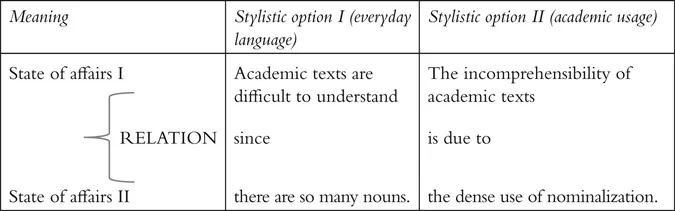 |
(based on Forner 1998)
Apart from causative verbs such as cause, induce, trigger, hervorbringen, etc., both academic German and, to a lesser extent, academic English use a number of other linking verbs to relate states of affairs, such as erfolgen, (vor)liegen, durchführen, darstellen, sich ergeben, entstehen, sich handeln, bilden, involve, imply, mean, argue (‘this limitation of view argues inadequacy of penetrative imagination’), etc., many of which are used within expanded predicates, technically known as ‘support verb constructions’ (Funktionsverbgefüge) (give rise to, come into view, ins Blickfeld geraten/treten/nehmen; for further discussion, see Section 4.1.2).
It is important to realize that we have to do with stylistic developments that have evolved over the past 150 years or so. Academic usage in the nineteenth century was still modelled on the first of the aforementioned options, as evidenced by the following quotes from D’Arcy Thompson and Goethe:
But ere we begin to study them we must take care to define our terms, …
Es scheint nicht überflüssig zu sein, genau anzuzeigen, was wir uns bei diesen Worten denken, welche wir öfters brauchen werden.
Sanders (1996: 76) recasts Goethe’s sentence into a modern mould, following the second of the aforementioned options: Zunächst erfolgt eine Definition der häufiger gebrauchten Wörter.
A third feature of academic usage is the abundant use of classifying adjectives (hermeneutical task) derived from nouns (the task of hermeneutics).
The fourth and final feature to be noted is the expansion of simple into complex forms. As just seen, this is the case, for example, with support verb constructions but, more importantly, with nouns, usually in an effort to eke out a sense that would otherwise be imprecise; thus, to take just one example, manufacturing may become manufacturing process, manufacturing sector, productivity of manufacturing, etc.
We can now assemble the four ingredients of our recipe to transform a nonspecialist into a specialist text:
| Popular science text (Jürgen Kaube) | Academic text (D.S.) |
|---|---|
| Der Anteil der Eltern steigt, die von der Schule erwarten, dass sie zusammen mit den Kindern die wesentlichen Bildungsprobleme ganz allein löst. Aber das kann die Schule nicht. Starke kognitive Unterschiede bestehen schon beim Eintritt in den Kindergarten. Dass sich die Chancen der Kinder vermindern, wenn die Eltern nicht Deutsch sprechen, scheint viele Eltern nicht genug zu bekümmern. (Jürgen Kaube, Ist die Schule zu blöd für unsere Kinder?, Berlin: Rowohlt 2019: 69) | Die vermehrten elterlichen Erwartungen hinsichtlich der Fähigkeit von Schule, die wesentlichen Bildungsprobleme institutionsintern zu lösen, sind unrealistisch. Eine Verminderung der Bildungschancen resultiert nämlich bereits frühzeitig aus Unterschieden in den kognitiven Voraussetzungen bei Kindergarteneintritt sowie aus fehlender elterlicher Sensibilität für die Bedeutung des Erwerbs der deutschen Sprache. |
My reworking of this excerpt illustrates the four major shifts just discussed:
- verbal formulations → nominalizations, including compounds (e.g., der Anteil der Eltern steigt, die … erwarten → die steigenden Erwartungen)
- subordinate clauses → relational verbs (e.g., dass sich die Chancen vermindern, scheint viele Eltern nicht zu bekümmern → die Verminderung der Chancen entsteht durch fehlende elterliche Sensibilität)
- nouns or other items → classifying and compound adjectives (e.g., Eltern → elterlich, ganz allein → institutionsintern)
- simple forms → complex forms (e.g., Chancen → Bildungschancen)
In addition to these shifts, the excerpt also illustrates four features of academic usage peculiar to German:
- a partiality for Latinate Bildungssprache (learned words; see Chapter 3.2), as exemplified by the adjective intern (here used in an adjectival compound)
- the availability of near-synonymic choices between Latinate Bildungssprache and words of Germanic stock (resultieren aus / entstehen durch; Realität/Wirklichkeit; Relation/Beziehung/Bezug/Verhältnis)
- the use of long subject phrases (die steigenden elterlichen Erwartungshaltungen bezüglich der Fähigkeit von Schule, die wesentlichen Bildungsprobleme institutions-intern zu lösen) that cannot normally be transferred intact into English (see Chapter 2.4)
- a predilection for lengthy modifiers (i.e., elements that give additional information) in noun phrases
Most English academic writers make less use of learned words and prefer more loosely jointed clauses and sentences that begin with short elements and place the longer, heavier elements towards the end.
This is the broad-brush picture of the lie of the land. Inevitably, it is in some ways lacking in light, shade, and compositional complexity. Any regular reader of academic texts cannot fail to notice substantial differences between the Kunstprosa of, say, literary or art criticism on the one hand, and the Fachprosa of economics, psychology, sports science, or linguistics on the other. Two contrastive examples:
| Literary criticism | Economics |
|---|---|
| More recently, Feisal Mohamed has written with acuity about the ways in which both revisionist and redemptionist readings of Samson can function to flatter our own assumptions about the transhistorical superiority of contemporary Western understandings of morality (Milton 122). In other words, even those critics for whom the chief hermeneutical task involves historical contextualization, those critics who seek to solve the ideological challenge of Samson by scrupulously articulating the distance between Milton’s ideological moment and our own, must speak perforce through the filter of embedded historical consciousness. This is by now a venerable truism: interpretation is historically sited. Hence the pivotal importance of the readerly self-estrangement I take to be a key effect of Dalila’s final speech in Samson Agonistes. (Gregerson, Linda. ‘Milton and the Tragedy of Nations.’ PMLA 129.4 [2014]: 672–687.) | Very little is known about tariff incidence, despite its central role in policy analysis. In this article, we estimate the impacts of tariffs on US trade quantities and prices. We estimate a US demand system that accommodates reallocations across imported varieties (defined as country-product pairs), across imported products (defined as 10-digit Harmonized System product codes), and between imported and domestic products within a sector (defined as a 4-digit NAICS industry code). We combine this system with foreign export supply curves for each variety. The estimation leverages the property that if changes in tariffs are uncorrelated with demand and supply shocks, then a tariff can be used to simultaneously instrument both the import demand and foreign export supply curves. (Fajgelbaum, Pablo D., et al. ‘The return to protectionism.’ The Quarterly Journal of Economics 135.1 [2020]: 1–55.) |
While both texts exemplify current academic usage in the relevant disciplines, the differences far outweigh the similarities. Lexical features the two texts have in common include the presence of certain general-language or sub-technical words (e.g., little, recently, use, speak, each) and heavy reliance on subject-specific terminology, including many nominalizations (e.g., self-estrangement, contextualization, reallocation). Both texts also resort to relational constructions, albeit of a different nature (function to-INF, be a key effect of vs. be uncorrelated with). A...
Table of contents
- Cover
- Half Title
- Title Page
- Copyright Page
- Dedication Page
- Contents
- Preamble
- Acknowledgements
- 1 Introduction: academic language today
- 2 Academic grammar
- 3 Academic vocabulary
- 4 Vocabulary and grammar: constructions
- 5 Communicative purpose and linguistic form
- 6 Language use in the disciplines
- Appendix
- Index
Trusted by 375,005 students
Access to over 1.5 million titles for a fair monthly price.
Study more efficiently using our study tools.
Frequently asked questions
Yes, you can cancel anytime from the Subscription tab in your account settings on the Perlego website. Your subscription will stay active until the end of your current billing period. Learn how to cancel your subscription
No, books cannot be downloaded as external files, such as PDFs, for use outside of Perlego. However, you can download books within the Perlego app for offline reading on mobile or tablet. Learn how to download books offline
Perlego offers two plans: Essential and Complete
- Essential is ideal for learners and professionals who enjoy exploring a wide range of subjects. Access the Essential Library with 800,000+ trusted titles and best-sellers across business, personal growth, and the humanities. Includes unlimited reading time and Standard Read Aloud voice.
- Complete: Perfect for advanced learners and researchers needing full, unrestricted access. Unlock 1.5M+ books across hundreds of subjects, including academic and specialized titles. The Complete Plan also includes advanced features like Premium Read Aloud and Research Assistant.
We are an online textbook subscription service, where you can get access to an entire online library for less than the price of a single book per month. With over 1.5 million books across 990+ topics, we’ve got you covered! Learn about our mission
Look out for the read-aloud symbol on your next book to see if you can listen to it. The read-aloud tool reads text aloud for you, highlighting the text as it is being read. You can pause it, speed it up and slow it down. Learn more about Read Aloud
Yes! You can use the Perlego app on both iOS and Android devices to read anytime, anywhere — even offline. Perfect for commutes or when you’re on the go.
Please note we cannot support devices running on iOS 13 and Android 7 or earlier. Learn more about using the app
Please note we cannot support devices running on iOS 13 and Android 7 or earlier. Learn more about using the app
Yes, you can access German and English by Dirk Siepmann in PDF and/or ePUB format, as well as other popular books in Languages & Linguistics & German Language. We have over 1.5 million books available in our catalogue for you to explore.