Metal Toxicology Handbook
eBook - ePub

Metal Toxicology Handbook

  1. 490 pages
  2. English
  3. ePUB (mobile friendly)
  4. Available on iOS & Android
eBook - ePub

Metal Toxicology Handbook

About this book

Heavy metals and metalloids, singly or in combination, induce toxic manifestations either through acute or chronic pathology. In particular, long-term chronic exposure to diverse heavy metals and metalloids to humans and animals can lead to numerous physical, muscular, neurological, nephrological, and diverse degenerative diseases and dysfunctions, including multiple sclerosis, muscular dystrophy, Parkinson's and Alzheimer's diseases, cardiovascular disorders, and several others.

Recognized heavy metals such as lead, mercury, arsenic, cadmium, thallium, and hexavalent chromium are known for enormous toxicity. The immediate vital signs of acute heavy metal exposure include nausea, vomiting, diarrhea, and acute abdominal pain. Mercury has been identified as the most toxic heavy metal, and mercury poisoning is known as acrodynia or pink disease. Similarly, lead, another toxic heavy metal, was at one time an integral part of painting.

Metal Toxicology Handbook further explains and discusses the varying attributes of metals, discussing toxicity, safety, and proper human utilization of metals. Beginning with a broad overview of metals, metalloids, redox biology, and neurodegeneration and going further into the roles, benefits, and toxicity of metals with each section, the text contains 28 chapters from eminent researchers and scientists in their respective fields and is a must-have for anyone researching the potential toxicity in metals.

Key Features


  • Discusses the pathology of metal toxicity


  • Highlights the benefits of metals


  • Explains the mechanism and salient features of restoring metabolic homeostasis


  • Highlights dose-dependent beneficial and adverse effects of vanadium safety and toxicity

The initial introductory section provides a broad overview of metals, metalloids, redox biology, and neurodegeneration. The second section discusses the pathology of metal toxicity in two chapters, while the third section highlights the mechanism and salient features of restoring metabolic homeostasis in two chapters. The fourth section demonstrates the aspect of radionuclides toxicity. In a change of pace, the fifth section discusses the benefits of metals in four chapters. The sixth section, titled "Toxic Manifestations by Diverse Heavy Metals and Metalloids, " provides fourteen chapters that discuss the toxicological mechanism and manifestation of individual metals.

The editors have crafted a commentary titled "A Treatise on Metal Toxicity" and summarized a vivid scenario of metal toxicity and its consequences.
Frequently asked questions

Yes, you can cancel anytime from the Subscription tab in your account settings on the Perlego website. Your subscription will stay active until the end of your current billing period. Learn how to cancel your subscription.
At the moment all of our mobile-responsive ePub books are available to download via the app. Most of our PDFs are also available to download and we're working on making the final remaining ones downloadable now. Learn more here.
Perlego offers two plans: Essential and Complete
  • Essential is ideal for learners and professionals who enjoy exploring a wide range of subjects. Access the Essential Library with 800,000+ trusted titles and best-sellers across business, personal growth, and the humanities. Includes unlimited reading time and Standard Read Aloud voice.
  • Complete: Perfect for advanced learners and researchers needing full, unrestricted access. Unlock 1.4M+ books across hundreds of subjects, including academic and specialized titles. The Complete Plan also includes advanced features like Premium Read Aloud and Research Assistant.
Both plans are available with monthly, semester, or annual billing cycles.
We are an online textbook subscription service, where you can get access to an entire online library for less than the price of a single book per month. With over 1 million books across 1000+ topics, we’ve got you covered! Learn more here.
Look out for the read-aloud symbol on your next book to see if you can listen to it. The read-aloud tool reads text aloud for you, highlighting the text as it is being read. You can pause it, speed it up and slow it down. Learn more here.
Yes! You can use the Perlego app on both iOS or Android devices to read anytime, anywhere — even offline. Perfect for commutes or when you’re on the go.
Please note we cannot support devices running on iOS 13 and Android 7 or earlier. Learn more about using the app.
Yes, you can access Metal Toxicology Handbook by Debasis Bagchi,Manashi Bagchi in PDF and/or ePUB format, as well as other popular books in Medicine & Nutrition, Dietics & Bariatrics. We have over one million books available in our catalogue for you to explore.

Information

Publisher
CRC Press
Year
2020
Print ISBN
9781138345249
eBook ISBN
9780429795732

PART I

Introduction
Metals, Metalloids, Redox Biology, and Neurodegeneration

CHAPTER 1

Role of Metals and Metalloids in Redox Biology1
Amit Madeshiya
Indiana University School of Medicine
Pradipta Banerjee
Centurion University of Technology & Management
Suman Santra and Nandini Ghosh
Indiana University School of Medicine
Sayantani Karmakar
International Institute of Innovation and Technology (IIIT)
Debasis Bagchi
Texas Southern University
Victory Nutrition International, Inc.
Sashwati Roy and Amitava Das
Indiana University School of Medicine
Contents
1.1 Introduction
1.2 Iron
1.3 Lead
1.4 Mercury
1.5 Cadmium
1.6 Chromium
1.7 Manganese
1.8 Copper
1.9 Zinc
1.10 Arsenic
1.11 Concluding Remarks
References
1 Amit Madeshiya and Pradipta Banerjee have contributed equally.

1.1 Introduction

Oxidation-reduction (redox) reactions play a critical role in biological systems [1]. These involve the basic functions of life ranging from respiration to metabolism. Alterations in these redox reactions may lead to changes in physiological processes and promote progression of various diseases that can even prove fatal to the body [2]. An imbalance in homeostasis of reactive oxygen species (ROS) is the main cause of several diseases [3,4]. Basically there are two types of ROS: (a) primary ROS, generated via metabolic process or after oxygen activation by physical irradiation, and (b) secondary ROS, generated by primary ROS via interacting with enzyme/metal-catalyzed reaction [5]. Cellular antioxidant defense systems damage signaling pathways and biomolecules when overwhelmed with high levels of free radical production. Imbalance between free radicals and antioxidants in the human body is termed as oxidative stress, which takes place as a result of increased ROS production and decreased elimination [6]. Oxidative stress is frequently implicated in a number of biochemical physiological and pathological reactions and pathways [6]. Pathological processes such as cardiovascular dysfunction, diabetes, atherosclerosis, inflammation, and apoptosis occur during oxidative stress [6].
In human physiology, metals and metalloids play pivotal roles as active molecules that participate in several physiological processes including enzyme–substrate reaction, metal transporter system, and redox signaling pathway. Most of the metals are required by the human body at optimum levels since high concentration of metals is toxic for the body [7]. Heavy metals such as lead and mercury have been proven to be fatal to human health when ingested through food. These heavy metals can access the human body through numerous routes including skin, respiration, and contaminated water or food. Some of these metals react with other constituents of the body such as oxygen and chloride. The reaction of these metals inside the body eventually produces ROS that causes oxidative stress which ultimately leads to impaired kidney function, neurological diseases, endocrine diseases, and different types of cancers [8].
High concentration of iron in the body gives rise to free radicals that overpower the cellular antioxidant defense mechanisms, degrade biomolecules, and dysregulate cell signaling pathways [9]. Copper has the potential to induce oxidative stress either by catalyzing ROS formation through a Fenton-like reaction or by significantly decreasing the glutathione levels [10]. Chromium is considered as an occupational carcinogen that not only targets the lungs but also leads to adverse health conditions including gastrointestinal symptoms, hypotension, hepatic and renal failures, and sometimes stomach tumors [11]. The trivalent forms of the metalloid arsenic (As3+) are the most toxic and react with the thiol groups of proteins leading to neurological disorders [12]. Hallmarks of chronic exposure to arsenic include skin lesions, peripheral neuropathy, and anemia. Zinc deficiency is associated with poor diet and related to increased oxidative damage that results in increased lipid, protein, and DNA oxidation [13]. Cadmium enters the human body through the lungs and skin, and accumulates in the intestine and kidneys [14]. Cadmium-induced testicular damage and necrosis have been well documented. Lead damages cellular components via increased oxidative stress through direct ROS generation and via depletion of the cellular antioxidant pool [10]. Roles of some important metals and metalloids in redox biology and their implications in physiology and pathological states will be discussed in this chapter.

1.2 Iron

Iron is one of the most essential trace elements of the earth which exhibits biological activities from bacteria to mammals. It has a wide range of oxidation states, i.e., −2 to +6, but biologically active oxidation states are +2 and +3. Fe+2 is soluble in mostly all biological fluids. Iron acts as the major metal component in many proteins (hemoglobin) and enzymes, and also plays important roles in growth, development, normal cellular function, and enzymatic actions. Oxygen, sulfur, and nitrogen serve as the major biological ligands of iron [15]. In mammalian system, four classes of iron-containing proteins are there, namely, iron–sulfur enzymes (flavoproteins, hemeflavoproteins), heme proteins (hemoglobin, myoglobin, cytochromes), proteins for storage and transport (transferrin, lactoferrin, ferritin, hemosiderin), and other iron-containing or activated enzymes (sulfur, non-heme enzymes) [16,17]. Fe-S clusters act as complex protein cofactors that are bound to cysteinyl sulfur in the active sites of proteins [18]. Naturally occurring Fe-S clusters having low potential (−300 mV) undergo redox transition from (4Fe-4S) to (4Fe-4S)+2 [19]. In the electron transport chain, iron interconverts between Fe+2 (reduced) to Fe+3 (oxidized) states.
Optimum levels of iron are necessary to maintain homeostasis, as deficiency or a high amount of iron leads to human diseases. Frey and Reed reported that in normal physiological condition, iron metabolism depends on (a) the actions of hormone, hepcidin, and iron exporter protein, ferroportin, and (b) iron regulatory proteins that bind iron-responsive elements [20]. When there is an iron overload, hydroxyl ions are produced which leads to oxidative stress in iron-sensitive tissues. Generation of ROS by iron-mediated pathway is an acute pathophysiological condition that may result in cell death in various organisms [21]. Iron-mediated cell death is often termed as ferroptosis.
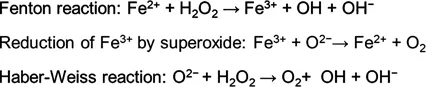
Cells in the redox state are usually dependent on iron (and copper) redox couple and are maintained within strict physiological limits. Rate of iron absorption in the proximal intestine and rate of iron released are prevented by homeostatic mechanism. Unused cellular iron by other ferroproteins accumulates in ferretin, and its iron-binding capacity is limited. Hemochromatosis is a typical condition where patients suffer from iron overload causing severe organ damage. Interestingly, free iron can generate damaging reactive free radicals via the Fenton reaction [6] (Figure 1.1). Free iron has deleterious effects. When an organism is overloaded with iron, the Fenton reaction plays a significant role in vivo. The superoxide radicals generated participate in the Haber–Weiss reaction. It is a combination of the Fenton reaction and the reduction of Fe(III) by superoxide (Figure 1.1).
images
Figure 1.1 Redox reactions involving iron.
Free radical attacks permanently modify genetic materials and are involved in mutagenesis, aging, and carcinogenesis. Free-radical-mediated DNA damage is observed in various cancer tissues. Double bonds of DNA bases are added by the hydroxyl radical generated during the catalyti...

Table of contents

  1. Cover
  2. Half Title
  3. Title Page
  4. Copyright Page
  5. Dedication Page
  6. Table of Contents
  7. Preface
  8. Editors
  9. Contributors
  10. Part I Introduction: Metals, Metalloids, Redox Biology, and Neurodegeneration
  11. Part II Pathology of Metal Toxicity
  12. Part III Mechanisms of Restoring Metabolic Homeostasis
  13. Part IV Radionuclides Toxicity
  14. Part V Benefits of Metals
  15. Part VI Toxic Manifestations by Diverse Heavy Metals and Metalloids
  16. Index