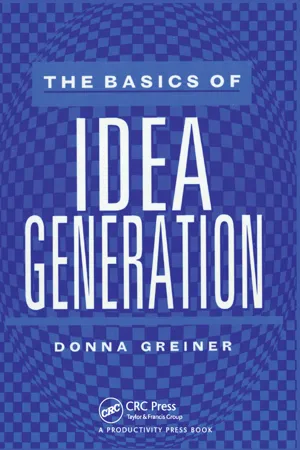
Continuous generation and implementation of ideas is critical to creating an environment that helps foster the development of improvement techniques. The Basics of Idea Generation provides a cost-effective method that can help inspire employees to consistently identify and implement new ideas, using a proven five-step process. The process starts by creating an opportunity statement. From there the method then has one collect raw materials, before holding an idea workout, and then evaluating the idea. Implementation is the final step. The author also explains the 20 tools that help complete each step, along with solutions to overcoming the barriers to creativity.
- English
- ePUB (mobile friendly)
- Available on iOS & Android
eBook - ePub
The Basics of Idea Generation
About this book
Information
Publisher
Productivity PressYear
2020Print ISBN
9780527763398
9781138438910
Edition
1eBook ISBN
9781000154061
CHAPTER 1
Five Steps to Ideation
STEP 1: CREATE AN OPPORTUNITY STATEMENT
In idea generation, as with any task, the first step toward achieving goals is to decide what those goals will be. As the old law says: If you don’t know where you’re going, how will you know when you get there?
There are many different types of goal statements. Most of the readers of this book work in companies that have created mission statements to make their organizational goals explicit. Just as a corporate mission statement focuses all employees on common goals and establishes a common framework for day-to-day operations, opportunity statements are used to define and establish goals for idea generation projects.
These goal statements are called “opportunity” statements because they represent positive, forward-moving improvements. Even when ideas are generated to solve problems, it is helpful to speak and think of the work of idea generation as an opportunity.
Starting the ideation process with an opportunity statement is equally critical for individual and team-based idea-generating efforts. The opportunity statement provides a method for keeping the desired outcome of the work clear throughout the ideation effort. It gives idea hunters a road map for successfully navigating the ideation process. And, importantly, the opportunity statement represents a shared commitment to the project by the participants who helped create it.
The work of creating ideas is a positive activity. Thinking of idea generation as an opportunity increases the likelihood of success.
THE TWO ELEMENTS OF OPPORTUNITY STATEMENTS
Opportunity statements should be simply stated and as unambiguous as possible. They are written statements that need not be lengthy. A small project might require only a sentence or two and an even larger effort can be described in a few paragraphs. Opportunity statements should also be written in the first person using wording such as “I will” or “we will” to build commitment.
There are two elements in every opportunity statement: an explanation of the goal of the ideation project and a timeline for project completion.
Define the Goal
The first element of the opportunity statement requires the definition of what project managers call “deliverables.” Deliverables are the useable end results of a project or its goals. The first sentence of the opportunity statement should explain exactly what the project aims to accomplish.
Goal definition might be very simple, such as when a single employee attacks a quality defect completely within her control. Such a goal definition might read: “I will create and implement an idea to eliminate….” Larger projects, such as the development of new product ideas that are created by teams, will usually include broader goals that may require more thought and a group consensus to accomplish.
Establish a Schedule
The second element of an opportunity statement is the timeline for project completion. This schedule assigns a time period and assigns responsibility for completing each of the five steps of the ideation process.
A specific time frame for project completion is useful for several reasons. First, the mere fact that a deadline is specified can help idea hunters reach their goals. (See the subconscious aspects of idea generation in the next step.) Second, a schedule allows idea hunters to set aside uninterrupted blocks of time for their search. Third, as steps in the schedule are successfully completed, a sense of accomplishment and confidence in our ability to be creative grows.
FOUR TIPS FOR SUCCESSFUL OPPORTUNITY STATEMENTS
1. Put it in writing. Putting all idea work in writing is important in several ways. It creates a permanent, tangible record of work and it encourages commitment from all participants. A written record puts all those involved “on the same page” and creates an idea pool in which the contributions of everyone in a group are saved. And, finally, it creates a road map preventing participants from losing sight of their deliverables.
2. Involve every team member. Successful opportunity statements, like mission statements, are usually not imposed from above, but need to come from the hearts and minds of those employees who will be responsible for fulfilling them. If you want to foster commitment, loyalty, and ownership in an idea project, make sure everyone involved participates in the definition of the project goals.
3. Create an opportunity, not a cage. Too restrictive an opportunity statement can hinder creative freedom. A useful technique to assist in the process of defining opportunities is to visualize how your work or company will look when your ideas have been implemented. Ignore the constraints of the situation and imagine the best possible outcome without being judgmental or overly practical. This “wish list” will allow you to define your goals without narrowing your options.
4. Use questions to zero-in on opportunities. Questions are a highly effective way to define your idea goals. In fact, questions like “why not?” are the basic starting point of any creative endeavor. Try using the 5W2H Method (what, why, where, when, who, how, and how much) to help define your current situation and the opportunities available to improve it. (See “Reporter’s Questions” in Chapter 2 for a user’s guide to this technique.)
“Whatever the mind of man can conceive and believe, it can achieve.”Napoleon Hill
STEP 2: COLLECT THE RAW MATERIAL
With the direction and schedule of an idea-generating project established, it is time to begin collecting the raw materials which will be combined with the added value of the idea hunter’s creativity to yield valuable and ready-to-implement ideas. This step is a research and germination phase of the ideation process.
There are three action phases at work within Step 2: Investigate, Inquire, and Incubate (the “3 I’s” Way). Before learning how to use the “3 I’s”, there are three traits that idea hunters need to understand and cultivate to make the most of their idea research and germination efforts. These traits are intellectual characteristics: openness, curiosity, and immersion.
• Openness, or the ability to accept thinking that differs from our own, is a critical trait of idea hunters. Henry Ford, whose genius and drive made owning an automobile an attainable dream for most Americans, provides an excellent example of what can happen when we are closed-minded to new ideas. When asked in what colors the Model T was available, he replied that customers could have his car in any color they wanted—as long as that color was black. This failure to remain open to the idea of options contributed to the rise of General Motors, which built its business on the many options it offered its customers. Believing that you already know all there is to know stifles creativity. Instead, maintain an open mind where new possibilities exist and new combinations may be formed.
• Curiosity may have killed the cat, but ideation projects run by idea hunters who are not curious will surely suffer the same fate. The trait of curiosity encourages idea hunters to search outside their own areas of expertise for ideas. The invention of Velcro is a good example. Velcro was invented by curious scientists who thought to study nature for undiscovered methods of adhesion. The common burr, as everyone who has ever pulled one off of their pants leg will immediately recognize, became the model for this immensely successful new product.
• Immersion refers to an idea hunter’s ability to remain devoted to his task, to focus and concentrate without becoming distracted by other matters. Few inventors can match Thomas Edison’s ability to immerse himself in his work. Loath to leave his work, Edison often slept in his West Orange, NJ “invention factory.” In his search for a stable filament for the electric light bulb, the untiring i...
Table of contents
- Cover
- Half Title
- Title Page
- Copyright Page
- Table of Contents
- Preface
- Introduction
- Chapter 1: Five Steps to Ideation
- Chapter 2: 20 Ideation Tools and Techniques
- Related Resources
Trusted by 375,005 students
Access to over 1.5 million titles for a fair monthly price.
Study more efficiently using our study tools.
Frequently asked questions
Yes, you can cancel anytime from the Subscription tab in your account settings on the Perlego website. Your subscription will stay active until the end of your current billing period. Learn how to cancel your subscription
No, books cannot be downloaded as external files, such as PDFs, for use outside of Perlego. However, you can download books within the Perlego app for offline reading on mobile or tablet. Learn how to download books offline
Perlego offers two plans: Essential and Complete
- Essential is ideal for learners and professionals who enjoy exploring a wide range of subjects. Access the Essential Library with 800,000+ trusted titles and best-sellers across business, personal growth, and the humanities. Includes unlimited reading time and Standard Read Aloud voice.
- Complete: Perfect for advanced learners and researchers needing full, unrestricted access. Unlock 1.5M+ books across hundreds of subjects, including academic and specialized titles. The Complete Plan also includes advanced features like Premium Read Aloud and Research Assistant.
We are an online textbook subscription service, where you can get access to an entire online library for less than the price of a single book per month. With over 1.5 million books across 990+ topics, we’ve got you covered! Learn about our mission
Look out for the read-aloud symbol on your next book to see if you can listen to it. The read-aloud tool reads text aloud for you, highlighting the text as it is being read. You can pause it, speed it up and slow it down. Learn more about Read Aloud
Yes! You can use the Perlego app on both iOS and Android devices to read anytime, anywhere — even offline. Perfect for commutes or when you’re on the go.
Please note we cannot support devices running on iOS 13 and Android 7 or earlier. Learn more about using the app
Please note we cannot support devices running on iOS 13 and Android 7 or earlier. Learn more about using the app
Yes, you can access The Basics of Idea Generation by Donna Greiner in PDF and/or ePUB format, as well as other popular books in Business & Business General. We have over 1.5 million books available in our catalogue for you to explore.