Printed antennas have become an integral part of next-generation wireless communications and have been found to be commonly used to improve system capacity, data rate, reliability, etc. This book covers theory, design techniques, and the chronological regression of the printed antennas for various applications. This book will provide readers with the basic conceptual knowledge about antennas along with advanced techniques for antenna design. It covers a variety of analytical techniques and their CAD applications and discusses new applications of printed antenna technology such as sensing. The authors also present special reconfigurable antennas such as ME dipole, polarization, feeding, and DGS. The book will be useful to students as an introduction to design and applications of antennas. Additionally, experienced researchers in this field will find this book a ready reference and benefit from the techniques of research in printed antennas included in this book. Following are some of the salient features of this book:
Covers a variety of analytical techniques and their CAD applications
Discusses new applications of printed antenna technology such as sensing
Examines the state of design techniques of printed antenna
Presents special reconfigurable antennas such as ME dipole, polarization, feeding, and DGS
Noida Institute of Engineering & Technology, Greater Noida
Prof. Binod Kumar Kanaujia
Jawaharlal Nehru University, New delhi
Dr. Anil Kumar Singh
M. J. P. Rohilkhand University, Bareilly
Contents
1.1 Evolution and Upcoming Growth of Printed Antennas
1.2 Features of Printed Antennas
1.2.1 Feeding Techniques
1.2.1.1 Coaxial Feeding
1.2.1.2 Microstrip Feeding
1.2.1.3 Proximity-Coupled Feeding
1.2.1.4 Aperture-Coupled Feeding
1.2.2 Performance Factors of Printed Antennas
1.2.2.1 Radiation Pattern
1.2.2.2 Directivity
1.2.2.3 Antenna Gain
1.2.2.4 Bandwidth
1.2.2.5 Polarization
1.2.2.6 Axial Ratio
1.3 Characteristics of Printed Antennas
1.3.1 Different Shapes of Printed Antennas
1.3.2 General Characteristics of Basic Patches
1.3.2.1 The Rectangular Patch
1.3.2.2 The Circular Patch
1.3.2.3 The Triangular Patch
1.3.2.4 Annular Ring Patch
1.4 Field of Applications for Printed Antennas
1.4.1 Advantages and Disadvantages of Printed Antennas
1.5 Techniques Developed for Low-Profile Printed Antennas
1.5.1 Features of Printed Antenna Technology
1.5.2 Basic Issues and Design Limitations
1.6 Analysis Methods for Some Common Patches
1.6.1 Analysis of Rectangular Patch Antenna by Transmission Line Model
1.6.2 Analysis of Circular Patch Antenna by Cavity Model
1.7 Special Measurement Techniques for Printed Antennas
1.7.1 Substrate Properties
1.7.2 Connector Characterization
1.7.3 Measurements of Printed Lines and Networks
1.7.4 Near-Field Probing
1.7.5 Efficiency Measurement
1.8 Summary Remarks
References
1.1 Evolution and Upcoming Growth of Printed Antennas
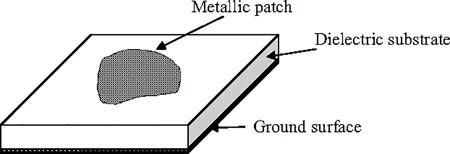
Wireless communication is the latest emerging pillar in the field of communication. It has reshaped the way of communication and connectivity. Its various applications such as broadcast of information, personal communication, satellite communication and mobile communication have notable merits such as simplicity in design, light weight, easy execution and estimate. The progress in wireless local area networks (WLANs), cell phone networks, satellite communication and other different wireless networks shows the demand as well as interest in the distinctive area of information technology and communication. Due to the blooming of advanced communication applications, there is a high demand of highly advanced and smart antennas, which are regarded as the key for wireless technologies. For wireless technology, the antenna with multiband operating property having high performance and features such as easy to control, easily manufactured, light weight, and simple structure etc. are preferred. Its two most interesting features are: physical simplification and flat structure, which lead the printed antennas to be the common choice of designers to assemble a printed antenna. Due to its engineering process, the simplest form of printed antenna is micro-strip antenna. Now-a-days electronic circuits not only used for a transmission line but also components such as filters, couplers, resonators, etc. frequently use an open-wave guiding structure known as micro-strip.. The use of micro-strip for constructing antennas is a new development, and an example of a micro-strip antenna is shown in Figure 1.1. The conducting ground plane supports the complete lower portion of the dielectric substrate, whereas the printed conducting strip is placed at the upper portion of the dielectric substrate.
FIGURE 1.1 Basic configuration of a printed antenna.
Designers worldwide are emphasizing the use of printed antenna, especially for low profile radiators, as it is a traditional and well-established antenna. The remarkable use of printed or micro-strip antennas in many established techniques makes it more reliable. Because of the rapid growth and progress in the antenna technology in a short duration of one to two decades, the historical evolution of the present-day antenna has become significant and interesting to read. With the rapidly increasing research and development and ever-growing research publications in the field of antenna, it would be worth saying that nowadays printed antennas have become dominant among the family of antennas. Now the demand is for more inventive printed antenna structures having reliable manufacturing approach. The main focus area for the contemporary system is lower profile antennas with low cost and less weight. However, the designer’s ability to regulate the process of manufacturing in a controlled manner leads to effectively modelled structures and reduced costs of the antenna. This book brings out the foremost concern of the designers and researchers for having a detailed computer modelling of printed antennas due to the latter’s challenges in the antenna domain.
Initially, Greig and Englemann [1] reported a new technique for transmission of kilo-mega range of waves and Deschamp [2] included the concept of microstrip antenna origin which is one of link from various sources. At that time the originated stripline structure emitting the undesirable radiations. To reduce the unwanted radiations from the circuit, the size of the conducting strip and substrate dimensions were reduced, which resulted in the creation of ‘microstrip’. The concept that the arrival of the transistor was the turning point in the development of planar printed circuits had been questionable, but the main attention was to develop such circuits and microwave filters having low cost. Though less or no attention was given to the radiation loss, the nature of the radiation from stripline circuits was taken into consideration by Lewin [3]. Due to the development of new generation missiles, there was an urgent demand for low profile printed antennas in the early 1970s; otherwise, th...
Table of contents
Cover
Half Title
Title Page
Copyright Page
Table of Contents
Preface
Editors
Contributors
Chapter 1 Basic Theory and Design of Printed Antennas
Chapter 2 Latest Trends in the Field of Printed Antennas
Chapter 3 Radiation Pattern Agility of Printed Antennas
Chapter 4 Band Hopping in Printed Antennas 95
Chapter 5 Pattern and Polarization Diversity in Antennas
Chapter 6 Compact Printed Antenna Designs: Need for UWB Communications
Chapter 11 Advances in Patch Antenna Design Using EBG Structures
Chapter 12 Design of Frequency Selective Surface (FSS) Printed Antennas
Index
Trusted by 375,005 students
Access to over 1.5 million titles for a fair monthly price.
Study more efficiently using our study tools.
Frequently asked questions
Yes, you can cancel anytime from the Subscription tab in your account settings on the Perlego website. Your subscription will stay active until the end of your current billing period. Learn how to cancel your subscription
No, books cannot be downloaded as external files, such as PDFs, for use outside of Perlego. However, you can download books within the Perlego app for offline reading on mobile or tablet. Learn how to download books offline
Perlego offers two plans: Essential and Complete
Essential is ideal for learners and professionals who enjoy exploring a wide range of subjects. Access the Essential Library with 800,000+ trusted titles and best-sellers across business, personal growth, and the humanities. Includes unlimited reading time and Standard Read Aloud voice.
Complete: Perfect for advanced learners and researchers needing full, unrestricted access. Unlock 1.5M+ books across hundreds of subjects, including academic and specialized titles. The Complete Plan also includes advanced features like Premium Read Aloud and Research Assistant.
Both plans are available with monthly, semester, or annual billing cycles.
We are an online textbook subscription service, where you can get access to an entire online library for less than the price of a single book per month. With over 1.5 million books across 990+ topics, we’ve got you covered! Learn about our mission
Look out for the read-aloud symbol on your next book to see if you can listen to it. The read-aloud tool reads text aloud for you, highlighting the text as it is being read. You can pause it, speed it up and slow it down. Learn more about Read Aloud
Yes! You can use the Perlego app on both iOS and Android devices to read anytime, anywhere — even offline. Perfect for commutes or when you’re on the go. Please note we cannot support devices running on iOS 13 and Android 7 or earlier. Learn more about using the app
Yes, you can access Printed Antennas by Binod Kumar Kanaujia, Surendra Kumar Gupta, Jugul Kishor, Deepak Gangwar, Binod Kumar Kanaujia,Surendra Kumar Gupta,Jugul Kishor,Deepak Gangwar in PDF and/or ePUB format, as well as other popular books in Technology & Engineering & Chemical & Biochemical Engineering. We have over 1.5 million books available in our catalogue for you to explore.