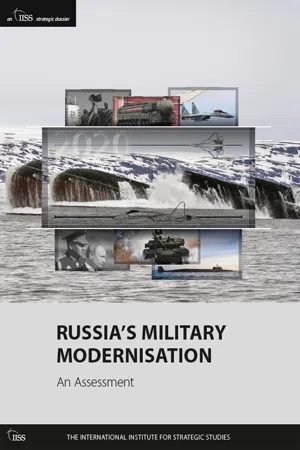
Russia’s Military Modernisation: An Assessment
eBook - ePub

Russia’s Military Modernisation: An Assessment

  1. 188 pages
  2. English
  3. ePUB (mobile friendly)
  4. Available on iOS & Android
eBook - ePub

Russia’s Military Modernisation: An Assessment

About this book

This new IISS Strategic Dossier examines the recent development of Moscow's armed forces and military capabilities. It analyses the aspirations underpinning Russia's military reform programme and its successes as well as its failures. The book also provides insights into Russia's operational use of its armed forces, including in the intervention in Syria, the goals and results of recent state armament programmes, and the trajectory of future developments. This full-colour volume includes more than 50 graphics, maps and charts and over 70 images, and contains chapters on:

  • Russia's armed forces since the end of the Cold War
  • Strategic forces
  • Ground forces
  • Naval forces
  • Aerospace forces
  • Russia's approach to military decision-making and joint operations
  • Economics and industry

At a time when Russia's relations with many of its neighbours are increasingly strained, and amid renewed concern about the risk of an armed clash, this dossier is essential reading for understanding the state,capabilities and future of Russia's armed forces.

Trusted by 375,005 students

Access to over 1.5 million titles for a fair monthly price.

Study more efficiently using our study tools.

CHAPTER ONE

Russia’s armed forces since the end of the Cold War

Military reform after 1991

The Russian armed forces faced critical challenges following the collapse of the Soviet Union in 1991. Over the following decade, the services had to confront the reality of a smaller establishment strength, with units and equipment allocated to newly independent republics of the former Soviet Union. They also had to deal with the legacy of the 1979–89 Afghanistan war, the damaging wars in Chechnya, the need to reshape Russia’s defence organisations, and personnel and funding crises. Additionally, economic problems had serious implications for defence funding: budgets fell sharply and procurement atrophied. Service chiefs, meanwhile, were unable over the decade to establish balanced and well-trained forces equipped with modern weapons. Factors stemming from the Soviet legacy also helped stymie their ambitions, including a complicated deployment system that was designed to bring combat formations to readiness by mobilising a reserve component and a vast array of equipment – much held in store – intended to outfit these forces.1 Indeed, these arrangements had ramifications. Then-president Boris Yeltsin’s decision not to issue a mobilisation order in advance of the First Chechen War meant that Russia’s formations sent there were in effect ad hoc and only brought up to strength by drafting in troops from disparate units.
There were fitful – and unsuccessful – attempts to initiate reforms during the 1990s, largely aiming to generate a combat-ready core within this overall structure. However, matters only began to improve in 2003 when the Ministry of Defence (MoD) formally introduced a contractservice initiative (though this was itself briefly reversed in 2009–10), and after 2007–08, when experiments began to improve command and control by activating strategic commands.2 This coincided with the MoD being tasked with fundamental change in the wake of the August 2008 war with Georgia, which heralded the shift away from the mass-mobilisation model.
Key takeaways

NEW LOOK AIMS

The New Look programme was designed to transform armed forces that still reflected the Soviet-era mass-mobilisation army into a modern combat-ready force held at high readiness.

BITTER EXPERIENCE

Russia’s experiences in the Chechen wars reinvigorated reform aspirations. In the first war, Russia’s forces there were often understrength and it was difficult to deploy coherent units. The Second Chechen War saw a modest improvement, and performance in the 2008 Georgia war was a key impetus for reform.

REFORM ORIGINS

Although the reforms after 2008 finally led to fundamental change, some Russian military leaders – notably Marshal Nikolai Ogarkov – had long advocated reforms that would lead to restructured, more professional and higher-readiness formations.

COMMAND AND CONTROL IMPROVES

The reforms were also intended to streamline command and control. Military districts were reduced in number and in 2010 four strategic commands were created, rising to five in 2015. A fifth military district was due to be formed in 2021.

MANOEUVRE COMBAT POWER STILL VITAL

Russia has developed capabilities that enable actions short of war and has honed existing competencies in areas like electronic warfare. But armour and artillery modernisation, together with the moves to improve command and control, organisation and deployability, indicate that the ability to conduct rapid deep-strike operations remains an aspiration.
Personnel and the mass-mobilisation legacy
Russia’s legacy mass-mobilisation system, in which the armed forces would be brought up to wartime strength by recalling reservists, meant that both Soviet-era military formations and, until 2008, their Russian successors effectively had two distinct tables of organisation and equipment (TOE).3
The wartime TOE set out the number of personnel and equipment required for a military operation, whereas its peacetime counterpart indicated the numbers intended for daily routines and combat training. Due to the different tasks required, these differed significantly in scale and composition. The plan was that units would in crisis or wartime be brought to strength with reservists, also gaining additional vehicles from equipment storage bases or from the civilian sector. These differential TOEs were seen not only in motor-rifle and tank divisions but also in the air force, air-defence formations and even in the Strategic Rocket Forces.4
Readiness, already challenged by the nature of the mobilisation model, was further tested by personnel shortages.5 All battalions, regiments, brigades, divisions, armies and districts were short of personnel. These shortages resulted from troops leaving service, transferring to other postings or leaving for training courses – in these cases of ‘current’ shortages, posts remained vacant. Units also experienced ‘temporary’ personnel shortages, when soldiers were temporarily unable to perform their tasks, for instance due to a tour of duty, a spell in hospital or a period of leave.
If a unit were deployed on operations, it had to transition to its wartime TOE, rectifying its ‘current’ and ‘temporary’ personnel shortages and taking from storage additional equipment. Without mobilisation, it was difficult to compensate for these personnel shortages.
There were broader challenges facing Russia’s service personnel in the 1990s, ranging from poor conditions and pay to the persistence of practices like dedovshchína (‘hazing’ or bullying) – and even the hiring of military personnel for labour.6 (Authorities attempted to address practices like the latter through legislation after the mid-2000s.) Meanwhile, Russia’s military formations were still dominated by conscripts. Conscription had a number of functions. It generated, each year, thousands of recruits arriving at reception centres and entering training, eventually to emerge on unit postings. It meant that there was, across society, a level of military experience that would be useful should mobilisation occur. Also, after contract-service initiatives began to be introduced after 1992, it was hoped that some conscripts would then decide to stay on as contractors, thus building up a more professional body of troops.7
However, challenges arose in the 1990s, as Russia experienced the results of declining birth rates. Between 1987 and 1999, live male births in Russia fell by around half, meaning that in time fewer young men were available to be called up – a challenge compounded by plans in 2008 to reduce the term of conscript service from two years to one.8 Additionally, more modern and more technically complex military equipment required more experienced and generally longer-serving troops.
This was the Soviet-era legacy: the complex system of mobilisation deployment that, for many years, frustrated many of Russia’s military leaders. And, despite the reform initiatives in the 1990s and from 2005–08, a qualified solution only emerged in 2008, when the mass-mobilisation principle came to an end and concerted effort began to generate contractor-staffed combat-ready formations.
Image

Afghanistan: the Soviet-era mobilisation system in practice

The former Soviet army comprised several categories of formation. The most combat-ready were called Type-A units.9 Documents indicate that these were to be staffed at 95–100% of their peacetime table of organisation and equipment (TOE), though this was only 70% of the wartime TOE. Military specialists presumed that such formations could be committed to combat on short notice without the remaining 30%.10
Lessons learned in Afghanistan proved such calculations overly optimistic. The motor-rifle and airborne divisions and brigades deployed there were all Type-A units. Although they would have been augmented up to the wartime TOE with reservists in case of war, the peacetime TOE of the 40th Army (which was re-formed for this mission) was deemed sufficient. It is possible that political factors lay behind this decision. Officially, the Soviet army was carrying out its ‘international duty’ to aid the communist government of the Democratic Republic of Afghanistan and assisting its people in maintaining national stability.11 If, however, the 40th Army had adopted a wartime TOE, the Soviet Union would in effect have been acknowledging that it was at war. An additional problem was that forces there had to contend with high levels of both ‘current’ and ‘temporary’ personnel shortages.
Although there is little official information on the 40th Army’s mobilisation readiness and staffing, a number of memoirs have been written by personnel involved in the conflict, referencing high casualties, poor conditions and long deployments (a tour of duty could last 24 months). Some motor-rifle companies, with a wartime TOE of 70 troops, would sometimes begin a mission in Afghanistan with only 30, while some motor-rifle battalions would only be able to dispatch on missions one company staffed to wartime TOE levels.12
The Soviet army had a system to compensate for these personnel shortages. Military commissariats mobilised reservists with similar military skills, but the system became effective only when there was a partial or a national mobilisation. In 1979, Soviet military leaders did indeed initiate a partial mobilisation in order to fully staff tank, motor-rifle and airborne divisions to be deployed in Afghanistan. The mobilisation lasted six months; the reservists were then dismissed and replaced by officers and soldiers transferred from other military districts.13
There were no more mobilisation orders throughout the campaign, and the Soviet army had no legal grounds by which it could activate its mechanism to bring units to strength. However, in 1984 the Turkestan and Central Asian military districts established a special reserve comprising lieutenants who had just graduated from military schools (some 200 men in each district) as well as noncommissioned officers (NCOs) fresh from training.14 Afterwards, this decision came in for criticism: those in the district reserve had no combat training; there was also no time limit to this commitment; and replacements soon had to be found for NCOs because they served only a relatively short period in conscript service.
Image
SOVIET PRESENCE IN AFGHANISTAN
Soviet soldiers on parade in Kabul in 1986, shortly before returning to the Soviet Union. The Soviet army withdrew in 1989. CREDIT: Daniel Janin/AFP/Getty Images
The Soviet army...

Table of contents

  1. Cover
  2. Title Page
  3. Copyright Page
  4. Table of Contents
  5. Common Abbreviations
  6. Glossary of Terms
  7. Introduction
  8. Chapter One Russia’s armed forces since the end of the Cold War
  9. Chapter Two Strategic forces
  10. Chapter Three Ground Forces
  11. Chapter Four Naval forces
  12. Chapter Five Aerospace Forces
  13. Chapter Six Russia’s approach to military decision-making and joint operations
  14. Chapter Seven Economics and industry
  15. Index

Frequently asked questions

Yes, you can cancel anytime from the Subscription tab in your account settings on the Perlego website. Your subscription will stay active until the end of your current billing period. Learn how to cancel your subscription
No, books cannot be downloaded as external files, such as PDFs, for use outside of Perlego. However, you can download books within the Perlego app for offline reading on mobile or tablet. Learn how to download books offline
Perlego offers two plans: Essential and Complete
  • Essential is ideal for learners and professionals who enjoy exploring a wide range of subjects. Access the Essential Library with 800,000+ trusted titles and best-sellers across business, personal growth, and the humanities. Includes unlimited reading time and Standard Read Aloud voice.
  • Complete: Perfect for advanced learners and researchers needing full, unrestricted access. Unlock 1.5M+ books across hundreds of subjects, including academic and specialized titles. The Complete Plan also includes advanced features like Premium Read Aloud and Research Assistant.
Both plans are available with monthly, semester, or annual billing cycles.
We are an online textbook subscription service, where you can get access to an entire online library for less than the price of a single book per month. With over 1.5 million books across 990+ topics, we’ve got you covered! Learn about our mission
Look out for the read-aloud symbol on your next book to see if you can listen to it. The read-aloud tool reads text aloud for you, highlighting the text as it is being read. You can pause it, speed it up and slow it down. Learn more about Read Aloud
Yes! You can use the Perlego app on both iOS and Android devices to read anytime, anywhere — even offline. Perfect for commutes or when you’re on the go.
Please note we cannot support devices running on iOS 13 and Android 7 or earlier. Learn more about using the app
Yes, you can access Russia’s Military Modernisation: An Assessment by The International Institute for Strategic Studies (IISS) in PDF and/or ePUB format, as well as other popular books in Politics & International Relations & Military & Maritime History. We have over 1.5 million books available in our catalogue for you to explore.