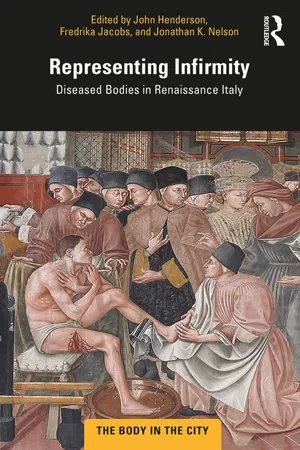
This volume is the first in-depth analysis of how infirm bodies were represented in Italy from c. 1400 to 1650. Through original contributions and methodologies, it addresses the fundamental yet undiscussed relationship between images and representations in medical, religious, and literary texts.
Looking beyond the modern category of 'disease' and viewing infirmity in Galenic humoral terms, each chapter explores which infirmities were depicted in visual culture, in what context, why, and when. By exploring the works of artists such as Caravaggio, Leonardo, and Michelangelo, this study considers the idealized body altered by diseases, including leprosy, plague, goitre, and cancer. In doing so, the relationship between medical treatment and the depiction of infirmities through miracle cures is also revealed. The broad chronological approach demonstrates how and why such representations change, both over time and across different forms of media. Collectively, the chapters explain how the development of knowledge of the workings and structure of the body was reflected in changed ideas and representations of the metaphorical, allegorical, and symbolic meanings of infirmity and disease.
The interdisciplinary approach makes this study the perfect resource for both students and specialists of the history of art, medicine and religion, and social and intellectual history across Renaissance Europe.
PART I Approaches to the representation of infirmity
1 CANCER IN MICHELANGELO’S NIGHT. AN ANALYTICAL FRAMEWORK FOR RETROSPECTIVE DIAGNOSES
Jonathan K. Nelson
The uses and abuses of retrospective diagnoses
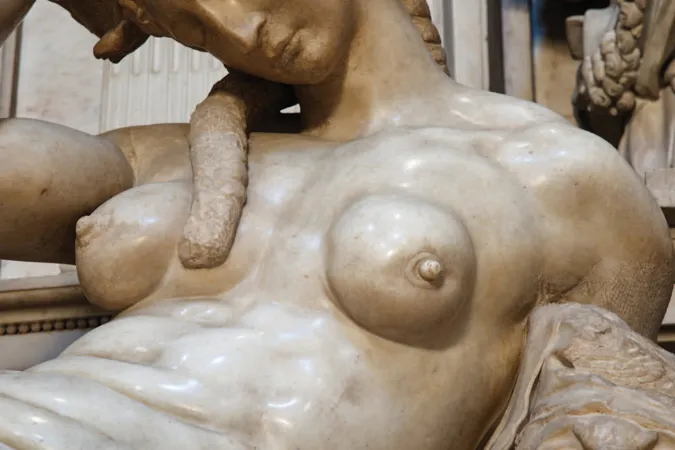
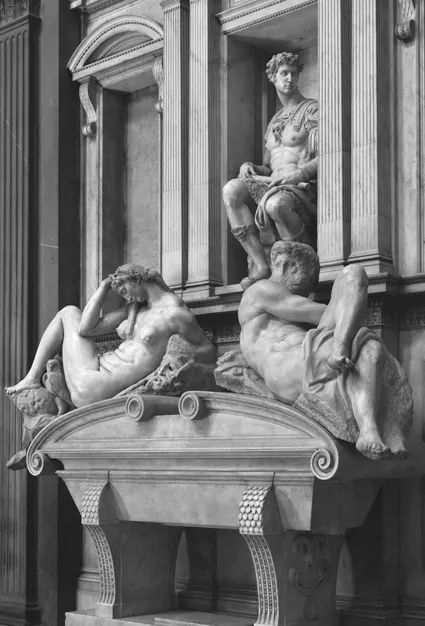
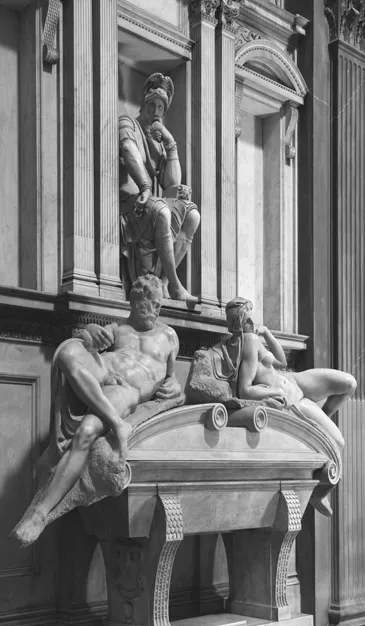
The lump on the left breast of the Night (Figure 1.1), a marble sculpture carved by Michelangelo in the 1520s, forces us to reconsider a series of widely held views, from the artist’s reputed ignorance of female anatomy to the modern fascination with medical diagnoses of art.1 Before turning to the sculpture, the first section considers some methodological problems posed by retrospective diagnoses through art. As discussed in the second section, the breast of the Night shows the physical signs of advanced cancer, and it is portrayed in such a way to suggest that Michelangelo made a conscious decision to represent an infirmity. This all-too-human element alludes to death, an appropriate subject for the decoration of the Medici mausoleum in the Church of San Lorenzo, Florence, known since the sixteenth century as the New Sacristy. Moreover, early sources often refer to cancer as gnawing into flesh, and this metaphor complements perfectly Michelangelo’s overall conceit for the tomb: ‘time devours all things’. The third section presents the hypothesis that Michelangelo associated Night with the melancholic temperament, given that doctors then believed that the disease of melancholia could lead to cancer. The poses and body types of the four allegorical statues in the New Sacristy—Night and Day on the tomb of Duke Giuliano (Figure 1.2), and Dawn and Dusk on the tomb of Duke Lorenzo (Figure 1.3)—seem to reflect the four canonical temperaments.
FIGURE 1.1 Michelangelo Buonarroti, Night, detail
Source: Gianni Trambusti, with the concession of the Ministero per i beni culturali—Museo Nazionale del Bargello
FIGURE 1.2 Michelangelo Buonarroti, Tomb of Duke Giuliano de’ Medici, detail
Source: Gianni Trambusti, with the concession of the Ministero per i beni culturali—Museo Nazionale del Bargello
FIGURE 1.3 Michelangelo Buonarroti, Tomb of Duke Lorenzo de’ Medici, detail
Source: Gianni Trambusti, with the concession of the Ministero per i beni culturali—Museo Nazionale del Bargello
Over the last three decades, medical journals have regularly included articles by physicians attempting to discover various diseases represented in paintings and sculptures.2 About twenty years ago, James Stark and I published one such study in the New England Journal of Medicine, ‘The Breasts of Night: Michelangelo as Oncologist’.3 Publications of this type attract little interest among historians of art or medicine. Specialists of paintings and sculptures generally ignore the research by physicians because of their unconvincing visual analyses of art. Another objection to this type of retroactive diagnose, especially for historians of medicine, is the lack of good data. Nevertheless, all can agree that modern physicians are trained and experienced in carrying out visual examinations. Surely some of the doctors who examine paintings and sculptures can make valuable observations for historical research. Many art historians, for example, now accept the proposal that Raphael represented the possessed boy in the Transfiguration (Vatican City) with the physical signs of epilepsy.4
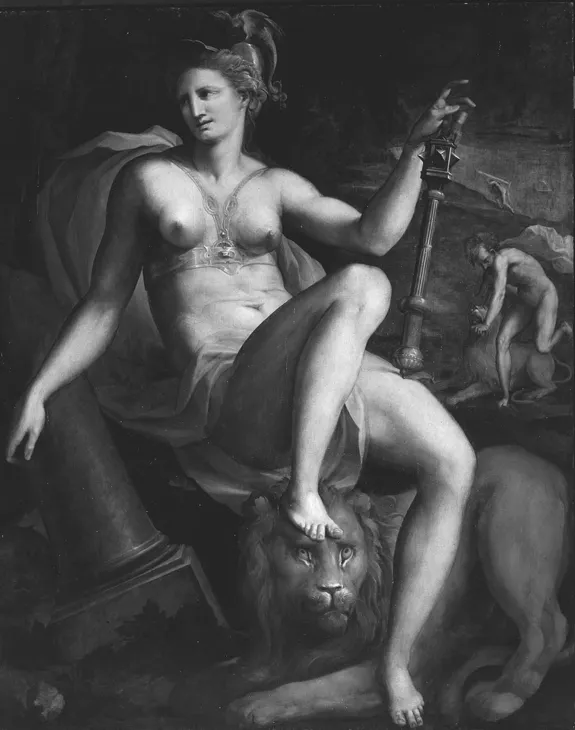
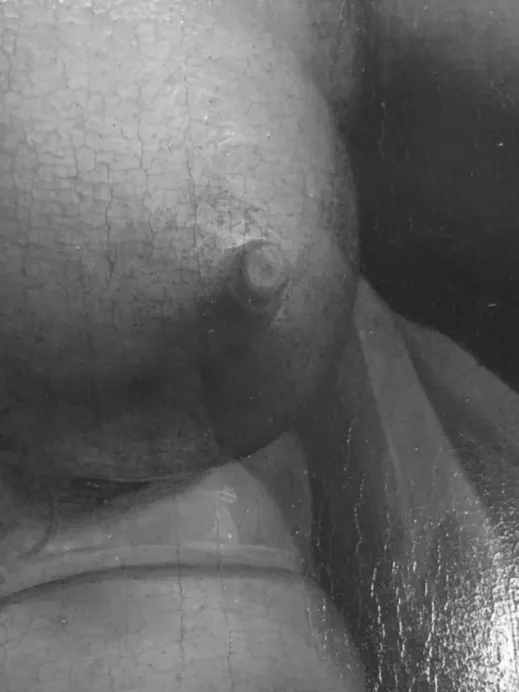
Though an article from 2018 in The Lancet Oncology, titled, ‘Earliest evidence of malignant breast cancer in Renaissance paintings’, presents a valuable insight about the left breast depicted in Michele Tosini’s Night, as discussed in the following section, it also makes the erroneous claim that the painting shows ‘an irritated region surrounding the areola-nipple’.5 Photographs seem to support this observation, but direct observation reveals only a shadow, created in part with red pigment. The authors also identified a tumour in the left breast of the Allegory of Fortitude (Figure 1.4), painted in about 1560 by Maso da San Friano. Their discussion of the ‘large bulge’ reveals a more serious misreading of Renaissance art. The representation of a debilitating disease in an allegory of strength should have set off some warning signs. In reality, Maso first painted a smaller breast and then enlarged it; over time, the uppermost paint layer became more transparent, revealing the original version below. From afar, this might be confused with a lump, but up close, it looks as if the smaller breast is enclosed within a sphere of flesh-coloured glass6 (Figure 1.5). The methodological problem with the analyses of both paintings is obvious. The authors, all oncologists, did not know how to evaluate the visual evidence and did not consult a specialist in Renaissance art. One can only imagine how physicians would react if an art historian published conclusions about the unusual physical aspect of a patient, based on the examination of a single radio-graph, without speaking with a doctor or technician. The oncologists’ study of the Fortitude is said to be part of a larger project aimed at ‘training the eye of medical students’.7 This would transform the painting into a dangerous didactic tool, given that Maso did not depict a tumour.
FIGURE 1.4 Maso da San Friano, Allegory of Fortitude
Source: With the concession of the Ministero per i beni culturali—Galleria dell’Accademia
FIGURE 1.5 Maso da San Friano, Allegory of Fortitude, detail
Source: Rossella Lari, with the concession of the Ministero per i beni culturali—Galleria dell’Accademia
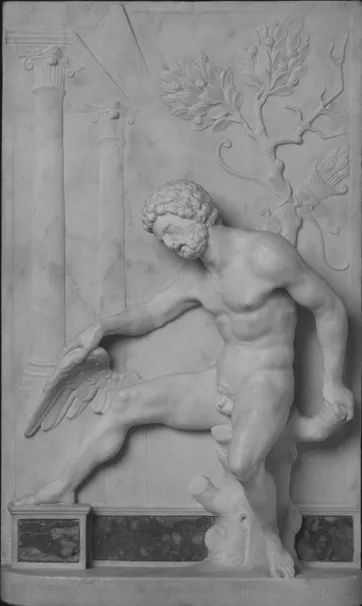
Painters and sculptors from the fifteenth and sixteenth centuries rarely depict serious illness or wounds in large-scale works, except for images of plague and leprosy victims. Far more typical is the highly stylized wound of Christ in Michelangelo’s Pietà (Vatican City). The artist and the educated viewers of his works were certainly familiar with Pliny the Elder, who addressed the topic of representing infirmity. In Natural History (34. 19. 59), he observed that a bronze sculpture by Pythagoras of Reggio depicting a lame man, presumably Philoctetes, ‘actually makes people looking at it feel a pain from his ulcer in their own leg’.8 Rather than follow this ancient example, Michelangelo and his contemporaries probably agreed with a view expressed by Plutarch, on the need for suitable imagery: ‘We avoid a man who is sickly or covered with sores as a disagreeable sight, but enjoy seeing Aristophon’s Philoctetes or Silanion’s Jocasta.’9 For Plutarch, the painting and sculpture, now both lost, evinced the beauty of representing what is fitting and suitable. A comparable sense of decorum led the sculptor Giammaria Mosca, working in the 1520s, to represent Philoctetes without physical imperfections (Figure 1.6), though the inscription of his marble relief reads: ‘This Poentian hero suffers from the Lernaean wound’.10 Infirmity, it seems, was better suited for words than images. Understandably, art historians remain sceptical about claims that Renaissance works include graphic representations of diseases.
Historians of medicine are suspicious about diagnoses based on a single image, especially one that does not provide information deemed essential for identifying diseases. For example, medical texts from antiquity through the seventeenth century regularly use the term ‘cancer’ to describe a range of unnatural swellings. Over the last twenty years, studies by Luke Demaitre, Alanna Skuse, and Michael Stolberg have documented how the concept of cancer was constructed in pre-modern Europe.11 The disease ‘was associated primarily with the breast and the uterus, with putrid, contagious secretions, and a pervasive impurity or contamination of the humours’.12 Among other physical signs identified by Gabriele Falloppio, the sixteenth-century physician still noted for his study of the female reproductive system, are a ‘hard tumour’, a ‘rather ashen colour’, and ‘sharp and piercing’ heat.13 Naturally, a white marble statue cannot directly communicate the smell, feel, colour, or temperature of a tumour.
Medical historians have also addressed the incommensurability of Renaissance and modern models of disease.14 Notions about how the body (mis)functions have changed so radically over the centuries that we cannot simply overlay our modern understandings on the past. The main risk of presentism is not that one winds up with the wrong answer. Rather, the investigation itself reconfirms the widespread misconception that modern categories can be imposed on the past. For millennia, and throughout the early modern period, learned and popular authors agreed that infirmities could be traced to the corruption or impeded flow of one or more of the four essential humours circulating throughout the body: black bile, yellow bile, phlegm, and blood.15 The predominance of one humour determined the temperament and complexion of an individual.16 All pre-modern authors agreed that cancer was caused by a congestion of black bile, a condition never mentioned by physicians today, so just what does it mean for a modern-day doctor to detect ‘cancer’ in a Renaissance work?
Scholars faced with the potential...
Table of contents
Cover
Half Title
Series Page
Title Page
Copyright Page
Contents
List of figures
List of contributors
Preface
Part I Approaches to the representation of infirmity
Part II Institutions and visualizing illness
Part III Disease and treatment
Part IV Saints and miraculous healing
Index
Index of diseases
Trusted by 375,005 students
Access to over 1.5 million titles for a fair monthly price.
Study more efficiently using our study tools.
Frequently asked questions
Yes, you can cancel anytime from the Subscription tab in your account settings on the Perlego website. Your subscription will stay active until the end of your current billing period. Learn how to cancel your subscription
No, books cannot be downloaded as external files, such as PDFs, for use outside of Perlego. However, you can download books within the Perlego app for offline reading on mobile or tablet. Learn how to download books offline
Perlego offers two plans: Essential and Complete
Essential is ideal for learners and professionals who enjoy exploring a wide range of subjects. Access the Essential Library with 800,000+ trusted titles and best-sellers across business, personal growth, and the humanities. Includes unlimited reading time and Standard Read Aloud voice.
Complete: Perfect for advanced learners and researchers needing full, unrestricted access. Unlock 1.5M+ books across hundreds of subjects, including academic and specialized titles. The Complete Plan also includes advanced features like Premium Read Aloud and Research Assistant.
Both plans are available with monthly, semester, or annual billing cycles.
We are an online textbook subscription service, where you can get access to an entire online library for less than the price of a single book per month. With over 1.5 million books across 990+ topics, we’ve got you covered! Learn about our mission
Look out for the read-aloud symbol on your next book to see if you can listen to it. The read-aloud tool reads text aloud for you, highlighting the text as it is being read. You can pause it, speed it up and slow it down. Learn more about Read Aloud
Yes! You can use the Perlego app on both iOS and Android devices to read anytime, anywhere — even offline. Perfect for commutes or when you’re on the go. Please note we cannot support devices running on iOS 13 and Android 7 or earlier. Learn more about using the app
Yes, you can access Representing Infirmity by John Henderson,Fredrika Jacobs,Jonathan K. Nelson in PDF and/or ePUB format, as well as other popular books in History & Early Modern History. We have over 1.5 million books available in our catalogue for you to explore.