Handbook on Networked Multipoint Multimedia Conferencing and Multistream Immsersive Telepresence using SIP: Scalable Distributed Applications and Media Control over Internet is the first book to put together all IETF request for comments (RFCs), and the internet drafts standards related to the multipoint conferencing and immersive telepresence.
This book includes mandatory and optional texts of all standards in a chronological and systematic way almost with one-to-one integrity from the beginning to end, allowing the reader to understand all aspects of the highly complex real-time applications.
It is a book that network designers, software developers, product manufacturers, implementers, interoperability testers, professionals, professors, and researchers will find to be immensely useful. Practitioners and engineers in all spectrums who are concentrating on building the real-time, scalable, interoperable multipoint applications, can use this book to make informed choices based on technical standards in the market place, on all proprietary non-scalable and non-interposable products. This book will provide focus and foundation for these decision makers.
1Scalable Networked Multipoint Multimedia Conferencing and Telepresence
1.1 Networked Multipoint Multimedia Conferencing
Multipoint conferencing where three or more parties communicate adds another new complex capability that requires media bridging (or mixing) of the multiple parties, and then, the bridged media needs to be sent to the conference participants. It also implies a lot of other things for management of a conference consisting of multiple parties, such as conference creation and termination, adding and removal of parties, dial-in and dial-out conferencing, privacy of attendees, side conferencing, application sharing, conference recording, floor control, media manipulation, whispering, announcements, and many other functionalities that are not usually relevant to the two-party conferencing, although the two-party conferencing system will be able to use all these multipoint conferencing features if applicable. In this book, we are describing the multipoint conferencing using the session initiation protocol (SIP) [1] and session description protocol (SDP) [2]. In this book, we are assuming that the readers already have some basic knowledge about both SIP and SDP.
A basic multipoint conferencing system can have centralized or distributed architecture considering the flows of signaling and media. In a centralized system, all signaling and media flow in a star configuration, where both signaling and media are controlled by a centralized entity, known as the conference application server, and all participants communicate with the centralized entity in a point-to-point fashion. In a purely distributive conferencing system, there is no centralized entity in setting up the multipoint conferencing, and it is a little difficult to build such a conferencing system. There are a couple of technical limitations in the SIP/SDP protocol architecture.
Although SDP serves quite well for point-to-point multimedia conferencing, its protocol architecture is such that it cannot be extended for distributed multipoint multimedia conferencing as of today. The only multipoint conferencing is the centralized star-like topology with the a priori known address of the centralized controller. In this conference architecture, again, capability negotiations are done using SDP in point-to-point fashion only. When we work with SDP, we have to know its limitations regarding how and where we can use SDP for setting up the multimedia conferencing dynamically. As a result, the Internet Engineering Task Force (IETF) multipoint working group known as XCON has developed the SIP/SDP-based multipoint conference standards as the centralized ones, where the centralized conference control is a functional entity named “focus/foci,” whose address is known a priori. It is assumed that foci control all conferencing resources, such as application servers, media servers, and multipoint bridging (mixing). Before we go into detail on multipoint conferencing, we provide a brief description of the multimedia conferencing protocol architecture.
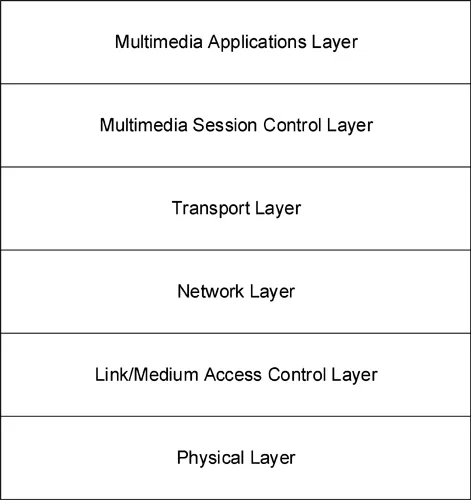
A multimedia conversational communications session can be very feature-rich, with a lot of very complex functionalities. The multimedia session control is an application layer control protocol and is designed to provide services to multimedia applications, as shown in Figure 1.1. The establishment of a real-time multimedia communications session, especially with humans, needs a lot of intelligence.
FIGURE 1.1 Relationship of Multimedia Session Control Layer to Other Layers.
Even an automaton can be a conference participant. Multiple users located in different geographical locations may participate in the same session. Each participant may play a different role in the conference based on the conference policy. The multimedia communications may consist of different kinds of media, and each media needs to be negotiated with each participant before establishment of the call. Different codecs may be used for audio or video by each participant, and negotiations may require agreeing on a common codec, or transcoding services may need to be offered for dissimilar codecs. Application sharing may require a variety of controls among the call participants. Even multimedia files may be shared or created through collaboration among conference participants. In addition, each media has its own quality-of-service (QOS) requirements, and QOS for each media needs to be guaranteed during the call setup, if that is what the conference participants expect per service level agreement (SLA). The multimedia session security, which includes authentication, integrity, confidentiality, non-repudiation, and authorization, is paramount for conference participants in relationship to both signaling and media (audio, video, and data/application sharing).
Early media (e.g., audio and video) is another feature that is used to indicate the progress of the multimedia session before the call is accepted by the called party. It may be unidirectional or bidirectional and can be generated by the calling party, the called party, or both. For example, early media generated by the caller can be a ringing tone and announcements (e.g., queuing status). Early media typically may consist of voice commands or dual-tone multi-frequency (DTMF) tones to drive interactive voice response (IVR) systems. Early media cannot be declined, modified, or identified. Consequently, it becomes very problematic to accommodate all the complex functionalities of the early media in the call setup.
If more than two participants join in the conference call, media bridging is required. Although audio bridging is straightforward, the video bridging can range from simple functionality, like video switching of the loudest speaker, to the composition of a very complex composite video of the conference participants, maintaining audio and video intermedia synchronization so that lip synchronization can be maintained. It may happen that the multipoint multimedia conference can be set up dynamically. For example, two participants are on a point-to-point conference call, and then a third or more conference participants need to be added to the same conference call. In this situation, the call needs to be diverted to a conference bridge for bridging of audio, video, and/or data dynamically without tearing down the two-party conference call.
Much complex functionality, like virtual meeting rooms, may be introduced to make the multimedia conferencing more resourceful and powerful. For example, there may be opportunities to join in a virtual meeting room for conferencing, while there may be many virtual meeting rooms available, where many other conferences may be going on simultaneously, each of which is separate and independent. A participant may even have the option to be a part of multiple conferences simultaneously while coming in and out of each conference at different times. Even a conference participant joining late may also dial-in a conference recording server to listen to and can see what has already happened while they were not in the conference. Even high-quality video with eye-contact features during the meeting may be needed in case human personal interactions need to be known among the conference participants as if they were in a face-to-face meeting.
The multimedia session establishment and teardown also needs to support both user and terminal mobility. In the case of user mobility, the session establishment mechanisms will have to deal with the recent address where a user has moved, and it is the user who will have to work proactively to update his or her recent address. The conferencing system and the session establishment mechanisms should have in-built schemes to deal with this. In the case of terminal mobility, the terminal itself may break and reestablish the network point of attachment as it moves fro...
Table of contents
Cover
Half-Title
Title
Copyright
Dedication
Contents
Preface
Author
Chapter 1 Scalable Networked Multipoint Multimedia Conferencing and Telepresence
Chapter 2 Centralized Conferencing System Architecture
Chapter 3 Media Server Control Architecture
Chapter 4 Conferencing Information Data Model for Centralized Conferencing
Chapter 9 Mixer Package for Media Control Channel Framework
Chapter 10 Media Session Recording
Chapter 11 Media Resource Brokering
Chapter 12 Media Control Channel Framework for Interactive Voice Response
Chapter 13 SIP Interface to VoiceXML Media Services
Chapter 14 Media Resource Control Protocol Version 2
Chapter 15 Media Control Channel Framework (CFW) Call Flow Examples
Chapter 16 Multistream Immersive Telepresence Conferencing Systems
Appendix
Index
Trusted by 375,005 students
Access to over 1.5 million titles for a fair monthly price.
Study more efficiently using our study tools.
Frequently asked questions
Yes, you can cancel anytime from the Subscription tab in your account settings on the Perlego website. Your subscription will stay active until the end of your current billing period. Learn how to cancel your subscription
No, books cannot be downloaded as external files, such as PDFs, for use outside of Perlego. However, you can download books within the Perlego app for offline reading on mobile or tablet. Learn how to download books offline
Perlego offers two plans: Essential and Complete
Essential is ideal for learners and professionals who enjoy exploring a wide range of subjects. Access the Essential Library with 800,000+ trusted titles and best-sellers across business, personal growth, and the humanities. Includes unlimited reading time and Standard Read Aloud voice.
Complete: Perfect for advanced learners and researchers needing full, unrestricted access. Unlock 1.5M+ books across hundreds of subjects, including academic and specialized titles. The Complete Plan also includes advanced features like Premium Read Aloud and Research Assistant.
Both plans are available with monthly, semester, or annual billing cycles.
We are an online textbook subscription service, where you can get access to an entire online library for less than the price of a single book per month. With over 1.5 million books across 990+ topics, we’ve got you covered! Learn about our mission
Look out for the read-aloud symbol on your next book to see if you can listen to it. The read-aloud tool reads text aloud for you, highlighting the text as it is being read. You can pause it, speed it up and slow it down. Learn more about Read Aloud
Yes! You can use the Perlego app on both iOS and Android devices to read anytime, anywhere — even offline. Perfect for commutes or when you’re on the go. Please note we cannot support devices running on iOS 13 and Android 7 or earlier. Learn more about using the app
Yes, you can access Handbook on Networked Multipoint Multimedia Conferencing and Multistream Immersive Telepresence using SIP by Radhika Ranjan Roy in PDF and/or ePUB format, as well as other popular books in Computer Science & Application Development. We have over 1.5 million books available in our catalogue for you to explore.