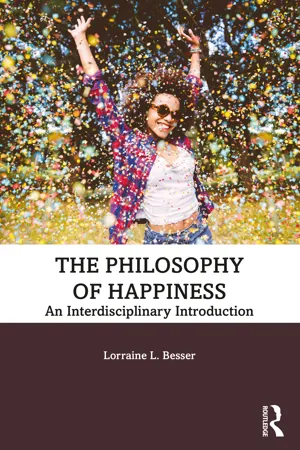
Emerging research on the subject of happiness—in psychology, economics, and public policy—reawakens and breathes new life into long-standing philosophical questions about happiness (e.g., What is it? Can it really be measured or pursued? What is its relationship to morality?). By analyzing this research from a philosophical perspective, Lorraine L. Besser is able to weave together the contributions of other disciplines, and the result is a robust, deeply contoured understanding of happiness made accessible for nonspecialists. This book is the first to thoroughly investigate the fundamental theoretical issues at play in all the major contemporary debates about happiness, and it stands out especially in its critical analysis of empirical research. The book's coverage of the material is comprehensive without being overwhelming. Its structure and pedagogical features will benefit students or anyone studying happiness for the first time: Each chapter opens with an initial overview and ends with a summary and list of suggested readings.
- 220 pages
- English
- ePUB (mobile friendly)
- Available on iOS & Android
eBook - ePub
About this book
Trusted by 375,005 students
Access to over 1.5 million titles for a fair monthly price.
Study more efficiently using our study tools.
Information
1
Introduction: The History of Happiness
Happiness is one of the most important things in life. For many of us, it serves as the bottom line: At the end of the day, we just want to be happy. We want this for ourselves, for our family, for our friends. And while we recognize that happiness may not be the only thing that matters, we would be hard-pressed to find someone who genuinely believes happiness to be irrelevant. Indeed, if we ever came across such a person, we'd be deeply confused and likely worried about this person: Who wouldn't think that happiness is a good thing?
Despite widespread agreement that happiness is important, for most of us the concept of “happiness” is a mystery. Sometimes we think about it a lot. We think about it in our deliberations. Will this job make me happy? Will choosing this person as my life partner make me happy? Will eating that chocolate cupcake make me happy? We also think about it in those reflective moments, when we ask, “Am I happy?” The reality is that rarely do we find these deliberations or reflective moments to be fruitful. It is hard to know whether a new job will make you happy; it is even hard to determine whether you are happy in any given moment. There are a range of factors that makes answering these questions challenging, which we will discuss over the course of this book. But one of the most central obstacles seems to be that most of us probably don't know what happiness really is.
Happiness is an important yet fundamentally mysterious concept. It is unsurprising, then, that philosophers have been interested in studying happiness for as long as we have records of philosophy, and that today, what was once fundamentally a philosophical question (“What is happiness?”) is one that not only philosophers but also psychologists, economists, even neuroscientists seek to answer. This book will explore the interdisciplinary nature of the study of happiness from within an overarching philosophical perspective. This book will not reveal the one truth about happiness, but it will discuss the variety of ways philosophers have understood happiness and the empirical research regarding the causes and correlates of happiness that has come to inform economic analysis and policy-making. We'll see lines of overlapping thought that help to explain the contours of happiness, and we will see some of the difficulties and challenges involved in studying happiness on both theoretical and empirical levels. We'll also see the potential this work has to inform our decision-making, whether at the individual or policy level.
This introductory chapter briefly covers some of the central historical themes in the study of happiness as a means to set the stage for the contemporary debates and positions that are the focus of this book.
Ancient Greek Philosophy
The works of Plato (381 B.C.E.) and Aristotle (340 B.C.E.) have had a deep and long-lasting influence on Western philosophy, and Aristotle's views on happiness in particular have shaped contemporary research and theories of happiness. Both of these philosophers took happiness to be broad and inclusive. They believed happiness is an all-encompassing feature of our lives; it is that for the sake of which we do all other things. They each offered views of happiness that frame happiness as something that arises when all aspects of oneself are functioning and making the contributions they were designed to make.
Plato frames his view of happiness in terms of “psychic harmony.” In the Republic, he develops this view by first arguing against the popular opinion that the best way to live is to embrace our appetites and desires. He imagines a character, Glaucon, who seeks to advance his own interests. Like many people, Glaucon believes that happiness arises in proportion to self-interest and that the best way to become happy is to pursue one's desires and appetites at all costs. Plato thinks Glaucon is wrong, and his challenge to this line of thinking has made a lasting impression.
Plato encourages us to consider the kinds of internal conflicts that arise when we prioritize the pursuit of our appetites and desires above other considerations—conflicts that Plato thinks prevent us from being happy. Most of us are familiar with the kind of internal conflict Plato worries about: It arises when we break a friend's trust to satisfy our own ambitions, when we cut corners for our own benefit, and when we break the law to pursue a desire. Even if we don't get “caught” doing any of these things, making the choice to prioritize our own desires and appetites over other things we believe to be important makes us feel bad.
Plato argues that internal conflict arises when the various components of our natures aren't working in harmony. For example, if people fulfill their desires for material goods by breaking the law, they end up ignoring their rational sides, which tell them that laws function as important protective measures to ensure the well-being of all in their jurisdiction. In this case, internal conflict arises because their appetites stifle the directives of reason.
According to Plato, there are three components of our nature (or, as is sometimes interpreted, of our soul): The appetitive side, which involves physical-based desires for food, drink, sex, and so on; the spirited side, which Plato associates primarily with anger and the desires it gives rise to; and the rational side, which involves beliefs and desires that arise from those beliefs. Most important among the beliefs and desires that comprise our rational side are the beliefs we have about what is right and wrong, beliefs that on Plato's account give rise to desires to do what is right and avoid what is wrong.
Plato believes that these parts exist within a natural hierarchy wherein the rational side governs the other. Reason tempers the spirit and directs the appetite, and it does this naturally. While internal conflict arises when people fail to respect the natural hierarchy, psychic harmony arises when the rational side does in fact govern the other sides. Plato describes this state as follows:1
One who is just does not allow any part of himself to do the work of another part or allow the various classes within him to meddle with each other. He regulates well what is really his own and rules himself. He puts himself in order, is his own friend, and harmonizes the three parts of himself like the three limiting notes in a musical scale—high, low, and middle. He brings together these parts and any others there may be in between, and from having been many things he becomes entirely one, moderate and harmonious. (Plato, 381 B.C.E., sec. 443c-e)
We become happy by knowing and respecting our natures and allowing our rationality to bring our spirited and appetitive sides into balance.
Aristotle, a student of Plato, follows the same basic framework as Plato in analyzing happiness. He begins by thinking about human nature and defines happiness broadly in terms of human nature functioning as it should. While Aristotle moves away from Plato's tripartite analysis of human nature, he embraces Plato's prioritization of reason, and our rationality, as the distinctive and authoritative aspect of human nature that shapes what it means for us to be happy.
Why should we prioritize reason? Aristotle's argument is relatively straightforward:2 Happiness, which he called eudaimonia, is the highest good for human beings and so ought to reflect what is distinctive about human beings. Since human beings are distinguished by their capacity to use reason, the highest good for human beings is to use reason in the best possible way. For Aristotle, this means using reason to develop and exercise the virtues, which are dispositions to think, feel, and respond in ways appropriate to the situation. A virtuous person develops the practical wisdom to know what to do and when to do it, and she successfully regulates her emotional states so that she feels the emotions that are appropriate to the situation and conducive to the exercise of virtue. Her development and exercise of virtue allow her to flourish as a human being.
We see that both Plato and Aristotle maintain that there is a fundamental, necessary connection between being virtuous and being happy: One can't be happy without being virtuous and vice versa. This is a bold thesis that has generated lots of debate among contemporary scholars, and it is one that we will return to at several junctures in this book. Is virtue really necessary to happiness? Taken in one light, this is an empirical question. Aristotle and Plato did not have the benefit of contemporary scientific methods, but we do; as we will see in chapters to come, empirical research on happiness and its causes and correlates provides important insight into the nature of happiness and has shaped contemporary discussion of it. Viewed in another light, this is not a purely empirical question but is rather a question of how we ought to understand happiness itself. If “happiness” is our highest good, as Plato and Aristotle take it to be, then it makes sense that it ought to involve reason and virtue. But is happiness really our highest good, or is it simply a prudential good that most of us value? Many contemporary philosophers think we should understand our highest good in terms of well-being rather than happiness. We'll sort through these differences in Chapter 2.
Writing shortly after Aristotle, Epicurus (325 B.C.E.) presents a view of happiness that more closely resembles popular usage of the word “happiness.” Happiness, for Epicurus, consists in a life of pleasure. This is a view of hedonism, variations of which are prominent in contemporary literature and are the subject of Chapter 3. Hedonistic views of happiness define happiness in terms of pleasure and are differentiated by their particular interpretation of pleasure.
Epicurus takes pleasure to consist in the absence of pain. This leads him to develop a view of hedonism that ends up being more moderate than we might expect. Since pleasure is the absence of pain, the key to happiness is to eliminate sources of pain. We do this by learning as much as we can about the things that give us fear, anxiety, and frustration, and by using this knowledge to moderate our emotional reactions. His four-part “cure” to unhappiness provides a helpful snapshot of this approach:
- Don't fear the gods.
- Don't worry about death.
- What is good is easy to get.
- What is terrible is easy to endure. (Epicurus, 325 B.C.E., p. vi)
The basic state of happiness that Epicurus describes takes happiness to be a state of mind, and one that does not fundamentally depend on the exercise of reason in the ways in which Aristotle's and Plato's views do. Using reason and being virtuous are important components of the happy life for Epicurus, but rationality and virtue don't define happiness for Epicurus in the ways they do for Aristotle and Plato.
Modern British Philosophy
Philosophical discussion of happiness takes an important turn with the works of British philosophers Jeremy Bentham (1789) and John Stuart Mill (1861). Bentham and Mill follow Epicurus in taking happiness to consist in a state of pleasure, and they develop hedonistic views of happiness differentiated by their specific analyses of pleasure. Yet Bentham and Mill highlight the social and ethical importance of happiness. They recognize that happiness isn't just something we should think about and pursue for ourselves; its importance to each of us entails that we should prioritize the happiness of all. This line of thought motivates the position of utilitarianism, the view according to which we should strive to promote the greatest happiness for all. Bentham argues that utilitarianism ought to drive our legal system, while Mill argues that utilitarianism ought to drive our personal morality. Both defenses of utilitarianism have had a long-lasting influence on moral philosophy and shape contemporary discussions of hedonism.
Bentham (1823) wrote with the aim of reforming the legal system. He argues that laws ought to be gauged by their tendency to promote happiness, which he takes to consist in pleasure and the avoidance of pain. In order to evaluate the laws, then, we need to figure out the extent to which they promote the happiness of all. Bentham advocates doing this by thinking through the expected consequences of any law (or act) and examining the degree of pleasure reasonably expected to follow. To examine the pleasure, Bentham proposes what has come to be called a “hedonic” or “felicific” calculus, which evaluates pleasure by its:
- Intensity,
- Duration,
- Certainty or uncertainty,
- Propinquity,
- Remoteness,
- Fecundity,
- Purity.
Bentham recognizes that the calculus runs differently depending on whether we are considering an individual's happiness or a group of people's happiness, but the basic idea is to give some content into the dimensions of pleasure, which make it better or worse.
Bentham was ambitious both in presenting happiness as the standard for public policy and in making an effort to measure happiness. It is hard to measure happiness. Happiness is a subjective mental state. Even if we follow Bentham in understanding that state exclusively in terms of pleasure, and embrace the hedonic calculus, measuring happiness still requires the daunting task of thinking about how people will respond to the proposed source of pleasure. Bentham does this by thinking through the commonalities that exist between individuals. This approach can go a long way, but it is limited. Contemporary empirical research teaches us that individual differences exist and count, and this is especially the case when thinking about happiness, which is a subjective mental state. This doesn't mean that the ta...
Table of contents
- Cover
- Endorsements
- Half Title
- Title Page
- Copyright Page
- Contents
- Preface
- Introduction
- 1 Introduction: The History of Happiness
- PART I Theory
- PART II What Makes Us Happy?
- PART III The Context of Happiness
- Conclusion
- Index
Frequently asked questions
Yes, you can cancel anytime from the Subscription tab in your account settings on the Perlego website. Your subscription will stay active until the end of your current billing period. Learn how to cancel your subscription
No, books cannot be downloaded as external files, such as PDFs, for use outside of Perlego. However, you can download books within the Perlego app for offline reading on mobile or tablet. Learn how to download books offline
We are an online textbook subscription service, where you can get access to an entire online library for less than the price of a single book per month. With over 1.5 million books across 990+ topics, we’ve got you covered! Learn about our mission
Look out for the read-aloud symbol on your next book to see if you can listen to it. The read-aloud tool reads text aloud for you, highlighting the text as it is being read. You can pause it, speed it up and slow it down. Learn more about Read Aloud
Yes! You can use the Perlego app on both iOS and Android devices to read anytime, anywhere — even offline. Perfect for commutes or when you’re on the go.
Please note we cannot support devices running on iOS 13 and Android 7 or earlier. Learn more about using the app
Please note we cannot support devices running on iOS 13 and Android 7 or earlier. Learn more about using the app
Yes, you can access The Philosophy of Happiness by Lorraine L. Besser in PDF and/or ePUB format, as well as other popular books in Philosophy & Epistemology in Philosophy. We have over 1.5 million books available in our catalogue for you to explore.