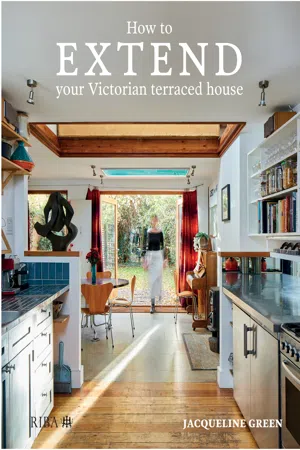
How to Extend Your Victorian Terraced House
eBook - ePub

How to Extend Your Victorian Terraced House

  1. 240 pages
  2. English
  3. ePUB (mobile friendly)
  4. Available on iOS & Android
eBook - ePub

How to Extend Your Victorian Terraced House

About this book

Brimming with design ideas, drawings and photographs of exemplary projects, this is a must-have, highly visual guide to extending a Victorian terraced house for designers, architects and homeowners.

An essential resource for designing and delivering a wide variety of extensions, it features case studies from the full gamut of nineteenth-century terrace house types. Detailed plans reveal, floor by floor, a range of options for extending and/or reconfiguring space. Colour-coded, before-and-after plans show at a glance which walls have been removed or changed in each option. This is complemented by extensive colour photography of realised, built work.

Ideas and inspiration are supplemented by practical guidance with 'rules of thumb' for design and key information on permitted development rights. All plans are drawn to scale, so that they may be measured from and used for planning any renovation project.

Covering different types of briefs and design solutions, this indispensable guide to renovating Victorian terraces features extensions, loft conversions, basements and interior remodelling. It contains over 150 floor plans and 100 full-page colour images.
Frequently asked questions

Yes, you can cancel anytime from the Subscription tab in your account settings on the Perlego website. Your subscription will stay active until the end of your current billing period. Learn how to cancel your subscription.
No, books cannot be downloaded as external files, such as PDFs, for use outside of Perlego. However, you can download books within the Perlego app for offline reading on mobile or tablet. Learn more here.
Perlego offers two plans: Essential and Complete
  • Essential is ideal for learners and professionals who enjoy exploring a wide range of subjects. Access the Essential Library with 800,000+ trusted titles and best-sellers across business, personal growth, and the humanities. Includes unlimited reading time and Standard Read Aloud voice.
  • Complete: Perfect for advanced learners and researchers needing full, unrestricted access. Unlock 1.4M+ books across hundreds of subjects, including academic and specialized titles. The Complete Plan also includes advanced features like Premium Read Aloud and Research Assistant.
Both plans are available with monthly, semester, or annual billing cycles.
We are an online textbook subscription service, where you can get access to an entire online library for less than the price of a single book per month. With over 1 million books across 1000+ topics, we’ve got you covered! Learn more here.
Look out for the read-aloud symbol on your next book to see if you can listen to it. The read-aloud tool reads text aloud for you, highlighting the text as it is being read. You can pause it, speed it up and slow it down. Learn more here.
Yes! You can use the Perlego app on both iOS or Android devices to read anytime, anywhere — even offline. Perfect for commutes or when you’re on the go.
Please note we cannot support devices running on iOS 13 and Android 7 or earlier. Learn more about using the app.
Yes, you can access How to Extend Your Victorian Terraced House by Jacqueline Green in PDF and/or ePUB format, as well as other popular books in Architecture & Architecture General. We have over one million books available in our catalogue for you to explore.

Information

CASE STUDY 1 THE HALF HOUSE

‘Half houses’ share the same street door but then have their own front door at the end of a shared corridor that enters the house in the centre of the plan, reducing circulation space. The house in this case study is built on a 4.3m-wide plot and, although not split-level, is built on a hill. There is therefore a large drop down from the house to the garden at the rear. It has a small, single-storey outrigger that houses the bathroom. As it is similar in size to the houses shown in Central Stair and Two Up Two Down, many of the plans shown in these two case studies can be used in this one and vice versa.

GROUND FLOOR

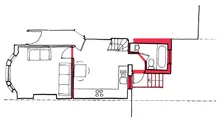
In the existing plan, the front door opens into the kitchen, which leads to a separate front reception room, to the bathroom at the rear, out to the garden and up the stairs to the first floor.

OPTION 1

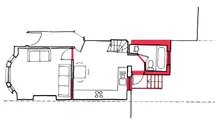
This option seeks to retain as much of the existing structure as possible to minimise costs. In order to do this, the bedrooms have been positioned on the ground floor with the existing bathroom. This creates an ‘upside-down house’, affording the opportunity to create a grander living area upstairs. A new partition has been erected to create a small bedroom where the existing kitchen had been located and the bathroom remains unchanged, accommodated in the existing outrigger. The area underneath the existing stairs has been enclosed to create a store area, and a small coat cupboard has been positioned adjacent to the front door. This plan can be read in conjunction with First-floor Option 4 and Loft Option 4.

OPTION 2

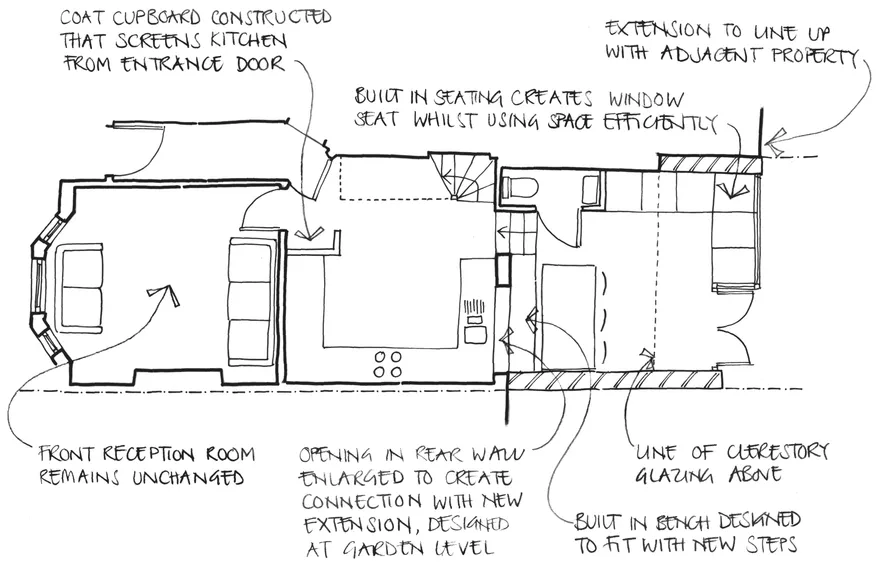
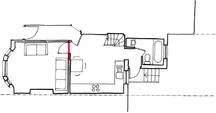
This option, which assumes an upstairs bathroom, retains a separate living room and existing kitchen location. A new niche provides visual screening between entrance door and kitchen – and a coat cupboard.
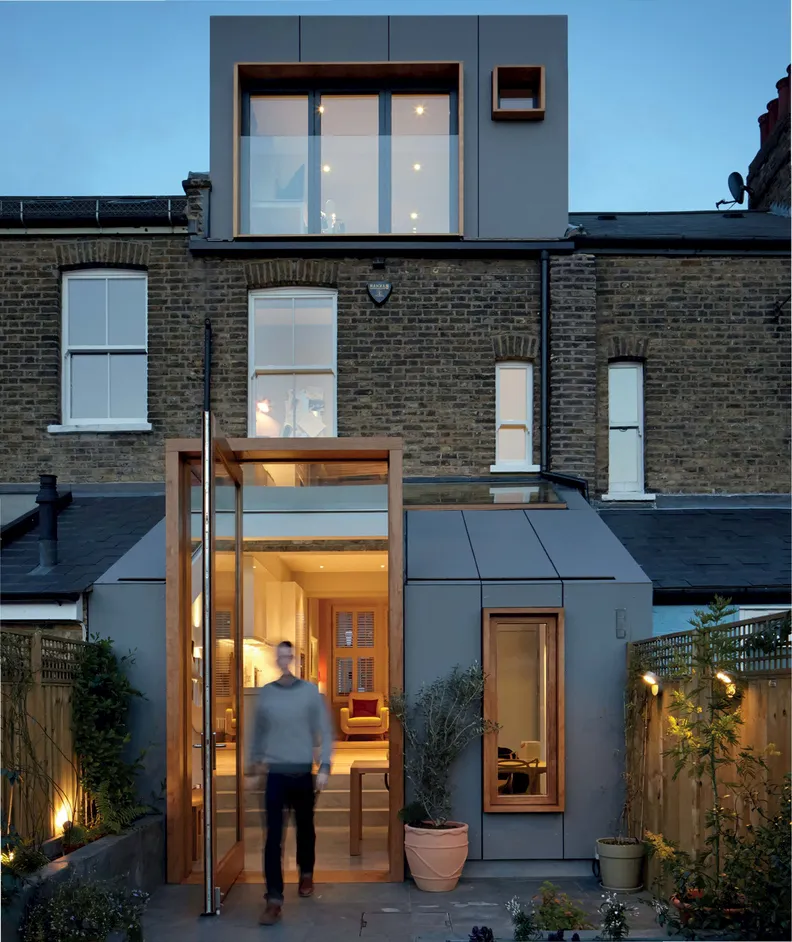
The outrigger has been rebuilt full width to the depth of the neighbouring building. Its living/dining area sits four steps down, reducing the height and impact of the extension. It also gives level access to the garden and a clerestory view from the kitchen over the extension. The clerestory also brings light deeper into the dwelling's footprint.
Part of the rear kitchen wall has been removed to enhance connection with the dining area. A small WC sits adjacent to the dining area – alternatively, this could be a store or utility room. Built-in dining-area bench seating links in with the height and width of the new steps. The built-in sofa fits snugly beside the WC, forming a window seat overlooking the garden. Both these fittings optimise available space while allowing more storage.

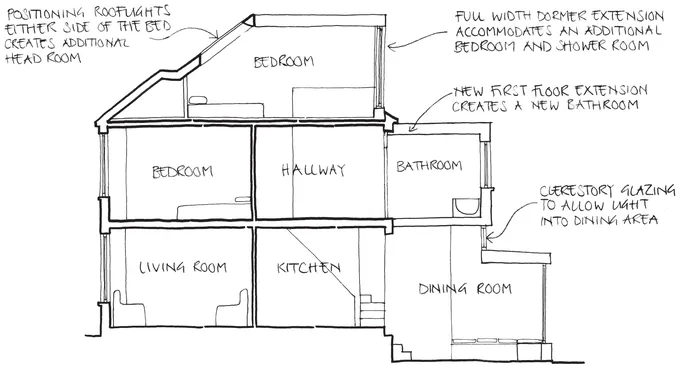
Section A

OPTION 3

In this option, the front reception room has been converted into a dining room adjacent to the kitchen. The existing entrance into this room has been retained and new sliding doors installed to close off the kitchen. This provides a protected means of escape from the upper floors. A section of the central, internal wall has been removed to create a connection between the kitchen and dining room. A breakfast bar has been positioned in this gap.
A small WC has been positioned under the stairs and, again, the existing single-storey outrigger has been replaced with a full-width rear extension that here accommodates a living room and small study area. The existing openings in the house's rear wall have been retained to minimise structural alterations. A sliding door has been positioned here to complete the protected means of escape, enabling a loft conversion without the need for a sprinkler system. The extension makes use of the level drop between house and garden – with built-in furniture maximising the use of space, allowing a storeroom to be positioned adjacent to the stairs. This option assumes an upstairs bathroom.

Section B

OPTION 4

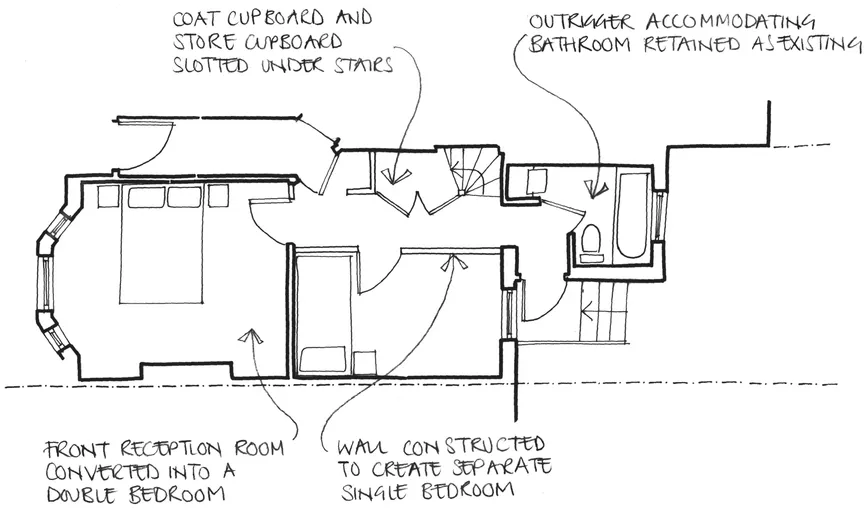
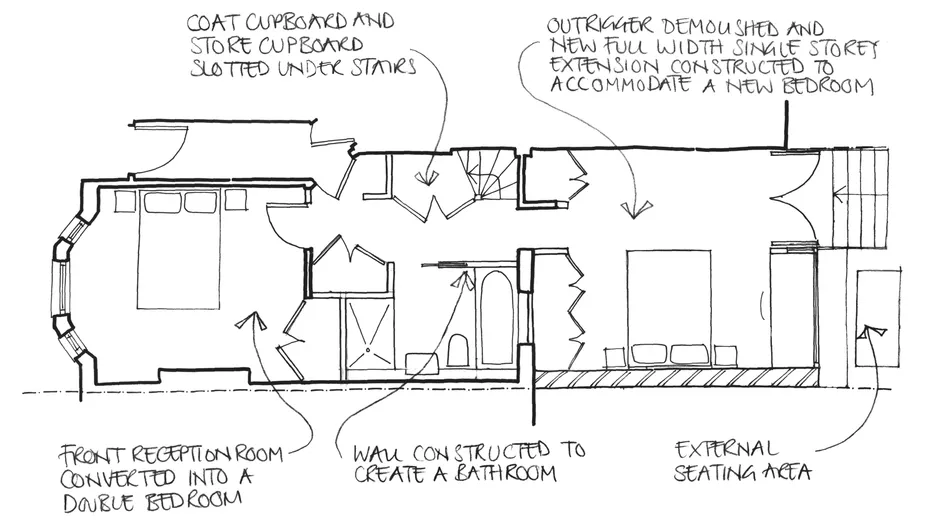
This option, like Ground-floor Option 1, creates an upside-down house with the bedrooms on the ground floor, enabling a grand, two-storey living area upstairs, as shown in First floor option 4 and Loft option 4. The front reception room remains intact, creating a good-sized double bedroom. The rear reception room is carved up to accommodate a large bathroom and ample storage. The existing outrigger is extended sideways and backwards to create a second, good-sized double bedroom with a window seat and access to the garden.

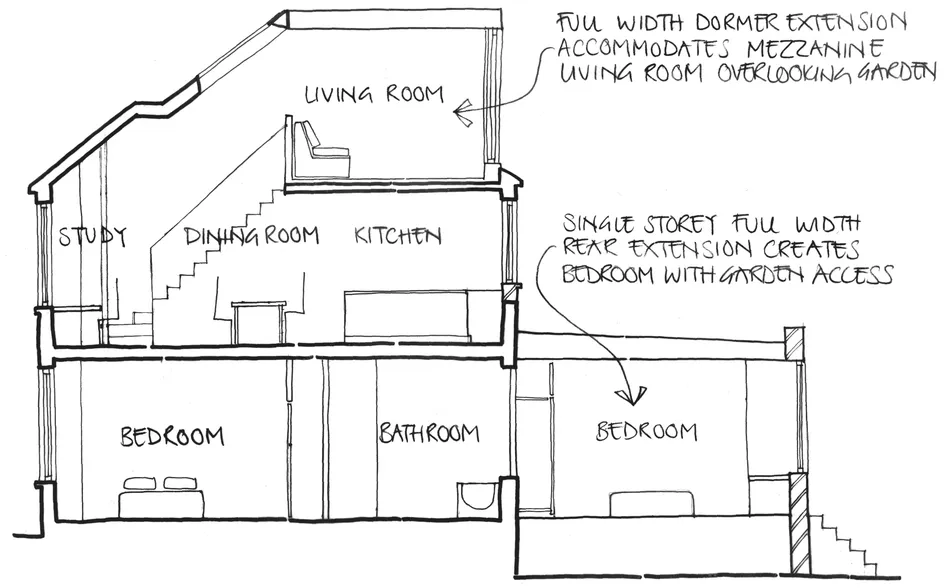
Section C

OPTION 5

(Based on the Landells Road project by Alma-nac)
By reconfiguring the stairs to start at the entrance, the circulation space previously required to access the upper floors can be eliminated. Double doors into the kitchen...

Table of contents

  1. Cover
  2. Title Page
  3. Copyright Page
  4. Dedication
  5. Contents
  6. Foreword
  7. About the Author
  8. Introduction
  9. Glossary and Key
  10. What to Consider When Designing an Extension
  11. Rules of Thumb
  12. Case Study 1 THE HALF HOUSE: a slim, two-storey half house with a small, single-storey outrigger
  13. Case Study 2 THE CENTRAL STAIR: a small, two-storey house with stairs running side to side
  14. Case Study 3 THE TWO UP TWO DOWN: a small, two-storey house with a long, single-storey outrigger
  15. Case Study 4 THE THREE UP THREE DOWN: a standard two-storey house
  16. Case Study 5 THE TALL TERRACE: a three-storey house with entrance at street level
  17. Case Study 6 THE SPLIT LEVEL: a three-storey house with its entrance floor above street level
  18. Case Study 7 THE LARGE SEMI: a large, three-storey house with an upper and lower ground-floor level
  19. Conclusion
  20. Index
  21. Image Credits