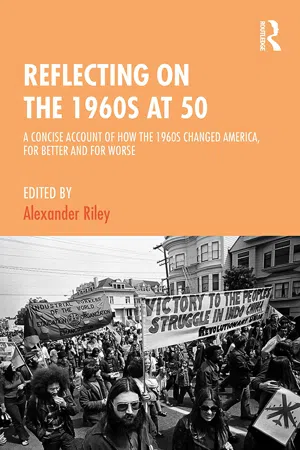
Reflecting on the 1960s at 50: A Concise Account of How the 1960s Changed America, for Better and for Worse is a punchy, conversational look at some of the most interesting pieces of cultural and social conflict from the '60s, reflected through the lens of our own vantage point today.
This approachable, informative volume uses transcripts of public interviews to provide the viewpoints of half a dozen nationally known scholars with long records of writing in scholarly and popular realms. They represent a range of disciplinary and political perspectives from the humanities to the social sciences and from the progressive left to the conservative right. These scholars offer their thoughts on:
the place of youth in American society that emerged from the '60s
the lingering contributions the counterculture made to American institutions and social life
the legacy in contemporary America of the struggles over racial disparities in the '60s
the ways in which the revolution of sexual mores and relations of that decade have affected marriage and family today
the war in Vietnam and its effects on contemporary views of America's military power and responsibility in the world
the evolution of American state power and administration that was energized by Lyndon Johnson's Great Society.
This book will be of interest to students of American history and the history and politics of the 1960s as well as sociologists. It searches for meaning in a period that made major contributions to the shape of America as a country.
Reflecting on Activism in the ’60s and Now: Todd Gitlin
Todd Gitlin (TG), Alexander Riley (AR), and Jennifer Silva (JS)
AR: Your forthcoming novel, which is titled The Opposition, is inspired by your experiences in the 1960s, and particularly in the year 1968. We’re now at the 50th anniversary of that year. An excerpt from the book published by the Smithsonian deals with the riot at the ’68 Democratic National Convention in Chicago. Would you tell us more about why you decided to write this book at this moment and why you chose to write a novel instead of an academic work of nonfiction?
TG: I’ve been trying to write this novel for more than forty years. This is probably my fourth shot at it. I was a writer before I was a sociologist and I was a writer of several kinds of genres, but the books that inspired me the most for my first book, which was a book about poor whites in Chicago, are still in some ways lurking in the background of my approach to reality, if you will. The James Agee of Let Us Now Praise Famous Men, the anthropologist Oscar Lewis’s narrative histories of Mexicans and Puerto Ricans encountering the United States, and John Dos Passos’ USA series of novels, which amalgamated narrative novelizing, poetry, a sort of documentary film on paper, little historical vignettes, biographical vignettes and so on. I have had a desire for a very long time to bring everything I have as a writer to an encounter with reality and no sooner were the ’60s over than I made a pass at this book. In fact, I started writing about Chicago around 1973. I was out of school and I had no particular interest in an academic career. I was writing this and writing that, journalism, poetry, what not. Even then, I wanted to convey the texture of the experience, which I had already understood to be bizarre. I had a very bizarre experience of life in America as an activist in the New Left and of course the ideas were of interest to me, and the passions were of interest to me, but mostly what I was trying to do in that aborted book was to get a feeling for what it felt like to do that kind of activity, to be that kind of person, which I understood, I think accurately, as a very odd experience.
Figure 1.1 Todd Gitlin.
Screenshot by Alexander Riley.
Well, I didn’t get anywhere. I didn’t write very much. Then I went back to graduate school. I remember once, around that time while I was in graduate school, I heard somebody quote Hunter S. Thompson, who said “When the going gets tough, the weird turn pro,” and I felt that spoke to my condition. So I decided to get “pro.” I went into the PhD program at Berkeley in Sociology and as soon as I was done with the dissertation, which was in part built on experiences I had in the ’60s, analyzing them through the prism of how media were playing a part in the developments of the ’60s, which wasn’t being systematically thought about at the time, I tried to find my way back into the novel. I wrote some more in the late ’70s, and I put it aside for what became my next book, a sociology book, and then as soon as that was out, I went back to the novel. Then I was approached by a publisher to write the history of the ’60s that was eventually published under the title The Sixties: Years of Hope, Days of Rage. But I was reluctant to give up the novel. I still knew that I wanted to write multi-dimensionally and that I didn’t want to be bound to fact. I had to put away that ambition in order to agree to write the ’60s book. I put away the novel and I started to write the book. I tried to write it from a distance. It was crap. It was just dead on the page and I had then one of the very few periods of writer’s block in my life. I think it was about three weeks when I just knew what I had been writing was dead, and so I put aside what I had started to write and I started rewriting in the first person. And I was very happy with that book. It was published in 1987. Afterward, I still felt a pang, a kind of “what if?” or an “if only” because I had abandoned the novel, now three times started. But c’est la vie, and I would tell myself, and I said it publicly on more than one occasion, that I had accomplished what I had been wanting to accomplish in the novel by writing that ’60s book, which was partly memoir, partly rumination, partly history, partly analysis, and so on.
Yet the phantom novel never quite went away. I wrote all kinds of other books and did all kinds of other projects. About seven years ago, I made another start on the novel. I started elsewhere, with some characters who were not me. The book is basically done. I’ve worked on it for about six years and I would say still that I was trying to do, in the last few years, what I was originally trying to do in 1973: to convey a way of life. For years, I’ve read a ton of books about the ’60s, and there are certain kinds of ’60s experiences which I think were common and formative and in some ways definitional that have not been properly encompassed in fiction. One of them is really something that will sound banal. What’s it feel like to be at a political meeting? I found one writer, not well known, maybe ten years ago who had a chapter that was about a meeting which felt right to me. The texture of it seemed right, but that was pretty much unique. For a long time, and I even wrote about this, I thought, given how many amateur or aspiring writers went through the ’60s, how come we didn’t have fiction that was adequate to it? As I looked at a lot of books, they were wrong, and I remembered a line from Norman Mailer who said something that sounds kind of banal, but for some reason it struck me. He said a novel has to have a sense of the real. My interpretation of that and the way that that addressed the problem of the absence of the ’60s fiction was that I think a lot of people that passed through the kinds of experiences I did lost a sense of the real, because the real shook, the real shimmied and blurred and it upended us. And so to try to get a handle on it was very difficult for many writers. For example, I’m an admirer of much of Philip Roth’s American Pastoral, but when he writes about ’60s characters, they seem completely phony to me. He didn’t get them. I dared think that I got these people.
There were other kinds of experiences, for example, the very common experience of women getting illegal abortions, which is something I knew about. Actually, the heroic abortion doctor Robert Spencer lived not far from here in a town called Ashland, Pennsylvania. A famous man who, I think it’s fair to say, rescued many thousands of women over a long period of time. I thought “OK, that’s a kind of experience that’s now thankfully unusual.” To write a letter and get a telegram back saying, “Be at such and such a place on such and such a date and bring $50” or whatever it was. And then you’re in this small town where half the cars parked on the street have out-of-state plates and the police are not in evidence, so obviously they’ve been payed off. That kind of experience. Meetings and an abortion are sort of formative.
This is a long way of saying that after everything I had written and thought about the ’60s I needed to come at it—at that, at them—at the immensity of what happened through life stories which would be partly rooted in actual experience, but partly imagined. And I wanted to do it big. There are about eight major characters in the book, none of whom is exactly me. I care about writing as such so I wanted to be able to evoke how the world appeared to people, what it was like to think you could actually change the world. It’s bizarre. Today there are people like Mark Zuckerberg who think they can change the world, but I don’t think they have much of an inner life. But I knew these remarkable people and I wanted in a certain sense to pay homage to them, so that’s why I went to this novel.
AR: We might come back to the novel, because there are a lot of things to follow up on. I’m especially interested in who these characters are, if any of them are modeled on actual people.
TG: You mentioned the Smithsonian excerpt. There’s a small tale here. Every five or ten years, I get asked to write about ’68. I’ve done a lot of them and I got a letter last summer from an editor of the Smithsonian. He said, “We’re doing a special issue on the ’60s in the fall, will you write something about 1968, maybe centered on Chicago?” I wrote back and said “Truthfully, I’m very bored by this, I’ve done so much of it. I don’t really want to do that, but as it happens, I’m writing a novel and I’ll be happy to let you see it.” My agent sent him the whole thing. I said, “I know this is going to seem bizarre to you because you’re not a magazine of fiction, but I really think this is true.” I was quite delighted that the editor got it and said “Yeah, ok, we’re going to run it.” And they did run it. It’s fiction and it’s true.
JS: I’ve spent the last three years in a declining coal town about an hour from here in Pennsylvania. I’ve been interviewing working-class and poor people about their political beliefs and behaviors. I wanted to bring in a story of someone I interviewed to ask how you might understand his life in the context of the 1960s. His name is Roger Adams, and he’s a 38-year-old white man who is the grandson of a coalminer. He has a high school degree and used to work as an emergency medical technician (EMT), but he has been out of work since 2009. He’s in chronic pain; he spends his days lying on his recliner with an orange pharmacy bottle on the shelf above his head. Roger voted for Barack Obama in 2008. But his criticism of the Democrats today is that they do not do enough to sustain people like him, like they did in the past. When I ask him who he is planning to vote for in 2016, he explains: “I’m a Democrat, but I hate Hillary. My dad was a Democrat. I’m gonna stay Democrat for him but I’ll never vote Democrat again. At one time the Democrats helped our family, they really did, but now, they don’t do enough to help people. They don’t do enough to create jobs, to get people back to work.” In 2016, he decides to vote for Donald Trump. He actually writes Donald Trump a letter asking him to help him get back to work and offers to be on his personal security team if he’s able to do that. Roger starts crying as he’s remembering his dad, a Vietnam veteran. He tells me: “I don’t care how much I hurt, I will always salute the flag, I will always stand and I will cover my heart.” When I ask him if the American Dream is alive, he says “I think it’s dying. I really do. I mean for some people, maybe the refugees, it’s alive. But for anybody here, it’s dying.” He tells me that the government “needs a totally new overhaul. Clear everybody out, start over.” At the end of the conversation, he asks if I have ever played video games like Fallout, Fallen Earth, or S.T.A.L.K.E.R., and he tells me “You see those games, like on Xbox, you see how it looks like a wasteland? That’s how America is gonna look real soon, it’s gonna be a civil war, and it will be real nasty.”
I wanted to hear your thoughts on this perspective given your experience as a public intellectual and activist. How would you think about the views of a Roger Adams?
TG: Can I go autobiographical? I have never met Roger Adams, but I spent two years in Chicago in the mid ’60s as both a writer working on a book about poor whites, many of whom were former coal miners or from coal mining communities in West Virginia, Kentucky, Tennessee and so on, and as an organizer among those people. I have very vivid memories of that time. I think we—Students for a Democratic Society (SDS), which had decided to go into community organizing—were on to something that we were unable to deliver on. In the civil rights movement—let’s go back to 1963—there were people active in the South who understood that through all their efforts and given the political configuration at the time, the civil rights movement was going to succeed. It was bound for glory, that is, it was going to succeed in abolishing segregation. And it did. Those are the years when we got the Civil Rights Act, and then the next year we got the Voting Rights Act. There were already people in the civil rights movement—one of them was Stokely Carmichael, later very well-known leader of the Student Nonviolent Coordinating Committee—who came to us, the white radicals in SDS, and said,
You know, we need to create an interracial movement of the poor, we are going to need a movement that federates poor black people, many of whom are Southern sharecroppers, with white people who are either actually or prospectively unemployed, and we need to find a class basis. [paraphrase]
There were about a hundred of us who had been campus activists who left the universities in ’64 and ’65, and we set up a dozen or so projects in northern or border cities.
I was in the one in Chicago where we met people like this. My book, Uptown: Poor Whites of Chicago, is largely narratives of people like Roger talking that way. We made some efforts, and some were more successful than others. As it happened, first of all, it was extremely difficult to organize there. Welfare mothers, that was one big category of our work. Young tough guys harassed by the police, that was another constituency we worked with. We worked with tenants who were getting screwed and tried to get landlords to sign contracts to keep up their housing and so on. We did that sort of thing. It was very hard. At the same time, first, the economy was relatively good in part because of the Vietnam war spending, and, second, many of us in the student-based left were now beginning to respond to the Vietnam war and so many people stopped doing that kind of organizing work in order to work directly against the war. By the way, there’s a whole section of the novel that involves that kind of organizing work.
I think it was an excellent idea to try to create a cross-race, cross-class movement because we understood there needed to be middle-class allies and so on. This whole project was funded originally with money from the United Auto Workers Union, so we understood the need for a sort of a general coalition. We didn’t think it would be easy. Such efforts have been made—we were not the only ones—and they failed. It was a disappointment to me. Barack Obama had experience like this as a community organizer in Chicago. He wrote about it beautifully in his Dreams from My Father. But he also found how hard it is to actually empower, and mobilize, and strategize with people who basically are disenfranchised. I don’t mean necessarily that they don’t have the vote, but that they feel helpless. Part of the work of an organizer is to convince people who feel helpless not to be helpless, to overcome their learned incapacity.
So, great idea, it still needs to be done, and in the inability to get that done—now I’m speaking not just of the student left, but of liberals in general—in the failure to mobilize, the failure to root the Democratic Party, in particular, in that kind of commitment, the failure, to put it oversimply, of left-wing populism or left-wing nationalism, the door was left open for you know who. And here we are. And, by the way, this is not simply an American tragedy, it’s a tragedy throughout the world. The success of the egregious nationalisms that are now all over Europe and coming up in Brazil and India is in no small part a consequence of the inability of the social democratic left to sound like it means it. To offer something to people who feel displaced, disenfranchised, encroached upon, and who often enough, by the way, develop really savage ideas about who’s at fault—for example, it’s the fault of dark-skinned people, or it’s the fault of Muslims, or it’s the fault of Mexicans, or what have you. But the grievances are real; the sense of having been abandoned is real. It’s on us. It’s on us. It’s not only on the vile and inexcusable demagogues who are frolicking today, but these people have not been given something else. It’s not just that they haven’t been given policies. They haven’t been shown a spirit. I hate the spirit of Steve Bannon and Donald Trump, but it is a spirit. It mobilizes people, it excites them, and you cannot defeat that with a program. You cannot ...
Table of contents
Cover
Half Title
Title Page
Copyright Page
Table of Contents
List of Speakers
Acknowledgements
Editor’s Introduction
1. Reflecting on Activism in the ’60s and Now: Todd Gitlin
2. Reconsidering the Counterculture and Its Effects on American Culture, Especially Schools and Universities: Mark Bauerlein
3. Revisiting the War in Vietnam: Mark Moyar
4. Rethinking the Great Society and the LBJ Presidency: Charles Kesler
5. Re-envisioning the Causes of Family Change since the ’60s: June Carbone
6. Reconceptualizing Race Relations and the Civil Rights Era: Glenn Loury
Index
Trusted by 375,005 students
Access to over 1.5 million titles for a fair monthly price.
Study more efficiently using our study tools.
Frequently asked questions
Yes, you can cancel anytime from the Subscription tab in your account settings on the Perlego website. Your subscription will stay active until the end of your current billing period. Learn how to cancel your subscription
No, books cannot be downloaded as external files, such as PDFs, for use outside of Perlego. However, you can download books within the Perlego app for offline reading on mobile or tablet. Learn how to download books offline
Perlego offers two plans: Essential and Complete
Essential is ideal for learners and professionals who enjoy exploring a wide range of subjects. Access the Essential Library with 800,000+ trusted titles and best-sellers across business, personal growth, and the humanities. Includes unlimited reading time and Standard Read Aloud voice.
Complete: Perfect for advanced learners and researchers needing full, unrestricted access. Unlock 1.5M+ books across hundreds of subjects, including academic and specialized titles. The Complete Plan also includes advanced features like Premium Read Aloud and Research Assistant.
Both plans are available with monthly, semester, or annual billing cycles.
We are an online textbook subscription service, where you can get access to an entire online library for less than the price of a single book per month. With over 1.5 million books across 990+ topics, we’ve got you covered! Learn about our mission
Look out for the read-aloud symbol on your next book to see if you can listen to it. The read-aloud tool reads text aloud for you, highlighting the text as it is being read. You can pause it, speed it up and slow it down. Learn more about Read Aloud
Yes! You can use the Perlego app on both iOS and Android devices to read anytime, anywhere — even offline. Perfect for commutes or when you’re on the go. Please note we cannot support devices running on iOS 13 and Android 7 or earlier. Learn more about using the app
Yes, you can access Reflecting on the 1960s at 50 by Alexander Riley in PDF and/or ePUB format, as well as other popular books in History & North American History. We have over 1.5 million books available in our catalogue for you to explore.