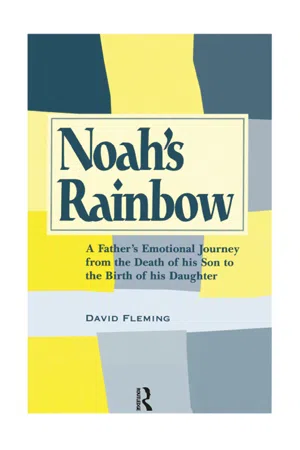
On 10th August 2000, David and Kim Fleming lost their son, Noah, during childbirth. After his funeral, a rainbow appeared in the sky over the Flemings' home. The family latched onto that symbol of hope and made it the driving force for their recover. A year and ten days later, the daughter Ally Hope was born. This book, written in the unique narrative style Fleming crafted during his ten years at ESPN and "Sports Illustrated", is a father's memoir of the emotional journey from the death of his son to the birth of his daughter. It is real and raw, but above all - redemptive. Although it opens with the harrowing tale of losing a child, the book is more about hope than death, more about what was learned than what was lost. For other grieving parents, and fathers in particular, this book will show that, while the death of a child will change your life forever, it doesn't have to ruin it. As it unfolds, "Noah's Rainbow" also becomes something of a love story, recounting the way the Flemings worked through this tragedy as a team, knowing that how they responded to Noah's death would be their son's only legacy. This book details exactly how they managed to do it: how they survived and grieved for their son, what they learned about themselves, their families and the world at large, the setbacks and the blessings, the daily gifts of hope, the restoration of their faith, the perpetuation of Noah's spirit, and, ultimately, the peace and strength that sustained them as they prepared for the birth of their second child. This book is for parents who are grieving the death of a child and is particularly geared towards fathers. The scope of the book, however, is broad enough to appeal to anyone who has suffered the loss of a loved one or who cares about someone who is grieving. It will also serve anyone searching for perspective or hope in life. It's a book a father would fell good about recommending to another father.
eBook - ePub
Noah's Rainbow
A Father's Emotional Journey from the Death of His Son to the Birth of His Daughter
- 214 pages
- English
- ePUB (mobile friendly)
- Available on iOS & Android
eBook - ePub
Noah's Rainbow
A Father's Emotional Journey from the Death of His Son to the Birth of His Daughter
About this book
Information

CHAPTER 1
The Sharp Heart
The first thing they hook you up to when you check into a maternity ward is a fetal heart monitor. It’s not much more than a flat plastic paddle attached to a long cord. The whole thing is then plugged into a small machine near the bed that monitors your baby’s heartbeat and broadcasts it back to you in three ways: a whooshing drum beat, a set of green fuzzy numbers and a jittery printout that looks like the results from a polygraph examine. It’s a truth machine. Indeed.
For whatever reason, though, when no fetal heartbeat registers, the machine goes silent, the paper goes blank, and the numbers are replaced with what now seems like a cruelly ironic little symbol for a heart. It sits there frozen on the screen, pumping at you, flashing at you, mocking you, like a stale yellow traffic light. The sound and printer go dead with a moaning whir and all that’s left is that heart.
That puke green, electronic heart. That cheap, misshapen, godforsaken, square heart. A heart with corners. A sharp heart. The same one I still see every time I close my eyes. The one that has forever been tattooed on my psyche.
It was early August 2000 when my wife, Kim, entered the hospital 41 weeks pregnant. Without professional prodding, it seemed our son, Noah, was perfectly content to stay exactly where he was, snoozing and getting rounder by the day. “He’s such a Fleming,” Kim joked. And for the longest time, after checking into the hospital in order for Kim to be induced the next morning, we listened to the reassuring pump and whoosh of the fetal heart monitor. It made it feel like our boy was right there in the room with us. His strong and noisy heart filled the air—loud, clear, and steady; never dropping below 135 beats per minute.
It went on like that for six hours. Now, there are a million things that can go wrong during a pregnancy, but for some reason, when we made it to the hospital, only hours away from reaching the finish line, in our hearts it seemed only natural to relax a bit, to celebrate and think, “We made it.” It’s such a great feeling. As we filled out paperwork and phoned our friends and family, Kim and I sat side by side in that hospital room, holding hands, playing kissy face, laughing, hugging, and daydreaming about having our son here in less than 24 hours.
“We’ll be a family tomorrow,” I said, walking over to check Noah’s printout. I held the paper in my hands, so proud of that strong and steady chart. It looked like the most magnificent mountain peak known to man.
Dave, get away from there. Kimmy, will Noah be taller than me? Everyone is honey. Will he have blond hair? Brown. He’ll be tough and funny, right? He might be sensitive and serious. When would he get married? I don’t know. What school would he go to? Miami, maybe. How about Stanford? Okay. Will I like his wife? Yeah … and she’ll adore you. I want to backpack through Europe with him the summer before he goes off to college. You think he’ll want to go with me? Maybe, if you can somehow manage to stop acting like such a complete dork right now.
Oh, what a glorious six hours.
Then, suddenly, Kimmy winced.
That is where everything began to turn sticky and confusing—gelatinous almost; where the world we knew before Noah was slammed shut behind us and sealed forever.
Although her contractions were coming up mild on the monitor, Kim was bent over in pain and in progressively more anguish. You must understand something: Kimmy is about as tough as they come. This wasn’t normal. I was shocked, in fact, when the next time the nurse came in with more paperwork, Kim asked if she could have a shot for the pain.
In the time it took for the nurse to get the shot and come back, Noah’s life had begun to slip away. In those 200 seconds, the kaleidoscope of color and smells and sights all went grayish and blurry—as if everything was suddenly wrapped in sticky plastic, the ceiling melting and swirling into the floor, the colors of our lives mixing into some new kind of reality. This all took two, maybe three minutes tops. That’s all it took for our world to change—completely and forever. Two hundred seconds. Two hundred terrifying seconds. The length of a short song on the radio. A few TV commercials. That’s it. That’s all the time and warning we got, and then our entire being was twisted inside-out; as if someone had yanked our guts out from the navel; like untangling an old, bunched-up sock.
Another burst of pain burned in Kimmy’s side.
She sat up and winced, bent sideways, squeezing my hand until I was sure the bones would snap like dry twigs.
Seconds before, we were talking about what college Noah might attend. Now the fetal monitor, which had been steady and strong like a drum, was suddenly wobbly and warped and jumping all over the place like a slot machine. The numbers, those ugly green fluorescent numbers, jumped to 210 then down to 15 and back up again and down with increasing randomness.
There was no pattern. No steady beat anymore. Not from any of our hearts.
Just when we thought it couldn’t get any worse, just when our thoughts made that leap from “No biggie, the monitor’s just slipped off” to “WAIT … IS SOMETHING WRONG?” the sounds and symbols disappeared all together.
Nothing.
Then 188.
Both our eyebrows rise.
Back to nothing.
Jesus.
Now 55.
111.
32.
…
Nothing.
Goddammit.
Silence.
A steady beat.
His heart beating again, ours too.
135 … 133 … 140 … 131 …
Breathe. Inhale.
Atta boy. Good boy. Thank you.
Our hands come together. We squeeze. Total silence on the outside; screaming in our heads. Our eyes lock. We are reading each other’s minds. Something’s wrong.
22 … — … 74 … — … 221
Back to that stupid green heart. Ba-bump. Ba-bump. Ba-bump.
— … 118 …
Nothing.
Nothing.
Oh Jesus.
Nothing.
No numbers, no sound. Just that heart.
Nothing on the screen. Forever.
Nothing, forever.
Looking back, that may have been the hardest moment to take. Because in retrospect we realized that in these few short minutes, Noah was fighting for his life. Fighting, suffering, struggling in his own little net, daddy’s little warrior.
“Oh, he just wasn’t meant for this world,” they will say, patting their own heart.
“Ya know, at least he didn’t suffer,” they will say, dropping off a casserole.
They weren’t there, though. He fought. He struggled. He gasped and moaned and cried. He may have been meant for another world, but Noah battled to be here. He wanted to be here. He suffered. He thrashed. He kicked. He was in pain. I have to admit that. I have to come to grips with that if I ever want to get better: my son was in great pain as he fought for his life.
He was bleeding to death.
That is essentially what happens with a placental abruption. The placenta, which supplies blood to the baby, tears away from the wall of the uterus, and the baby bleeds out. Imagine what it would be like if someone unplugged the aorta from your heart. Placentas have life spans. That is another lovely detail we learned. Placentas can get old or tired or used up. They can die. Partial placental abruptions are not uncommon. A pregnant mother sees a little blood while at home, she drives to the hospital, gets some clotting medicine, stays in bed for a while, then has her baby.
But full placental abruptions where fetal death occurs are extremely rare. Lightning strike rare; 1-in-5,000,000 rare. It’s the Powerball of pain. It’s so rare, in fact, very little research has been done. There are no celebrity benefits. No marathons. No bake sales. No research grants. No one trying to cure it. Trust me, Kim is an expert now; can quote The New England Journal of Medicine; statistics, studies, proteins with long names. She knows more than most doctors, although we’ve learned that’s not always saying much.
“Okay,” said the serious and confident neonatologist we saw after Noah died. “Now, you had a placental abruption at 41 weeks that resulted in fetal death.”
“The fetus’ name was Noah,” I always want to interject. But who am I kidding? I don’t have the guts anymore, don’t have the energy or the confidence.
“And you were at home … ?”
“No we were in the hospital.”
“In the hospital?”
“Yeah, on a heart monitor waiting to be induced.”
Stunned silence. Always stunned silence. Nurses. Doctors. Even the gray-haired expert who has seen it all takes off his glasses and rubs his eyes. He adjusts his ugly, blue and burnt orange Tommy Hilfiger tie. He buffs off a spot on his giant mahogany desk the size of a Civic.
“Oh … I see … hmmmm.”
There are very few known causes for placental abruptions, other than extreme high blood pressure and cocaine use. And if there are next-to-no known causes, then there are even fewer ways to prevent, predict or counteract a full PA once it starts, other than almost immediate detection, which we most certainly did not get.
The nurse came back in, finally, with the pain shot for Kimmy and immediately we asked her about the heart monitor. She made a cursory glance over her shoulder and saw the screen.
Heart. Heart. Heart.
“Hmmm,” she mumbled.
Then it jumped.
212 … — … 42 … — … 117 … —
Heart. Heart. Heart.
“See?”
The nurse shrugged.
“Probably just slipped off your tummy,” she said.
We squeezed hands. Our lungs refilled with air. Just slipped off your tummy. Happens a lot.
The shot went into the IV, but it gave Kimmy no relief. As the nurse lifted Kim’s gown and fiddled with the fetal monitor, Kim relaxed a little bit and sunk back into the bed. Her body was no longer as tense, but the pain was still there, still white hot.
The nurse kept fiddling. Kept adjusting while looking over her shoulder at the mon...
Table of contents
- Cover
- Title Page
- Copyright Page
- Dedication
- Table of Contents
- Acknowledgments
- Chapter 1 The Sharp Heart
- Chapter 2 God Descends as A Child Ascends
- Chapter 3 The First Drop From an Ocean of Grief, Released
- Chapter 4 Families Arrive, With Baggage
- Chapter 5 Hundred Bucks Off Your Fourth Plot
- Chapter 6 The Bathroom Summit
- Chapter 7 Goodbye Sweet Baby Boy
- Chapter 8 Returning to the Monumental Minutia of Life
- Chapter 9 Back to Work
- Chapter 10 Sparring With The Almighty
- Chapter 11 An Elephant at Thanksgiving Dinner
- Chapter 12 Noel Nadir, the Beginning
- Chapter 13 Noel Nadir, the End
- Chapter 14 The Balancing Act Begins
- Chapter 15 Back in the Arms of Mother Miami
- Chapter 16 Two Fathers
- Chapter 17 Spring Comes Again
- Chapter 18 Sunrise in the Cemetery
- Chapter 19 Noah’s Gifts
- Chapter 20 A New Kind of Tears
- Chapter 21 Okay God, Bring It On
- Chapter 22 Ally’s Birth, Our Rebirth
- Chapter 23 Her Name is
- About the Author
Trusted by 375,005 students
Access to over 1.5 million titles for a fair monthly price.
Study more efficiently using our study tools.
Frequently asked questions
Yes, you can cancel anytime from the Subscription tab in your account settings on the Perlego website. Your subscription will stay active until the end of your current billing period. Learn how to cancel your subscription
No, books cannot be downloaded as external files, such as PDFs, for use outside of Perlego. However, you can download books within the Perlego app for offline reading on mobile or tablet. Learn how to download books offline
Perlego offers two plans: Essential and Complete
- Essential is ideal for learners and professionals who enjoy exploring a wide range of subjects. Access the Essential Library with 800,000+ trusted titles and best-sellers across business, personal growth, and the humanities. Includes unlimited reading time and Standard Read Aloud voice.
- Complete: Perfect for advanced learners and researchers needing full, unrestricted access. Unlock 1.5M+ books across hundreds of subjects, including academic and specialized titles. The Complete Plan also includes advanced features like Premium Read Aloud and Research Assistant.
We are an online textbook subscription service, where you can get access to an entire online library for less than the price of a single book per month. With over 1.5 million books across 990+ topics, we’ve got you covered! Learn about our mission
Look out for the read-aloud symbol on your next book to see if you can listen to it. The read-aloud tool reads text aloud for you, highlighting the text as it is being read. You can pause it, speed it up and slow it down. Learn more about Read Aloud
Yes! You can use the Perlego app on both iOS and Android devices to read anytime, anywhere — even offline. Perfect for commutes or when you’re on the go.
Please note we cannot support devices running on iOS 13 and Android 7 or earlier. Learn more about using the app
Please note we cannot support devices running on iOS 13 and Android 7 or earlier. Learn more about using the app
Yes, you can access Noah's Rainbow by David Fleming in PDF and/or ePUB format, as well as other popular books in Psychology & Mental Health in Psychology. We have over 1.5 million books available in our catalogue for you to explore.