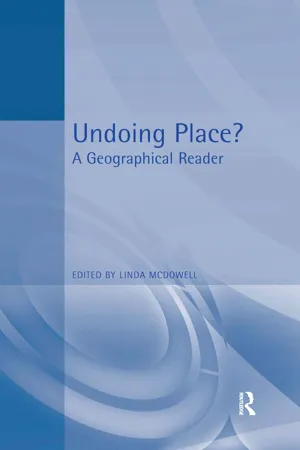
Does geography affect our sense of 'self'? How are social characteristics mapped out on the ground? And is there any 'authentic' sense of place now, or are we increasingly 'placeless'?
Concentrating on the period between the end of the Second World War and the end of the century, this Reader argues that there is a reciprocal relationship between the constitution of places and people. What it means to be a man or a woman , to have a nationality and a sense of place, has been transformed and reinvented as our view of the world has changed. The present is perceived as a time of fear, a period in which all that is solid seems to melt into air, while the 1950s are a site of nostalgia, a period of clarity and certainty, a time when people know their place.
Bringing together an interdisciplinary collection of articles for social and cultural geographers, this Reader critically examines the argument that the close associations of the 1950s between place (the home, the community and the nation state) and the social divisions (gender, class and nationality) are breaking down in the 1990s. Drawing out the oppositional movements in each decade, it seeks to show how the supposed stability of one and the mobility of the other are exaggerated.
- 360 pages
- English
- ePUB (mobile friendly)
- Available on iOS & Android
eBook - ePub
About this book
Information
1
Stephanie Coontz
'Leave It to Beaver' and 'Ozzie and Harriet': American Families in the 1950s
Excerpts from: The way we never were: American families and the nostalgia trap. New York, Basic Books (1992)
Our most powerful visions of traditional families derive from images that are still delivered to our homes in countless reruns of 1950s television sit-coms. When liberals and conservatives debate family policy, for example, the issue is often framed in terms of how many 'Ozzie and Harriet' families are left in America. Liberals compute the percentage of total households that contain a breadwinner father, a full-time homemaker mother, and dependent children proclaiming that fewer than 10 percent of American families meet the 'Ozzie and Harriet' or 'Leave It to Beaver' model. Conservatives counter that more than half of all mothers with preschool children either are not employed or are employed only part-time. They cite polls showing that most working mothers would like to spend more time with their children and periodically announce that the Nelsons are 'making a comeback', in popular opinion if not in real numbers.1
Since everyone admits that nontraditional families are now a majority, why this obsessive concern to establish a higher or a lower figure? Liberals seem to think that unless they can prove the 'Leave It to Beaver' family is on an irreversible slide toward extinction, they cannot justify introducing new family definitions and social policies. Conservatives believe that if they can demonstrate the traditional family is alive and well, although endangered by policies that reward two-earner families and single parents, they can pass measures to revive the seeming placidity and prosperity of the 1950s, associated in many people's minds with the relative stability of marriage, gender roles, and family life in that decade. If the 1950s family existed today, both sides seem to assume, we would not have the contemporary social dilemmas that cause such debate.
At first glance, the figures seem to justify this assumption. The 1950s was a profamily period if there ever was one. Rates of divorce and illegitimacy were half what they are today; marriage was almost universally praised; the family was everywhere hailed as the most basic institution in society; and a massive baby boom, among all classes and ethnic groups, made America a 'child-centered' society.2
In retrospect, the 1950s also seem a time of innocence and consensus: Gang warfare among youths did not lead to drive-by shootings; the crack epidemic had not yet hit; discipline problems in the schools were minor; no 'secular humanist' movement opposed the 1954 addition of the words under God to the Pledge of Allegiance; and 90 percent of all school levies were approved by voters. Introduction of the polio vaccine in 1954 was the most dramatic of many medical advances that improved the quality of life for children.
The profamily features of this decade were bolstered by impressive economic improvements for vast numbers of Americans. Between 1945 and 1960, the gross national product grew by almost 250 percent and per capita income by 35 percent. Housing starts exploded after the war, peaking at 1.65 million in 1955 and remaining above 1.5 million a year for the rest of the decade; the increase in single-family homeownership between 1946 and 1956 outstripped the increase during the entire preceding century and a half. By 1960, 62 percent of American families owned their own homes, in contrast to 43 percent in 1940. Eighty-five percent of the new homes were built in the suburbs, where the nuclear family found new possibilities for privacy and togetherness. While middle-class Americans were the prime beneficiaries of the building boom, substantial numbers of white working-class Americans moved out of the cities into affordable developments, such as Levittown.3
Many working-class families also moved into the middle class. The number of salaried workers increased by 61 percent between 1947 and 1957. By the mid-1950s, nearly 60 percent of the population had what was labeled a middle-class income level (between $3,000 and $10,000 in constant dollars), compared to only 31 percent in the 'prosperous twenties', before the Great Depression. By 1960, thirty-one million of the nation's forty-four million families owned their own home, 87 percent had a television, and 75 percent possessed a car. The number of people with discretionary income doubled during the 1950s.4
For most Americans, the most salient symbol and immediate beneficiary of their newfound prosperity was the nuclear family. The biggest boom in consumer spending, for example, was in household goods. Food spending rose by only 33 percent in the five years following the Second World War, and clothing expenditures rose by 20 percent, but purchases of household furnishings and appliances climbed 240 percent. 'Nearly the entire increase in the gross national product in the mid-1950s was due to increased spending on consumer durables and residential construction', most of it oriented toward the nuclear family.5
Putting their mouths where their money was, Americans consistently told pollsters that home and family were the wellsprings of their happiness and self-esteem. Cultural historian David Marc argues that prewar fantasies of sophisticated urban 'elegance', epitomized by the high-rise penthouse apartment, gave way in the 1950s to a more modest vision of utopìa: a single-family house and a car. The emotional dimensions of utopia, however, were unbounded. When respondents to a 1955 marriage study 'were asked what they thought they had sacrificed by marrying and raising a family, an overwhelming majority of them replied, "Nothing".' Less than 10 percent of Americans believed that an unmarried person could be happy. As one popular advice book intoned: 'The family is the center of your living. If it isn't, you've gone far astray'.6
The novelty of the 1950s family
In fact, the 'traditional' family of the 1950s was a qualitatively new phenomenon. At the end of the 1940s, all the trends characterizing the rest of the twentieth century suddenly reversed themselves: For the first time in more than one hundred years, the age for marriage and motherhood fell, fertility increased, divorce rates declined, and women's degree of educational parity with men dropped sharply. In a period of less than ten years, the proportion of never-married persons declined by as much as it had during the entire previous half century.7
At the time, most people understood the 1950s family to be a new invention. The Great Depression and the Second World War had reinforced extended family ties, but in ways that were experienced by most people as stultifying and oppressive. As one child of the Depression later put it, 'The Waltons' television series of the 1970s did not show what family life in the 1930s was really like: 'It wasn't a big family sitting around a table radio and everybody saying goodnight while Bing Crosby crooned "Pennies from Heaven".' On top of Depression-era family tensions had come the painful family separations and housing shortages of the war years: By 1947, six million American families were sharing housing, and postwar family counselors warned of a widespread marital crisis caused by conflicts between the generations.
Dunng the 1950s, films and television plays showed people working through conflicts between marital loyalties and older kin, peer group, or community ties; regretfully but decisively, these conflicts were almost invariably 'resolved in favor of the heterosexual couple rather than the claims of extended kinship networks,,.. homosociability and friendship.' Talcott Parsons and other sociologists argued that modern industrial society required the family to jettison traditional productive functions and wider kin ties in order to specialize in emotional nurturance, childrearing, and production of a modern personality. Social workers 'endorsed nuclear family separateness and looked suspiciously on active extended-family networks.'8
Popular commentators urged young families to adopt a 'modern' stance and strike out on their own, and with the return of prosperity, most did. By the early 1950s, newlyweds not only were establishing single-family homes at an earlier age and a more rapid rate than ever before but also were increasingly moving to the suburbs, away from the close scrutiny of the elder generation.
For the first time in American history, moreover, such average trends did not disguise sharp variations by class, race, and ethnic group. People married at a younger age, bore their children earlier and closer together, completed their families by the time they were in their late twenties, and experienced a longer period living together as a couple after their children left home. The traditional range of acceptable family behaviors - even the range in the acceptable number and timing of children - narrowed substantially.9
The values of 1950s families also were new. The emphasis on producing a whole world of satisfaction, amusement, and inventiveness within the nuclear family had no precedents. Historian Elaine Tyler May comments: 'The legendary family of the 1950s . . . was not, as common wisdom tells us, the last gasp of "traditional" family life with deep roots in the past. Rather, it was the first wholehearted effort to create a home that would fulfill virtually all its members' personal needs through an energized and expressive personal life.'10
Beneath a superficial revival of Victorian domesticity and gender distinctions, a novel rearrangement of family ideals and male-female relations was accomplished. For women, this involved a reduction in the moral aspect of domesticity and an expansion of its orientation toward personal service. Nineteenth-century middle-class women had cheerfully left housework to servants, yet 1950s women of all classes created makework in their homes and felt guilty when they did not do everything for themselves. The amount of time women spent doing housework actually increased during the 1950s, despite the advent of convenience foods and new, labor-saving appliances; child care absorbed more than twice as much time as it had in the 1920s. By the mid-1950s, advertisers' surveys reported on a growing tendency among women to find 'housework a medium of expression for ... their femininity and individuality.'11
For the first time, men as well as women were encouraged to root their identity and self-image in familial and parental roles. The novelty of these family and gender values can be seen in the dramatic postwar transformation of movie themes. Historian Peter Biskind writes that almost every major male star who had played tough loners in the 1930s and 1940s 'took the roles with which he was synonymous and transformed them, in the fifties, into neurotics or psychotics'. In these films, 'men belonged at home, not on the streets or out on the prairie, ... not alone or hanging out with other men'. The women who got men to settle down had to promise enough sex to compete with 'bad' women, but ultimately they provided it only in the marital bedroom and only in return for some help fixing up the house.12
The 'good life' in the 1950s, historian Clifford Clark points out, made the family 'the focus of fun and recreation.' The ranch house, architectural embodiment of this new ideal, discarded the older privacy of the kitchen, den, and sewing room (representative of separate spheres for men and women) but introduced new privacy and luxury into the master bedroom. There was an unprecedented 'glorification of self-indulgence' in family life. Formality was discarded in favor of 'livability', 'comfort', and 'convenience'. A contradiction in terms in earlier periods, 'the sexually charged, child-centered family took its place at the center of the postwar American dream.'13
On television, David Marc comment, all the 'normal' families moved to the suburbs during the 1950s. Popular culture turned such suburban families into capitalism's answer to the Communist threat. In his famous 'Kitchen debate' with Nikita Khrushchev in 1959, Richard Nixon asserted that the superiority of capitalism over communism was embodied not in ideology or military might but in the comforts of the suburban home, 'designed to make things easier for our women'.14
A complex reality: 1950s poverty, diversity, and social change
Even aside from the exceptional and ephemeral nature of the conditions that supported them, 1950s family strategies and values offer no solution to the discontents that underlie contemporary romanticization of the 'good old days'. The reality of these families was far more painful and complex than the situation-comedy reruns or the expurgated memories of the nostalgic would s...
Table of contents
- Cover
- Half Title
- Title Page
- Copyright Page
- Dedication
- Contents
- Acknowledgements
- Introduction Rethinking Place
- Section One Homeplace
- 1 '"Leave It to Beaver" and "Ozzie and Harriet": American Families in the 1950s' (1992)
- 2 'Homeplace: A Site of Resistance' (1991)
- 3 The Suburban Home Companion: Television and the Neighborhood Ideal in Postwar America' (1992)
- 4 'Beyond the Modern Home: Shifting the Parameters of Residence' (1993)
- Section Two In Place: Place and Community
- 5 '"It's All Falling Apart Here": Coming to Terms with the Future in Teeside' (1988)
- 6 'Ambivalent Attachments to Place in London: Twelve Barbadian Families' (1993)
- 7 'Space and Power' (1993)
- 8 'The Ghosting of the Inner City' (1985)
- 9 'West Hollywood as Symbol: The Significance of Place in the Construction of a Gay Identity' (1995)
- Section Three Out of Place: Escape Attempts
- 10 'Women in Outlaw Motorcycle Gangs' (1990)
- 11 'Mods, Rockers and Turf Gangs: Carnivals of Violence' (1991)
- 12 Ό Life Unlike to Ours! Go for It! New Age Travellers' (1995)
- 13 'Racism, Black Masculinity and the Politics of Space' (1990)
- 14 On the Road Again: Metaphors of Travel in Cultural Criticism' (1992)
- Section Four No Place like Home: The Rest in the West
- 15 '"The Whisper Wakes, the Shudder Plays": "Race", Nation and Ethnic Absolutism' (1987)
- 16 'Roast Beef and Reggae Music: The Passing of Whiteness' (1992)
- 17 'Cultural Identity and Diaspora' (1990)
- 18 'Tradition and Translation: National Culture in Its Global Context' (1991)
- Section Five Imagined Places
- 19 'The "Magic of the Mall": An Analysis of Form, Function, and Meaning in the Contemporary Retail Built Environment' (1993)
- 20 'Disney World: The Power of Facade/ The Facade of Power' (1991)
- 21 'Future Travel: Anthropology and Cultural Distance in an Age of Virtual Reality Or, A Past Seen From a Possible Future' (1992)
- Section Six Postscript: The Possibility of a Politics of Place
- 22 The Political Place of Locality Studies' (1989)
- 23 'Together in Difference; Transforming the Logic of Group Political Conflict' (1993)
- Index
Trusted by 375,005 students
Access to over 1.5 million titles for a fair monthly price.
Study more efficiently using our study tools.
Frequently asked questions
Yes, you can cancel anytime from the Subscription tab in your account settings on the Perlego website. Your subscription will stay active until the end of your current billing period. Learn how to cancel your subscription
No, books cannot be downloaded as external files, such as PDFs, for use outside of Perlego. However, you can download books within the Perlego app for offline reading on mobile or tablet. Learn how to download books offline
Perlego offers two plans: Essential and Complete
- Essential is ideal for learners and professionals who enjoy exploring a wide range of subjects. Access the Essential Library with 800,000+ trusted titles and best-sellers across business, personal growth, and the humanities. Includes unlimited reading time and Standard Read Aloud voice.
- Complete: Perfect for advanced learners and researchers needing full, unrestricted access. Unlock 1.5M+ books across hundreds of subjects, including academic and specialized titles. The Complete Plan also includes advanced features like Premium Read Aloud and Research Assistant.
We are an online textbook subscription service, where you can get access to an entire online library for less than the price of a single book per month. With over 1.5 million books across 990+ topics, we’ve got you covered! Learn about our mission
Look out for the read-aloud symbol on your next book to see if you can listen to it. The read-aloud tool reads text aloud for you, highlighting the text as it is being read. You can pause it, speed it up and slow it down. Learn more about Read Aloud
Yes! You can use the Perlego app on both iOS and Android devices to read anytime, anywhere — even offline. Perfect for commutes or when you’re on the go.
Please note we cannot support devices running on iOS 13 and Android 7 or earlier. Learn more about using the app
Please note we cannot support devices running on iOS 13 and Android 7 or earlier. Learn more about using the app
Yes, you can access Undoing Place? by Linda Mcdowell, Linda Mcdowell,Linda McDowell in PDF and/or ePUB format, as well as other popular books in Social Sciences & Gender Studies. We have over 1.5 million books available in our catalogue for you to explore.