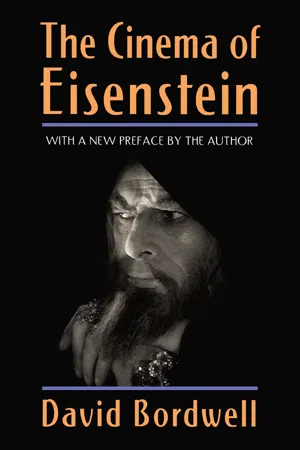
The Cinema of Eisenstein is David Bordwell's comprehensive analysis of the films of Sergei Eisenstein, arguably the key figure in the entire history of film. The director of such classics as Potemkin,Ivan the Terrible, October, Strike, and Alexander Nevsky, Eisenstein theorized montage, presented Soviet realism to the world, and mastered the concept of film epic. Comprehensive, authoritative, and illustrated throughout, this classic work deserves to be on the shelf of every serious student of cinema.
- 344 pages
- English
- ePUB (mobile friendly)
- Available on iOS & Android
eBook - ePub
The Cinema of Eisenstein
About this book
Information
1.
A Life in Cinema
Eisenstein led a busy, dramatic life. His achievements and adventures merit far more detailed investigation than can be undertaken here. What is useful for the purposes of this book is an overall orientation to his career, a framework within which we can situate his films and theoretical writings.
From Theatre to Cinema
Sergei Mikhailovich Eisenstein was born in Riga, Latvia, on 22 January 1898 (10 January on the prerevolutionary calendar). His father, Mikhail Osipovich Eisenstein, was an assimilated German Jew and a prominent architect and civil engineer. His mother, Yulia Ivanovna Konetskaya, came from a wealthy merchant family.
Eisenstein had a cosmopolitan childhood, traveling to Paris (where he saw his first film) and learning French, German, and English. From earliest childhood he read avidly, drew caricatures, and displayed keen interest in the theatre. His childhood friend Maxim Shtraukh recalled that he was infatuated with the circus and presented shows in the family’s backyard.
Eisenstein would later claim that his sympathy for social protest sprang from his father’s despotic rule of the household. In 1909 Yulia Ivanovna left, and three years later the parents divorced. The son stayed with his father but visited his mother and grandmother in St. Petersburg.
At first Eisenstein intended to follow his father’s profession. In 1915, after graduating from secondary school, he was admitted to the Institute of Civil Engineering in St. Petersburg. For the next two years, while pursuing his courses, he lived with his mother.
The 1917 revolutions interrupted his studies. In February Eisenstein was called up for military service and sent to the front. After the Bolsheviks seized power in October, Eisenstein returned briefly to the Engineering Institute. In 1918, as the Civil War intensified, he joined the Red Army, serving as a technician in the Engineering Corps. His father joined the White forces.

While in the army Eisenstein continued to draw, making caricatures and decorating the agit-trains that propagandized throughout the countryside. He also became involved in a number of theatrical productions in cities where he was stationed. Eventually he was assigned to organize productions and ensembles on the front.
Eisenstein was demobilized in the fall of 1920 and returned to Moscow. He began studying Japanese in the General Staff Academy, but after serving in the Proletkult Central Workers’ Theatre, he left the Academy. At Proletkult he supervised scenic design and the directors’ workshops.
Proletkult (the Proletarian Culture movement) had been founded in early 1917 by the philosopher Alexander Bogdanov. Taking up suggestions in the Marxist classics, he advocated the development of a distinctly proletarian art that would replace that of the declining bourgeoisie. Bogdanov asserted that art would play a central role in Communist society by organizing experience into emotional, often utopian “images.” Bogdanov also promoted “Tectology,” a “science” that would transform the world into a harmonious social system.
At first, Proletkult drama emphasized collective spectacle, plays derived from European Symbolism and Expressionism, and religious and mythological dramas. After the Party had refused to recognize the organization as the official embodiment of Communist culture, Proletkult’s Moscow organization moved toward a more experimental stance. Eisenstein entered a wing of the Moscow group whose creative workshops were receptive to the avant-garde.
Eisenstein immersed himself in Moscow’s theatre world. At Nikolai Foregger’s workshop he studied commedia dell’arte techniques. He taught courses in theatre for the Red Army and ran an intensive acting workshop at Proletkult. He worked on more than twenty productions, one of the most notable being The Mexican, codirected with Boris Arvatov and V. S. Smishlyaev for Proletkult in 1921. The show included a vigorous boxing match. As the audience onstage cheered the champion, the real audience in the auditorium rooted for the revolutionary underdog. Eisenstein later relished the memory of the “smacking of gloves against taut skin and strained muscles” (1934i:7). By arousing the audience so immediately, the show provided the first step toward the “agit-attraction theatre” that Eisenstein would cultivate over the next three years (1923b:77).
Arvatov, one of the major theorists of Constructivism, was among the earliest influences on the young director. With him Eisenstein built a pedagogical program for the Proletkult directing workshop that envisaged performance as “kinetic construction” of the body and took production as “monumental constructions.” At the same time, Eisenstein fell under the sway of the man he later described as his “second father.”
Vsevolod Meyerhold was the acknowledged master of Left theatre. His staging of Vladimir Mayakovsky’s Mystère-bouffe (1918) had recast the story of Noah and the Flood as an allegory of proletarian conquest. In employing cubist designs by Malevich and acting techniques drawn from the circus, the production had been a model of theatrical experimentation turned to propagandist ends. In November 1920 Meyerhold’s production of Emile Verhaeren’s The Dawn transformed a Symbolist drama into a political rally. Actors declaimed oratorically, military searchlights raked the hall, and leaflets were scattered among the audience. In the spring of 1921 Meyerhold and Mayakovsky restaged Mystère-bouffe with even more circus elements and allowed the action to spill out into the auditorium.
In the fall of 1921 Meyerhold opened his State Higher Directing Workshop. There Eisenstein studied Meyerhold’s performance and production methods, assisted in the training of actors, and contributed set and costume designs to a production of Heartbreak House (1922). After a little more than a year, Meyerhold dismissed the younger man, indicating that he had nothing more to learn. He continued to work with Meyerhold as an assistant director.
“All Eisenstein’s work has its origins in the laboratory where we once worked together as teacher and pupil” (Meyerhold 1936:311). Meyerhold’s claim is exaggerated, but he was certainly a powerful influence. Eisenstein’s belief in controlling the spectator through the performer’s bodily virtuosity; his emphasis on rhythm and pantomime; his interest in Asian theatre, the circus, and the grotesque; even his 1930s attempt to create a curriculum in which film directors would undergo stringent physical and cultural training—all were initiated or strengthened by the association with Meyerhold. The haughty master cast a spell on Eisenstein. “I never loved, idolized, worshipped anyone as much as I did my teacher” (1964:75). After Meyerhold’s arrest in 1939, Eisenstein preserved his papers, carrying them away during the wartime evacuation of Moscow.
Eisenstein was forming other alliances in the early 1920s. The actors Judith Glizer and his childhood friend Maxim Shtraukh worked in Proletkult theatre. So did Grigory Alexandrov, who would become his collaborator. At Meyerhold’s workshops he met Sergei Yutkevich, with whom he went to American movies, worked on several productions, and in the summer of 1922 wrote a commedia dell’arte parody called The Colombian Girl’s Garter. In this he and Yutkevich tried out the idea of theatrical “attractions,” startling shocks comparable to the roller coaster and sideshow “attractions” of amusement parks. Through Yutkevich Eisenstein met the central members of the Leningrad group FEX (Factory of the Eccentric Actor), Grigory Kozintsev and Leonid Trauberg.
Eisenstein and his associates took for granted that avant-garde artists worked for political ends. Many artists had been converted by the Bolshevik revolution, and the extreme Left atmosphere of “war Communism” had intensified their political fervor. Abstract painting or experimental writing had to be justified as “laboratory experiments” in forms that could have social utility. By 1923 purely experimental art was unacceptable; virtually all artists were obliged to work with recognizable content in the name of agitation, propaganda, or education.
The New Economic Policy (NEP), launched in 1921, introduced a mixed- market economy to aid recovery from the ravages of the Civil War. NEP encouraged various artists’ organizations to compete for power and Party recognition. Some groups demanded that literature and the visual arts embrace a traditional realism. Only this approach, they maintained, would be accessible to the masses. Other groups, indirectly derived from Proletkult, called for proletarian art that would articulate new Soviet myths and raise workers’ consciousness.
Eisenstein came to be associated with another trend, loosely identified as “Left art.” The grouping included such figures as Mayakovsky, Arvatov, Vladimir Tatlin, Alexei Gan, Osip Brik, Alexander Rodchenko, Varvara Stepanova, Lyubov Popova, and Sergei Tretyakov. Most of the Left artists had been associated with some form of Futurism before the Revolution, and they hoped that earlier experiments in pure, dynamized forms could be harnessed to social ends.
The avant-garde of the early 1920s has principally been identified by the general term Constructivism. By and large, Constructivism in theatre and the visual arts sought to create out of Futurism and pictorial abstraction a political art based on principles of engineering and properties of the material. Constructivist art was, in a sense, abstract art rethought in terms of machine design and turned to agitational or propagandistic ends. By the mid-1920s most Constructivists had answered the “social command” and had turned to making works of practical utility, such as posters and book illustrations. Many of them thereby moved closer to a kindred trend, Productivism. Productivists sought to bring the results of formal experimentation directly into industrial manufacture, designing textiles, clothes, and furniture. Whereas Constructivists adapted procedures from industrial design to the “fine arts,” the Productivists eliminated the distinction between fine arts and applied arts altogether.
Hostile to “bourgeois” tendencies, repudiating the art of the past, and trading on the Futurist desire to startle the viewer, Left artists were vulnerable to charges of what Lenin called “hooligan communism” (Braun 1979:149). Later Eisenstein ruefully recalled his origins: “All around was the insistent demand to destroy art, substitute materials and documents for the chief element of art—the image, do away with its content, put constructivism in the place of organic unity, replace art itself with practical and real reconstruction of life” (1946c: 14).
Several Constructivists and Productivists gathered around the literary journal Lef, the standard bearer of Lef (the Left Front of the Arts). In a series of manifestos the editors demanded that art agitate the masses and organize social life. Writers were exhorted to practice “language engineering” and to find allies in literary theory (the Formalist critics Viktor Shklovsky and Yury Tynyanov), production design (Rodchenko, Gan), theatre, and film (Dziga Vertov). Lef sought to create a broad front of experimenters who amalgamated artistic modernism with radical ideology.
Eisenstein became associated with Lef through Sergei Tretyakov, who was also working with Proletkult. Tretyakov’s Lef manifestos drew upon Bogdanov’s ideas in demanding that the art worker be a scientist, a “psycho-engineer” calculating and organizing the spectator’s responses (Tretyakov 1923:216). He claimed as well that these responses would have to be affective ones; even if the artist worked in a coolly rational mode, art required that the perceiver be emotionally engaged. This conception of art and the artist would be reiterated by Eisenstein throughout the 1920s.
In the theatre of the Civil War period, mass spectacles and cosmic pageants had coexisted with experiments in assimilating popular modes, such as vaudeville, circus, and American film comedy. This strain continued in the FEX “electrification” of Gogol’s Marriage (1922), in Meyerhold’s Magnanimous Cuckold (1922) and Tarelkin’s Death (1922), and in works by Sergei Radlov and Alexander Tairov. The productions were considered emblematic of “Eccentrism,” a performance style mixing grotesque clownishness with mechanized acrobatic stunts in the manner of American cinema. In a 1922 article Eisenstein and Yutkevich noted that the films of Fairbanks, Chaplin, Arbuckle, and other Hollywood performers yielded “new opportunies for genuine Eccentrism” (31).
In this tumultuous atmosphere Eisenstein became the younger generation’s most noteworthy stage director. A series of Proletkult productions with Tretyakov made his name.

Most notorious was their 1923 production of Alexander Ostrovsky’s classic play Enough Simplicity in Every Wise Man, known in their version simply as The Wiseman. For the hundredth anniversary of the playwright’s birth, Commissar of Education Anatoly Lunacharsky requested that radical artists pay obeisance to the classics, summoning them “Back to Ostrovsky!” Eisenstein and Tretyakov did not exactly enter into the spirit of things. They splintered Ostrovsky’s three-act play into several episodes while inserting topical commentary and low comedy. On a st...
Table of contents
- Cover
- Half Title
- Title Page
- Copyright Page
- Dedication
- Contents
- Preface 2005
- Preface
- Abbreviations
- 1. A Life in Cinema
- 2. Monumental Heroics: The Silent Films
- 3. Seizing the Spectator: Film Theory in the Silent Era
- 4. Practical Aesthetics: Pedagogy
- 5. Cinema as Synthesis: Film Theory, 1930–1948
- 6. History and Tragedy: The Late Films
- 7. The Making and Remaking of Segei Eisenstein
- Chronology
- Filmography
- Further Reading
- Bibliography
- Photo Credits
- Index
Trusted by 375,005 students
Access to over 1.5 million titles for a fair monthly price.
Study more efficiently using our study tools.
Frequently asked questions
Yes, you can cancel anytime from the Subscription tab in your account settings on the Perlego website. Your subscription will stay active until the end of your current billing period. Learn how to cancel your subscription
No, books cannot be downloaded as external files, such as PDFs, for use outside of Perlego. However, you can download books within the Perlego app for offline reading on mobile or tablet. Learn how to download books offline
We are an online textbook subscription service, where you can get access to an entire online library for less than the price of a single book per month. With over 1.5 million books across 990+ topics, we’ve got you covered! Learn about our mission
Look out for the read-aloud symbol on your next book to see if you can listen to it. The read-aloud tool reads text aloud for you, highlighting the text as it is being read. You can pause it, speed it up and slow it down. Learn more about Read Aloud
Yes! You can use the Perlego app on both iOS and Android devices to read anytime, anywhere — even offline. Perfect for commutes or when you’re on the go.
Please note we cannot support devices running on iOS 13 and Android 7 or earlier. Learn more about using the app
Please note we cannot support devices running on iOS 13 and Android 7 or earlier. Learn more about using the app
Yes, you can access The Cinema of Eisenstein by David Bordwell in PDF and/or ePUB format, as well as other popular books in Media & Performing Arts & Film & Video. We have over 1.5 million books available in our catalogue for you to explore.