This introductory text provides nurses with the foundations of a sociological understanding of health issues which they should find of great help in thinking about their work and the role of their profession. It explains the key sociological theories and debates with humour and imagination in a way which will encourage an inquisitive and reflective approach on the part of any student who engages with the text.
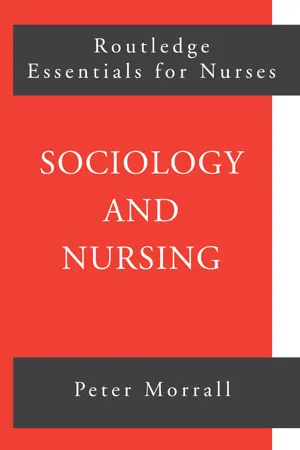
- 224 pages
- English
- ePUB (mobile friendly)
- Available on iOS & Android
eBook - ePub
About this book
Information
Chapter 1
Imagination
to understand the changes of many personal milieux we are required to look beyond them. … To be able to do that is to possess the sociological imagination.(Mills 1959: 10/11)
Sociologists imagine the world differently compared with the way it is viewed for example, by psychologists, and biologists, or by those who proffer ‘common sense’. In this chapter ‘the sociological imagination’ is delineated through an exploration of three major theoretical frameworks. I am using the term ‘theoretical framework’ to describe the grouping of perspectives which may have subtle differences that distinguish them, but which have similar philosophical routes, and complementary observations to make about the organisation of society and human action.
The first theoretical framework I have chosen regards society as both existing and having a set of configurations that to a greater or lesser extent induces humans to behave and think in preordained ways, including that of ‘being sick’. As an alternative to this structural understanding of human behaviour and thinking, which can be interpreted as viewing all thought and behaviour as ‘determined’ by society, the second explanatory genre projects the notion of individual volition. That is, it is argued that humans can and do direct their own lives. The third theoretical framework has gained popularity in nursing literature in the last couple of decades, and has been extracted from a range of sociological theorising that aims to ‘deconstruct’ reality (including the actuality of ‘disease’) in one way or another.
As with all academic subjects, certain people have made major contributions to sociology throughout its relatively short history. This chapter will concentrate on a small number of the ‘founders’ of sociology and their respective perspectives.
There is nothing totally ‘natural’, ‘God-given’ or inevitable about personal and social behaviour. Falling in love, committing a crime, achieving success in a career, or being ill, are all influenced by social factors. The basis of the ‘sociological imagination’ is to look beyond the obvious, and to challenge both our own preconceived ideas and those of others. This is of particular importance when those with power in society hold prejudicial views about already vulnerable and dispossessed people. Above, all, it is to always ask the question ‘why’, and to keep on asking the question ‘why’!
It was C. Wright Mills (1959) who pointed to the connection between ‘private troubles’ and ‘public issues’. Whatever we undergo as individuals (and this applies to emotions, pain, disease and cognition) our social surroundings have either helped create, or are affected by, these experiences. For example, the private trouble of losing a loved one in a car accident is a public issue in that both the amount of money governments put into road safety, and the degree to which a society values commodities such as cars, are linked to the number of people who are killed on the roads. The private trouble of being diagnosed as having cancer is also a public issue as either directly or indirectly it relates to health policy and health-service resources, which in turn are connected with social values. Better health promotion strategies installed by government and health agencies, a greater political will at local and national levels to improve the physical environment, more money ploughed into cancer research and treatment rather than, for example, arms technology, may have prevented that person’s malignant tumour. The private issue of depression is a public issue in the sense that this ‘internal’ condition may have been precipitated by alienating and dehumanising social circumstances.
Social events and social relationships are not taken at face value by the sociologist. Conventional wisdom is tested to see whether or not it stands up to the scrutiny of research and well-worked-out theorising. Many prevailing ideas do not. For example, it was ‘common sense’ for white imperialists and colonialists from Europe to believe that black Africans were sub-human. Another ‘commonsense’ judgement was made by the ruling elite in the Victorian age that the mad should be locked up in asylums, the poor put in workhouses and criminals transported to Australia. Not so long ago, it was ‘common sense’ to regard women as not only the ‘weaker sex’ physically but also intellectually.
Everyone, unless extremely young or lacking cognitive ability through, for example, intoxication or dementia, in some way studies their social world. The veritable ‘man on the Clapham omnibus’ may ponder over why there is such conspicuous opulence (in the form of what is displayed in shop windows, personal adornment, and material possessions such as cars) alongside scores of young people begging on the streets. He may speculate about the patent differences between one residential area of the city and another with respect to the ethnic make-up of its population, the condition of housing and the physical ambience.
The formal study of society, however, was initiated by Auguste Comte (1798–1857) who in 1838 conceived of the term ‘sociology’, and thereby inaugurated a new academic discipline. Many of Comte’s ideas are to found in the work of later theorists. The literal interpretation of the word ‘sociology’, coming from the Latin ‘socius’ and ‘ology’ is the study of companionship. My own definition is as follows: ‘Sociology is the rigorous investigation of social phenomena using systematic theorising and methodical research procedures.’ It is the use of theories and research (which have been scrutinised through exacting peer review and debate) that separates ‘common sense’ from substantive knowledge.
Of course, the ‘man on the Clapham omnibus’ may, through his own reasoning or a lucky guess, have reached the same conclusions as social theorists and researchers after perhaps years of theorising and data collection. But he will not, except through assertion and belligerence, be able to sustain his point of view, whereas the evidence of the sociologist could be substantial enough to warrant serious attention and response.
However, there is much controversy over what sociology actually is as subject, and about the role of theory and research in the analysis of society. It is exceptional to find two sociologists who agree with each other about all aspects of the sociological enterprise. Internal disagreement can be seen as ‘productive’ in that organised deliberation (for example, at conferences and in academic journals) can tease out inconsistencies and defects in a theoretical concept or in the procedures and results of a research project. On the other hand, the perpetual arguments and disparate propositions disgorged by sociologists may demonstrate the fallibility of the subject.
In the 1960s and 1970s in Britain and other Western countries, sociology became established as an academic subject in universities and schools. However, in the 1980s, under the Tory government in Britain, sociology was denigrated as a worthless subject and also judged as too left wing politically for a radical ‘new-right’ administration to stomach, to the point whereby, infamously, Margaret Thatcher announced that ‘there was no such thing as society’ – indicating, therefore, that there was nothing for sociologists to study. Given the subject’s lamentable record in predicting social events, and its undoubted Marxist bias at the time, both of these accusations had some justification.
Whilst never suffering from a reduction in the amount of students who wished to study the subject at secondary or tertiary levels, its low standing in the eyes of the general public was exemplified in a notorious television advertisement for British Telecommunications during the 1980s. The scene is of a caring if anxious mother talking with her son on the telephone about his school examination results. Miserably, he explains to his mother that he has failed everything except sociology, and this he patently considers to be of little compensation. His mother, enacting the vocal intonation and gestures of a stereotypical Jewish mother, counters with the (for sociologists) cringe-making phrase ‘well, at least it’s an “ology”’.
Moreover, the intellectually corrupt condition of sociology was epitomised with publication in 1975 of the novel The History Man by Malcolm Bradbury, an academic himself at a red-brick university in England. Despite its rather misleading title, this otherwise well-written and perspicacious book (which was also produced as a television drama), told the story of a sexually exploitative and anti-establishment lecturer, whose superlative aggrandisement of sociological prognostications served to signify the over-ambitious presumptions of the discipline. That is, the central character of the book, Howard Kirk, was a ridiculous figure who represented an epistemology that had overreached itself, and in doing so appeared as absurd as Kirk himself.
In the 2000s, however, sociology, whilst not chastened in its aspirations and notwithstanding colossal amounts of self-indulgent and impotent theorising over the previous twenty years, has been revitalised. For example, the eminent professor of sociology and Director of the London School of Economics, Anthony Giddens, has had much influence on the thinking of the British ‘New Labour’ government elected in 1997, with his theorising on social democratic programmes under the epithet of the ‘Third Way’ (Giddens 1998). Giddens also delivered the prestigious BBC ‘Reith’ Lectures in 1999, which attract worldwide audiences and participation by other senior academics and political commentators.
The work of the American sociologist Amitai Etzioni on ‘communitarianism’ (1998), and that of the German social theorist Ulrich Beck on ‘risk society’ (1992) have also been influential in Western politics. These commentators, in different ways, have pointed to the consequences of immense social change and the need for communities and social systems to adjust in order to reduce the damage to society and its inhabitants from these changes.
Moreover, Ian Christie has argued that while the pronouncements of sociologists may still not be at the forefront of the public’s consciousness, issues affecting the lives of individuals and communities (for example, crime, the disintegration of traditional family life, poverty, unemployment, stress at work, patterns of disease) are defined in terms of their social causes and consequences, and social solutions are sought (Christie 1999). Classical sociological research techniques (i.e. the survey and interviewing) are routinely employed to assess crime rates, explore family dynamics, analyse voting habits and in assessing the health needs of communities and individuals.
Nursing has incorporated social factors into most if not all of its educational programmes. Whether it be the study of childbirth, breast cancer, coronary vascular disease or schizophrenia, the inclusion of social factors in the aetiology, care and treatment of patients and their families are de rigueur. Medicine, whilst far more resistant to the ‘contamination’ of its natural scientific foundation, has accepted sociology in its undergraduate training for decades. Furthermore, apart from the obvious case of psychiatric medicine, heavily influenced by Sigmund Freud’s sociological account of the effects of culture and the family on the unconscious psychological mechanisms of the individual (Bocock 1976), postgraduate medical education specialising purely in social science applied to disease is now not unusual. For example, the University of Leeds offers surgeons a course in the psycho-social aspects of oncology.
Structure
The structural paradigm in sociology posits that humans belong to social groups and that it is membership of these groups that to a greater or lesser degree dictates behaviour. Specifically, the institutions of society (for example, the health system; the police service; the law courts; the educational system; the family; business and commerce; the media) and the ways in which society is divided (on the basis of, for example, social class; gender; ethnicity; age; and geographical region) set out the boundaries for human performance. Structuralist theorising has infiltrated many areas of health policy.
For Comte (1853), there were general laws of social structure and development, just as the chemist or physicist was able to state that laws existed in the physical world and thereby shaped that world. He perceived society as analogous to human anatomy and physiology. Each structure of society like the structures of the human body (for example, the heart, liver, brain and colon) was interconnected. Each was dependent on the other parts, and this was to become more so as society progressed through its historical stages towards greater complexity.
Hence, Comte was holistic in his approach to comprehending society. He saw society as being made up of interrelating parts, but also as a ‘whole’ entity. If we look at the human body we know that it is made up of billions of molecules but we can’t hope to appreciate fully what it is to be a ‘human’ by merely examining one minute constituent element of the body. Of course, mapping out the structure, composition and purpose of each gene may be incredibly useful in the search for causes of disease and certain personality traits, but on its own it will not provide a comprehensive grasp of human spirituality, motivation, personality, athleticism, sexuality, love or thinking. Similarly, for Comte, it is society as a whole and society’s institutions and large-scale structures that have to be analysed rather than the activities of individuals.
Like Comte, and being greatly influenced by him, Emile Durkheim (1858–1917) contributed much to the development of sociology as an academic subject and in particular to the formulation of the functionalist perspective. Functionalism attempts to explain why society is the way it is by portraying all of its institutions (for example, those associated with the law, education or health) as having a purpose. For Durkheim, as for Comte, society is more than the sum of its parts. That is, society has an existence of its own which is not just the aggregate of behaviour exhibited by its members, and cannot be comprehended by the examination of such individual behaviour. Sociological research should seek out social facts, and use methods (specifically, the social survey) that attest to the structural impositions of society on human behaviour.
Hence, Durkheim contested the reductionist idea that social acts (for example, marriage, attending school, being ill, inner-city riots or working as a nurse) could be explained by reference to the behaviour and motivation of individuals. For example, Durkheim (1966; orig. 1897) argued that the rate of suicide is more to do with how society is ordered than to do with the individual’s personality or state of (mental) health. Ostensibly the most personal of all acts, killing oneself, was induced or frustrated by such ‘social facts’ as the structure of family ties.
Durkheim regarded the various social structures and institutions as operating cohesively for society. If conflict occurs (as for example between trade unions and employers) then eventually ‘adaptation’ will ensue (deals will be made or one side will win) and therefore social stability is maintained. In this way societies develop evolutionarily rather than through revolution. Even the class structure is accepted as functional to the successful working of society.
So...
Table of contents
- Cover
- Half Title
- Title Page
- Copyright Page
- Contents
- Introduction
- 1 Imagination
- 2 Health
- 3 Science
- 4 Power
- 5 Professions
- 6 Medicalisation
- 7 Inequality
- 8 Sex
- 9 Madness
- 10 Death
- Conclusion
- Appendix: practice grid
- References
- Index
Trusted by 375,005 students
Access to over 1.5 million titles for a fair monthly price.
Study more efficiently using our study tools.
Frequently asked questions
Yes, you can cancel anytime from the Subscription tab in your account settings on the Perlego website. Your subscription will stay active until the end of your current billing period. Learn how to cancel your subscription
No, books cannot be downloaded as external files, such as PDFs, for use outside of Perlego. However, you can download books within the Perlego app for offline reading on mobile or tablet. Learn how to download books offline
Perlego offers two plans: Essential and Complete
- Essential is ideal for learners and professionals who enjoy exploring a wide range of subjects. Access the Essential Library with 800,000+ trusted titles and best-sellers across business, personal growth, and the humanities. Includes unlimited reading time and Standard Read Aloud voice.
- Complete: Perfect for advanced learners and researchers needing full, unrestricted access. Unlock 1.5M+ books across hundreds of subjects, including academic and specialized titles. The Complete Plan also includes advanced features like Premium Read Aloud and Research Assistant.
We are an online textbook subscription service, where you can get access to an entire online library for less than the price of a single book per month. With over 1.5 million books across 990+ topics, we’ve got you covered! Learn about our mission
Look out for the read-aloud symbol on your next book to see if you can listen to it. The read-aloud tool reads text aloud for you, highlighting the text as it is being read. You can pause it, speed it up and slow it down. Learn more about Read Aloud
Yes! You can use the Perlego app on both iOS and Android devices to read anytime, anywhere — even offline. Perfect for commutes or when you’re on the go.
Please note we cannot support devices running on iOS 13 and Android 7 or earlier. Learn more about using the app
Please note we cannot support devices running on iOS 13 and Android 7 or earlier. Learn more about using the app
Yes, you can access Sociology and Nursing by Peter Morrall in PDF and/or ePUB format, as well as other popular books in Medicine & Health Care Delivery. We have over 1.5 million books available in our catalogue for you to explore.